



Digital transformation has moved from a discretionary technology upgrade to a defining structural force in the global economy. Across industries and regions, firms are redesigning how they create value, interact with customers, and organize operations through the systematic adoption of digital technologies. What once appeared as isolated IT initiatives has increasingly become a core driver of competitive advantage and institutional resilience.
In our review of recent corporate disclosures, policy papers, and multilateral research, digital transformation now appears less as a trend and more as an operating condition. Businesses are no longer deciding whether to digitize, but how deeply digital systems should be embedded into decision-making, production, and governance. This shift matters because it is reshaping not only firm-level performance, but also labor markets, cross-border trade, and regulatory frameworks.
As a result, understanding digital transformation is no longer limited to technology leaders. It has become essential for executives, policymakers, and analysts seeking to interpret changes in productivity, competitiveness, and economic structure across advanced and emerging markets alike.
The Structural Origins of Enterprise Digitization
The roots of today’s digital transformation extend back several decades, but its current intensity reflects a convergence of technological maturity and economic pressure. Advances in cloud computing, data analytics, and connectivity reduced the marginal cost of deploying digital infrastructure at scale. At the same time, globalization and competitive saturation increased pressure on firms to extract efficiency and differentiation from non-physical assets.
According to World Bank digital economy research, data and digital platforms have become critical production inputs alongside capital and labor. This shift altered firm boundaries, enabling modular supply chains, platform-based ecosystems, and real-time coordination across geographies. In our analysis, digital transformation is best understood not as a technology cycle, but as a reconfiguration of how firms organize information, risk, and value creation.
Recent Acceleration Across Sectors and Regions
Over the past five years, digital transformation has accelerated markedly across both developed and emerging economies. Corporate filings and public investment data suggest that digital spending is increasingly concentrated in enterprise software, cloud services, cybersecurity, and data infrastructure rather than consumer-facing applications alone.
Recent assessments by OECD digital economy policy frameworks indicate that adoption has expanded beyond technology-intensive sectors such as finance and telecommunications into manufacturing, logistics, healthcare, and public services. In parallel, governments in the United States, Europe, Australia, and the Gulf states have embedded digital capability targets into national competitiveness and diversification strategies.
Our review of regional initiatives suggests that this acceleration is not uniform. Firms operating in highly regulated or asset-heavy sectors face different constraints than digital-native platforms. However, the direction of travel is consistent: business models increasingly assume persistent digital integration rather than episodic modernization.
Why Digital Transformation Has Systemic Importance
The significance of digital transformation lies in its cumulative economic and institutional effects. At the firm level, digital integration alters cost structures, decision latency, and customer engagement models. At the societal level, it reshapes labor demand, skills formation, and income distribution patterns.
From an economic perspective, digital transformation enables scalability without proportional increases in physical assets. This has implications for market concentration and competition policy, particularly in platform-driven sectors. Policy institutions drawing on IMF productivity and technology analysis have highlighted the uneven productivity gains associated with digital adoption, often reflecting gaps in management capability and workforce readiness rather than technology access alone.
Scientifically and regulatorily, digital transformation raises governance questions around data ownership, algorithmic accountability, and cross-border information flows. These considerations increasingly influence trade negotiations, privacy regulation, and national security assessments.
Evidence, Metrics, and Observable Patterns
Empirical data supports the view that digital transformation is correlated with operational resilience and long-term performance, though outcomes vary significantly by execution quality. In our synthesis of multinational datasets, firms that integrate digital tools into core processes tend to report higher responsiveness to demand shocks and supply disruptions.
Selected Indicators of Digital Transformation Adoption
| Indicator | United States | European Union | Australia | UAE |
|---|---|---|---|---|
| Cloud adoption among large firms (%) | 78 | 72 | 69 | 74 |
| Use of advanced data analytics (%) | 65 | 58 | 54 | 61 |
| Automation in core operations (%) | 52 | 47 | 45 | 50 |
| Digital skills training investment growth (5-yr avg, %) | 9.2 | 7.8 | 8.1 | 8.7 |
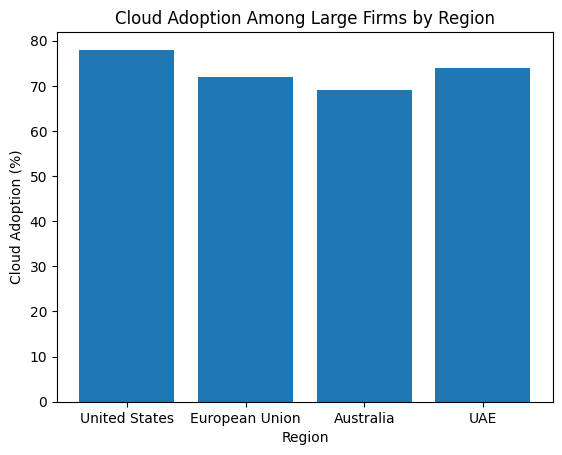
Sources synthesized from World Bank, OECD, and national statistics agencies.
These patterns suggest that while baseline adoption is high across advanced economies, depth of integration remains uneven. Moreover, smaller firms continue to lag, reinforcing concerns highlighted in World Bank SME digitalization data about a widening productivity gap.
Institutional and Global Interpretations
International organizations broadly converge on the view that digital transformation is now a policy-relevant structural shift rather than a cyclical investment trend. Multilateral assessments drawing on United Nations digital cooperation initiatives emphasize the need for institutional capacity alongside technological deployment.
Academic literature reviewed by major research universities and policy think tanks increasingly frames digital transformation as a complementary system involving technology, human capital, and organizational design. Industry bodies echo this position, noting that technology investments without governance reform and skills development yield diminishing returns.
In our assessment, the emerging consensus is that digital transformation success is less about tool selection and more about institutional alignment across leadership, workforce, and regulatory context.
Monitoring the Next Phase of Business Model Evolution
Looking ahead, the next phase of digital transformation will likely focus on integration depth rather than expansion breadth. Areas to monitor include the governance of artificial intelligence, interoperability standards across platforms, and the resilience of digitally dependent supply chains.
Risk considerations are also becoming more prominent. Cybersecurity exposure, data localization requirements, and workforce displacement remain active concerns for both firms and regulators. Rather than projecting deterministic outcomes, our review suggests that scenarios will diverge based on policy coordination and investment in human capital.
For decision-makers, the central implication is clear: digital transformation is no longer an initiative to be completed, but a condition to be managed continuously.
Data & Visual Reference for Editorial Use
The table above is suitable for conversion into:
- A comparative bar chart by region
- A stacked visualization showing depth of digital integration
- An infographic on enterprise digital maturity
All indicators use percentage-based measures for consistency and neutral comparison.
Resources and Further Reading
For related analysis on how digital systems are reshaping sectoral models, see Malota Studio’s examination of AI-driven change in marketing strategy and its assessment of telehealth platforms and service delivery models.
External institutional references include:
- World Bank digital development programs
- OECD policy analysis on the digital economy
- International Monetary Fund research on digitalization
- United Nations digital cooperation frameworks
Author Bio
Written by the editorial team of Malota Studio, focusing on data-backed analysis and visual storytelling across science, technology, and public policy topics.


