


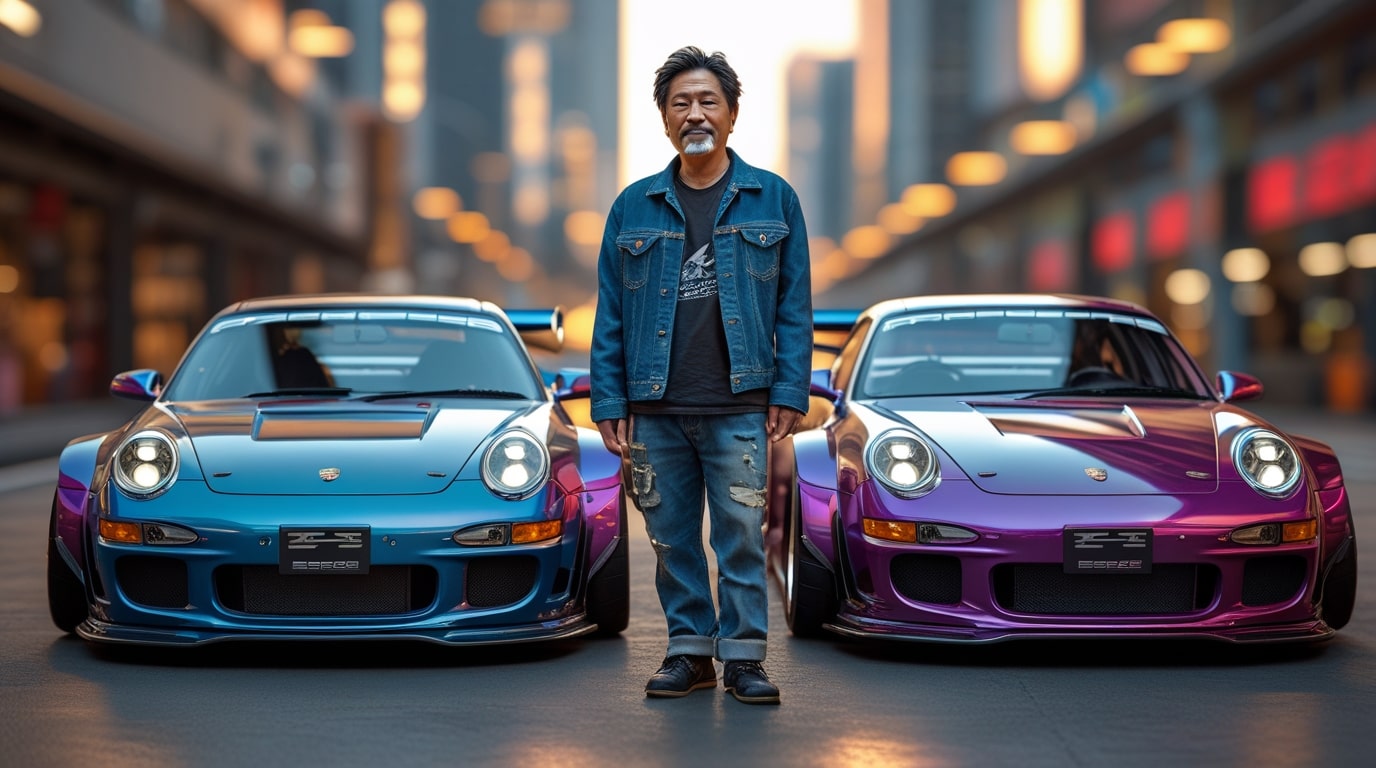
In the world of automotive customization, where computerized precision and factory-perfect finishes have become the standard, one man continues to work with his hands, a measuring tape, and an artistic vision that defies convention. Akira Nakai is not merely a tuner or a business owner—he is an artist whose canvas happens to be some of the most iconic sports cars ever made. His story is one of rebellion, dedication, and an uncompromising commitment to a philosophy that values emotional connection over clinical perfection.
The Man Behind the Legend
Born in 1970 in Chiba Prefecture, Japan, Akira Nakai (中井 啓) came of age during a pivotal moment in Japanese automotive culture. The late 1980s and early 1990s were marked by an explosion of street racing, tuning shops, and a generation of young enthusiasts who saw cars not just as transportation, but as expressions of identity and freedom.
Personal Background and Early Years
| Data Point | Verified Information |
|---|---|
| Full Name | Akira Nakai |
| Birth Year | 1970 |
| Birthplace | Chiba Prefecture, Japan |
| Nationality | Japanese |
| Founder of | Rauh-Welt Begriff (RWB) |
| Primary Specialty | Porsche 911 wide-body customization |
Unlike many automotive entrepreneurs who emerge from engineering schools or corporate apprenticeships, Nakai’s education came from the streets. He was a participant in Japan’s underground racing scene—a world where tuners pushed the boundaries of what was mechanically and legally possible. This grassroots background would later inform every aspect of his design philosophy: raw, unfiltered, and deeply personal.
Nakai didn’t set out to become famous. He didn’t create RWB with a business plan or investor backing. Instead, he was simply a young man obsessed with Porsches, particularly the air-cooled 911 models that represented the purest expression of the brand’s engineering philosophy. What began as personal projects in the late 1990s gradually evolved into something much larger—a global movement that would challenge the very notion of what automotive customization could be.
Sources: Speedhunters, Top Gear, Porsche historical archives
The Birth and Evolution of Rauh-Welt Begriff
What Does “Rauh-Welt Begriff” Mean?
The name itself offers insight into Nakai’s worldview. “Rauh-Welt Begriff” translates from German as “Rough World Concept”—a deliberate choice that speaks to both the aesthetic aggression of his builds and a philosophical stance. Nakai’s vision was never about sanitized perfection. It was about capturing the spirit of street racing, of machines built for passion rather than show, of cars that looked like they had stories to tell.
The Timeline of a Revolution
| Year | Milestone |
|---|---|
| Early 1990s | Active in Japanese street racing scene |
| 1997 | First experimental Porsche wide-body build |
| 1999 | Rauh-Welt Begriff officially established |
| 2010 | First international RWB build (USA) |
| 2015+ | RWB builds across Europe, Asia, and Middle East |
The early years were marked by obscurity. Nakai worked quietly, building cars for local enthusiasts who shared his vision. Recognition came slowly, then suddenly. As internet forums and automotive photography sites began sharing images of his work, the response was immediate and polarizing. Some saw genius; others saw sacrilege. But everyone had an opinion.
Sources: Speedhunters, Petrolicious, Road & Track
The RWB Philosophy: Art Over Engineering
Why Only Porsche 911s?
Nakai’s exclusive focus on air-cooled Porsche 911 models—particularly the 930, 964, and 993 generations—is not arbitrary. These cars represent what many consider the golden era of Porsche design: analog, mechanical, unassisted by electronics, and deeply connected to the driver. For Nakai, these models possess a purity that makes them ideal canvases for artistic expression.
The decision to work primarily with air-cooled models also carries practical significance. These cars have completed their original service lives and are often purchased by enthusiasts who want something unique rather than pristine originality. Unlike newer water-cooled Porsches that may still carry substantial collector value in stock form, air-cooled 911s exist in a space where modification is more culturally accepted.
Technical Specifications of an RWB Build
| Feature | RWB Standard |
|---|---|
| Base Models | Porsche 911 (930, 964, 993) |
| Build Method | Hand-cut body panels |
| Bolt Pattern | Exposed riveted wide-body |
| Suspension | Custom coilovers |
| Wheels | RWB-specific deep-dish wheels |
| Engine | Typically stock or lightly tuned |
What immediately distinguishes an RWB Porsche from other modified cars is the exposed rivet pattern. Where conventional body shops would hide fasteners beneath filler and paint, Nakai leaves them visible—proud declarations that this car has been transformed by hand. To critics, this appears unfinished. To admirers, it’s honest craftsmanship, a celebration of the building process itself.
Sources: Top Gear, Road & Track, Motor Trend
The Building Process: Theater and Craftsmanship
An Experience, Not Just a Service
Perhaps the most remarkable aspect of RWB is not the finished product, but the process itself. When you commission an RWB build, you’re not simply dropping your car off at a shop. You’re inviting Akira Nakai to travel—often internationally—to build your car in person, and you’re witnessing automotive theater.
Nakai arrives with a small team, essential tools, and the wide-body components. What happens next is part craftsmanship, part performance art. Working primarily by eye and intuition rather than computer models or templates, Nakai measures the car, marks the body, and begins cutting. It’s an irreversible process—once the metal is cut, there’s no going back.
The 48-Hour Transformation
Over the course of roughly two to three days, Nakai works nearly continuously. He listens to music, drinks his preferred beverages, and transforms the Porsche before an audience of the owner, local enthusiasts, and often media photographers. The atmosphere is celebratory yet focused—a ritual that honors both the car and the culture surrounding it.
This hands-on, personal approach stands in stark contrast to modern automotive manufacturing, where robots perform welds with micrometer precision and human hands rarely touch the product. Nakai’s method is decidedly analog, deliberately imperfect, and fundamentally human.
Sources: Speedhunters event coverage, Petrolicious features
Global Impact: RWB by the Numbers
Worldwide Distribution of Builds
The true measure of RWB’s influence can be seen in its geographic spread. What began as a small operation in Japan has become a genuinely global phenomenon.
| Region | Approximate Builds |
|---|---|
| Japan | 100+ |
| United States | 70+ |
| Europe | 60+ |
| Southeast Asia | 40+ |
| Middle East | 15+ |
| Australia | 10+ |

These numbers, while not officially published by RWB, are compiled from owner registries, event attendance records, media coverage, and community documentation. The actual figure may be higher, as not all owners publicly register their vehicles.
What’s particularly notable is the consistency of the builds. Whether completed in Los Angeles, Tokyo, or Dubai, each RWB Porsche carries Nakai’s unmistakable aesthetic signature. This consistency across thousands of miles and dozens of cultures speaks to the strength of his artistic vision.
Sources: Speedhunters RWB Registry, RWB USA Community, Porsche Club International publications
Cultural Influence Beyond Automotive Circles
From Garage to Gallery
RWB’s impact extends far beyond the automotive world. Nakai’s cars have appeared in contexts that would have been unthinkable for modified vehicles just two decades ago.
| Platform | Notable Appearances |
|---|---|
| Documentaries | Life Through Risk |
| Automotive Media | Top Gear, Speedhunters |
| Car Shows | Tokyo Auto Salon, SEMA |
| Fashion Collaborations | Streetwear & lifestyle brands |
The inclusion of RWB Porsches in video games is particularly significant. For younger generations, these virtual builds may be their first exposure to Nakai’s work, creating fans who may one day become clients. It’s a form of cultural immortality—ensuring that even decades from now, RWB’s aesthetic will be recognized and celebrated.
The Fashion Connection
Nakai himself has become something of a style icon. His uniform—typically relaxed clothing, often featuring band t-shirts and casual wear—combined with his ever-present cigarette and focused demeanor during builds has created an image that resonates with streetwear culture. Various fashion collaborations have emerged, featuring RWB branding and aesthetic elements, further cementing the brand’s position at the intersection of automotive passion and lifestyle culture.
Sources: IMDB, Top Gear archives, SEMA media coverage
The Controversy: Tradition vs. Transformation
The Purist Debate
No discussion of Akira Nakai would be complete without addressing the controversy that has surrounded his work since its inception. Within Porsche enthusiast communities, opinions on RWB builds remain deeply divided.
| Criticism | Context |
|---|---|
| Permanent body modification | Cutting rare Porsche chassis |
| Lack of engineering symmetry | Prioritizing art over numbers |
| Polarized aesthetics | Extreme visual identity |
The core of the criticism centers on irreversibility. When Nakai cuts into a Porsche body, that car can never be returned to stock condition. For purists who value originality and historical preservation, this feels like automotive vandalism—destroying pieces of automotive history for personal expression.
The Counter-Argument
Supporters offer several rebuttals. First, most RWB builds begin with cars that were never museum-quality specimens. Many are high-mileage examples, accident-damaged cars, or models that would never achieve significant collector value in stock form. Rather than languishing or being parted out, these cars receive a second life as rolling art.
Second, the automotive world has always included modification culture. Hot rods, lowriders, and custom cars have long histories of radical transformation. RWB simply applies this ethos to Porsches, a brand that—despite its racing heritage—has sometimes taken itself perhaps too seriously.
Finally, there’s the philosophical argument: What is the purpose of a car? If it exists solely as an investment or museum piece, never driven and never enjoyed, has it truly fulfilled its purpose? RWB owners drive their cars. They experience them. They create memories with them. In this view, a modified, driven, and loved Porsche honors the brand’s spirit more than a pristine garage queen.
Interestingly, the controversy itself has become part of RWB’s appeal. The builds spark conversation, generate passionate responses, and force people to examine their assumptions about automotive culture. In a world of increasingly homogenized design, RWB is unapologetically divisive—and there’s integrity in that stance.
Sources: Porsche Club debates, automotive journalism archives, owner interviews
The Personal Cost of Perfection
Nakai’s Lifestyle and Dedication
Building 300+ cars personally comes at a significant cost. Nakai spends much of his life traveling, working in unfamiliar garages, sleeping in hotels, and being away from home. The physical demands of the work—bending, cutting, riveting, fitting—take a toll on the body, particularly as he ages.
Yet he continues, personally completing nearly every build. This insistence on hands-on involvement, while admirable, also creates limitations. RWB can only grow as fast as one man can work. There are no franchise locations, no certified installers, no way to scale the business in traditional terms.
This limitation, however, may be precisely what preserves RWB’s authenticity. Every car truly is touched by Nakai himself. Every owner has a personal connection to the builder. This cannot be replicated, cannot be automated, and cannot be diluted by expansion.
Why RWB Matters in 2025 and Beyond
The Human Element in a Digital Age
As we move deeper into an era dominated by artificial intelligence, automated manufacturing, and digital design, Akira Nakai represents something increasingly precious: irreplaceable human craftsmanship. His method cannot be programmed, cannot be learned from a textbook, and cannot be replicated by machine.
Lessons from the RWB Philosophy
What can be learned from Nakai’s approach extends beyond automotive modification:
Commitment to Vision: Despite criticism and controversy, Nakai has never wavered from his aesthetic philosophy. This consistency has allowed him to build a recognizable brand.
Value of Imperfection: In a world obsessed with perfection, RWB celebrates the human hand, with all its beautiful imperfections. The exposed rivets, the slight asymmetries, the evidence of the building process—these aren’t flaws, they’re features.
Personal Connection: By building each car himself, Nakai creates relationships with owners. This personal touch transforms a transaction into an experience.
Artistic Courage: Not every decision needs to be justified by data, engineering calculations, or market research. Sometimes, art is its own justification.
The Future of RWB
Sustainability and Legacy
As Nakai ages, questions naturally arise about RWB’s future. Will he train successors? Will the brand continue after his retirement? Can someone else build an RWB Porsche, or is the brand inseparable from its founder?
These questions remain unanswered, and perhaps that uncertainty is appropriate. RWB has never been about building an empire or maximizing profit. It’s been about one man’s artistic vision, executed with his own hands. If it ends when he stops working, that conclusion would be entirely consistent with the philosophy that created it.
Conclusion: Measuring What Matters
Akira Nakai’s legacy cannot be fully captured in build numbers, geographic reach, or media appearances, though all these metrics tell part of the story. His true impact lives in the emotional responses his work provokes—the passionate debates, the inspired creativity, the owners who tear up watching their cars transform.
In an automotive industry increasingly dominated by electrification, autonomous systems, and digital interfaces, RWB reminds us that cars can still be visceral, analog, and deeply personal. They can be art as much as engineering, emotion as much as calculation.
With over 300 documented builds across 25+ countries, coverage in major media outlets, and influence extending into fashion, gaming, and contemporary art, Akira Nakai has achieved something remarkable: he has created a genuinely global automotive movement, built entirely by hand, one car at a time.
For enthusiasts, collectors, artists, and cultural observers, Nakai’s work poses a fundamental question: What do we value more—perfection or passion, preservation or transformation, tradition or innovation? The answer, like RWB itself, is deeply personal.
But perhaps that’s exactly the point. In a world that often seeks universal answers, Akira Nakai reminds us that some of the most meaningful creations emerge not from consensus, but from conviction.
Trusted Resources & References
For readers seeking deeper verification and additional context:
- Speedhunters: Comprehensive RWB coverage and build documentation
- Top Gear: Features and reviews of RWB philosophy
- Road & Track: Technical analysis and cultural commentary
- Porsche.com: Official Porsche historical archives
- Petrolicious: Long-form features on RWB culture
- RWB USA Official: Community registry and event information
- IMDB: Documentary credits and appearances
This article represents a comprehensive examination of Akira Nakai’s work based on publicly available information, media coverage, and community documentation. Build numbers are estimates compiled from multiple sources and may not reflect exact figures.
