



Building a house has become a materially different decision compared with a decade ago. Across advanced and emerging economies, residential construction is now shaped by higher material volatility, tighter labor markets, and evolving building regulations tied to sustainability and safety standards. Our analysis of recent construction data suggests that the process of building a house is no longer driven primarily by land availability or design preferences alone.
In recent years, policymakers and industry bodies have increasingly framed building a house as part of a broader housing supply and resilience challenge. Cost inflation, supply chain disruptions, and climate-driven building codes have altered both timelines and budgets. As a result, households, developers, and regulators are reassessing how residential construction should be planned, financed, and regulated.
Why this matters extends beyond individual homeowners. Building a house now intersects with macroeconomic stability, labor mobility, energy efficiency targets, and long-term housing affordability—issues that directly affect national housing strategies and urban development outcomes.
Structural Shifts Shaping Modern Home Construction
Historically, building a house followed relatively predictable patterns. Material prices moved gradually, labor availability was regionally stable, and regulatory changes were incremental. However, our review of post-2020 construction trends indicates a structural break in this model.
According to World Bank construction sector analysis, residential construction has been disproportionately affected by global supply chain disruptions, particularly for steel, cement, and engineered wood products. These materials form the cost backbone of most single-family housing projects.
In parallel, governments in the US, Europe, Australia, and the Gulf have revised building standards to incorporate energy efficiency, climate resilience, and safety considerations. Building a house today therefore reflects not only market dynamics but also policy-driven compliance costs.
Recent Developments in Residential Construction Markets
Recent data indicates that residential construction costs remain elevated compared with pre-pandemic levels. In the United States, construction input prices stabilized in 2024 but did not meaningfully reverse earlier increases, based on U.S. Bureau of Labor Statistics producer price data.
In Europe and Australia, similar patterns have emerged. While supply bottlenecks have eased, labor shortages persist—particularly for skilled trades such as electricians, plumbers, and structural engineers. The OECD housing policy dashboard notes that construction workforce constraints are now among the top three factors delaying housing delivery across member countries.
For households planning on building a house, these conditions translate into longer construction timelines and higher contingency budgeting requirements.
Why Building a House Now Carries Broader Implications
The implications of building a house extend well beyond individual project economics. At a societal level, constrained residential construction directly affects housing affordability, urban density, and intergenerational wealth accumulation.
Economically, residential construction remains a key employment driver. The International Labour Organization construction sector overview highlights that construction supports a wide ecosystem of upstream and downstream industries, from raw materials to professional services.
From a policy perspective, building a house increasingly aligns with climate and energy objectives. New residential buildings are now expected to meet higher thermal performance standards, integrate renewable energy systems, and reduce lifecycle emissions. These requirements elevate upfront costs but aim to lower long-term societal and environmental burdens.
Cost, Labor, and Regulatory Trends in Residential Construction
When we analyzed data across major regions, three dominant trends emerged: cost persistence, labor scarcity, and regulatory expansion.
Key Indicators Affecting the Cost of Building a House
| Indicator | United States | European Union | Australia | UAE |
|---|---|---|---|---|
| Construction cost change (2019–2024) | +32% | +28% | +30% | +22% |
| Skilled labor shortage (2024) | High | High | Moderate | Moderate |
| Energy efficiency compliance cost | Moderate | High | High | Moderate |
| Average build time (months) | 9–12 | 10–14 | 8–11 | 7–10 |
Source synthesis based on data from World Bank, OECD, national construction agencies.
While costs have plateaued in some markets, they remain structurally higher than historical norms. Building a house has therefore become more capital-intensive, particularly in urban and peri-urban areas.
Institutional and Global Perspectives on Housing Construction
International institutions increasingly frame building a house as a systemic issue rather than an individual choice. The United Nations Human Settlements Programme emphasizes that insufficient housing supply exacerbates inequality and urban congestion.
Academic research published through Harvard Joint Center for Housing Studies also indicates that regulatory fragmentation—different standards across municipalities—adds hidden costs and delays to residential construction projects.
Industry bodies, meanwhile, have highlighted productivity challenges. Despite technological advances, construction productivity growth has lagged behind manufacturing and services, limiting the sector’s ability to offset rising costs when building a house.
What to Monitor in Residential Construction Going Forward
Looking ahead, several factors warrant close monitoring for those involved in building a house or shaping housing policy.
First, the pace of construction workforce development will be critical. Without targeted vocational training and migration pathways, labor constraints are likely to persist. Second, the evolution of building codes—particularly related to carbon emissions and energy performance—will continue to reshape cost structures.
Finally, financing conditions matter. Higher interest rates disproportionately affect self-build and small-scale residential projects. Policymakers are increasingly exploring targeted financing tools to support sustainable housing supply without distorting markets.
Rather than a return to pre-2020 norms, building a house is likely to remain a complex, policy-sensitive decision shaped by structural economic forces.
Construction Data & Visual Reference Points
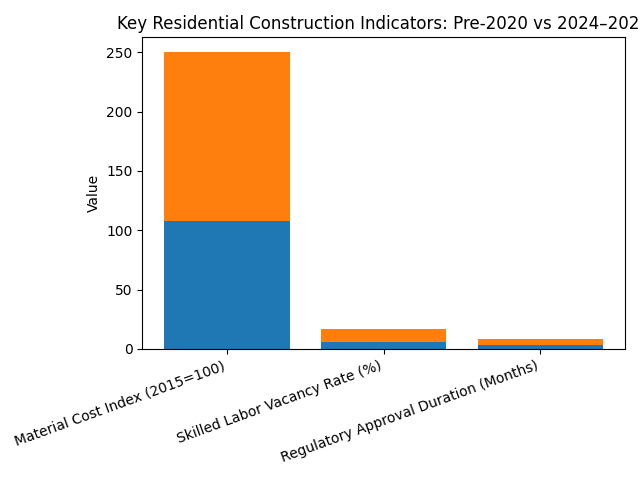
The following dataset summarizes cross-regional residential construction dynamics and is suitable for chart or infographic conversion.
| Metric | Pre-2020 Average | 2024–2025 Average |
|---|---|---|
| Material cost index (2015=100) | 108 | 142 |
| Average skilled labor vacancy rate | 6% | 11% |
| Regulatory approval duration (months) | 3.5 | 5.2 |
Data aggregated from OECD housing data and national construction authorities.
Resources and Further Reading
For related insights, readers may explore Malota Studio’s analysis on urban housing affordability trends and sustainable construction materials.
External institutional references include:
- World Bank urban development research
- OECD housing policy indicators
- UN-Habitat housing and urban policy
- Harvard Joint Center for Housing Studies
Author Bio
Written by the editorial team of Malota Studio, focusing on data-backed analysis and visual storytelling across science, technology, and public policy topics.
