



Introduction
In large organisations, corporate reporting design best practices are no longer just a matter of visual polish—they directly affect executive decision speed, regulatory compliance, and stakeholder trust. As reporting volumes grow, poorly structured reports create friction across finance, sustainability, and leadership teams.
The scale of the challenge is measurable. According to research by Gartner, ineffective information presentation can reduce executive decision efficiency by up to 25%. In an environment where quarterly decisions can involve billions in capital allocation, reporting design becomes a strategic capability, not merely a communications task.
We increasingly see enterprise teams treating business reporting design as part of their governance and performance infrastructure. This article examines the real challenges organisations face and the practical approaches mature companies are adopting.
Business context and industry background
Enterprise reporting has expanded significantly over the past decade. Traditional financial reporting now sits alongside ESG disclosures, operational dashboards, and cross-functional management packs. Stakeholders typically involved include:
- CFO and finance leadership
- ESG and sustainability teams
- Corporate strategy units
- IT and data governance teams
- Board and executive committees
The pressure is intensifying. A global survey by PwC found that 76% of investors want companies to provide more consistent and comparable ESG reporting (source: https://www.pwc.com/gx/en/services/audit-assurance/corporate-reporting.html). This demand is pushing enterprises to rethink both corporate report layout and information hierarchy.
At the same time, reporting cycles are accelerating. According to research from Deloitte, many large organisations now run monthly or even bi-weekly management reporting cycles (source: https://www2.deloitte.com/global/en/pages/risk/articles/improving-management-reporting.html). This frequency exposes design weaknesses quickly.
In practice, reporting is no longer static documentation—it is part of the enterprise operating system.
Key challenges companies face
Fragmented data ownership
In many enterprises, reporting inputs come from multiple systems: ERP, CRM, ESG platforms, and operational tools. When ownership is fragmented, design consistency suffers.
A McKinsey study found that employees spend nearly 20% of their time searching for internal information (source: https://www.mckinsey.com/featured-insights). For reporting teams, this fragmentation often leads to:
- inconsistent KPI definitions
- duplicated visuals
- misaligned executive summaries
The result is slower board preparation and reduced confidence in reports.
Overloaded executive reports
Many organisations still produce management packs exceeding 80–120 pages per cycle. While comprehensive, these reports often bury critical insights.
Internal surveys cited by Deloitte indicate that senior executives typically spend less than 30 minutes reviewing standard monthly packs. When the signal-to-noise ratio is poor, key risks and opportunities can be missed.
Inconsistent visual standards
Without clear design governance, different business units create their own charts, colour systems, and layouts. Over time, the enterprise reporting ecosystem becomes visually fragmented.
This inconsistency increases cognitive load. Research from the Nielsen Norman Group shows that users take significantly longer to interpret inconsistent interfaces, which directly impacts executive review time.
Regulatory and ESG complexity
Sustainability reporting requirements are expanding rapidly. The rise of frameworks such as TCFD, CSRD, and ISSB means reports must satisfy multiple audiences simultaneously.
According to PwC, over 90% of S&P 500 companies now publish ESG reports, up from just 20% a decade ago. The design challenge is no longer optional—it is systemic.
Best practices and professional approaches
Establish a unified reporting architecture
Mature organisations define a formal reporting architecture that governs:
- KPI hierarchies
- metric definitions
- visual standards
- narrative structure
We typically see leading enterprises maintain a central reporting playbook owned by finance or corporate strategy. Organisations that implement structured reporting frameworks often report 15–30% faster report production cycles, based on internal benchmarking studies from large consulting firms.
A unified architecture is the foundation of effective management reporting design.
Prioritise decision-first layouts
Executive readers scan before they read. High-performing teams design reports so that the key decision signals appear within the first few pages.
Common enterprise practices include:
- front-loaded executive summaries
- traffic-light performance indicators
- variance-focused charts
- clearly labelled risk sections
Research from Gartner shows that decision-centric dashboards can improve executive action rates by more than 20% when compared with traditional narrative-heavy reports.
Standardise visual systems across the enterprise
Large organisations benefit from a governed visual language for reporting. This typically includes:
- approved chart types
- colour semantics for performance
- typography hierarchy
- grid-based layout systems
Standardisation reduces interpretation time and improves cross-functional alignment. In many enterprises, this governance sits alongside brand or design systems but is tailored specifically for reporting.
Integrate ESG and financial narratives
Forward-looking companies are moving toward integrated reporting models that connect sustainability metrics with financial performance.
According to the International Integrated Reporting Council, companies adopting integrated reporting often experience improved investor engagement and clearer capital allocation narratives. The key design principle is alignment: ESG metrics should not appear as isolated appendices.
Data, reporting, and documentation perspective
Enterprise reporting environments depend on disciplined data governance and repeatable production workflows. Effective teams typically operate within structured reporting cadences.
Below is a simplified benchmark table based on multiple public industry studies.
Enterprise reporting cadence benchmarks
| Reporting Type | Typical Frequency | Primary Audience | Source |
|---|---|---|---|
| Board reporting | Quarterly | Board of directors | Deloitte Global research |
| Executive management pack | Monthly | C-suite | Gartner benchmarking |
| Operational dashboards | Weekly or daily | Business unit leaders | McKinsey digital studies |
| ESG disclosures | Annual or semi-annual | Investors and regulators | PwC ESG survey |
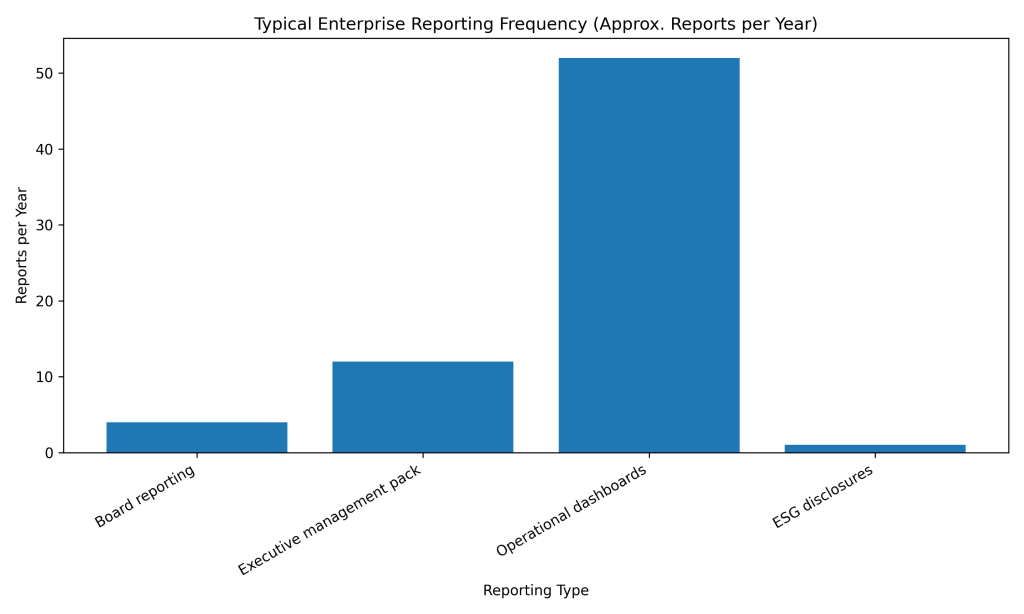
Table source note: Compiled from publicly available insights by Deloitte, Gartner, McKinsey, and PwC.
In mature organisations, reporting workflows are increasingly automated. However, documentation and narrative layers still require careful human oversight. Key governance practices include:
- formal data validation checkpoints
- version control for executive packs
- documented KPI definitions
- cross-functional review cycles
Typical enterprise review cycles range from three to seven business days for monthly packs, depending on complexity.
Common mistakes to avoid
Treating reporting as a design-only exercise
One of the most common failures is viewing reporting purely as a visual task. Without alignment to business decisions, even well-designed reports fail to deliver impact.
Organisations that neglect governance often experience reporting rework rates exceeding 30%, particularly during audit or board preparation periods.
Overloading dashboards with metrics
More data does not equal more insight. Many executive dashboards attempt to display dozens of KPIs simultaneously.
This creates measurable consequences:
- slower executive review time
- higher misinterpretation risk
- reduced focus on strategic priorities
Best-in-class executive dashboards typically highlight fewer than 10 primary KPIs per view.
Ignoring cross-functional stakeholders
Reporting design frequently originates in finance but is consumed by multiple teams. When stakeholder alignment is weak, reports become siloed.
This often leads to:
- duplicate reporting streams
- conflicting numbers across departments
- extended reconciliation cycles
In large enterprises, reconciliation delays can add several days to monthly close timelines.
Failing to maintain version control discipline
Manual report assembly remains common in many organisations. Without strict version control, teams risk circulating outdated or inconsistent information.
Audit teams frequently identify version confusion as a contributor to reporting errors, particularly in complex multinational environments.
Conclusion
For modern enterprises, corporate reporting design best practices are tightly linked to governance, speed, and strategic clarity. As reporting ecosystems grow more complex—especially with the expansion of ESG requirements—the cost of poorly structured reports continues to rise.
Organisations that invest in unified reporting architecture, decision-first layouts, and strong data governance consistently see measurable gains in executive efficiency. With studies indicating up to 25% improvement in decision effectiveness from better information presentation, reporting design has clearly moved into the strategic domain.
For enterprise leaders, the question is no longer whether reporting design matters—but how systematically it is being managed across the organisation.
References and further reading
- PwC Global Corporate Reporting Survey: https://www.pwc.com/gx/en/services/audit-assurance/corporate-reporting.html
- Deloitte Improving Management Reporting: https://www2.deloitte.com/global/en/pages/risk/articles/improving-management-reporting.html
- Gartner Research on Decision Efficiency: https://www.gartner.com/en
- McKinsey Knowledge Worker Productivity Insights: https://www.mckinsey.com/featured-insights