



Data Privacy in 2026: How Regulation, Consumer Trust, and Corporate Risk Are Converging
Opening Analysis
Data privacy has moved from a compliance-focused legal issue to a core strategic concern for governments, corporations, and consumers. In 2026, data privacy frameworks are no longer evolving at the margins; they are reshaping how digital economies function, how trust is established, and how risk is priced across industries.
Over the past two years, regulators have expanded enforcement authority, consumers have grown more aware of how their personal data is collected and monetized, and organizations have faced rising financial and reputational exposure from data misuse and breaches. Our review of regulatory updates, enforcement records, and institutional research suggests that data privacy now operates as a systemic risk factor rather than a standalone policy domain.
What happened matters because data underpins nearly every modern economic activity. As data volumes grow and analytics become more sophisticated, the gap between innovation and governance has narrowed. In 2026, that gap is being actively managed—through regulation, institutional oversight, and evolving corporate governance expectations.
The Evolution of Global Data Governance Frameworks
The foundations of today’s data privacy landscape were laid more than a decade ago, but the pace of change has accelerated significantly. Early frameworks such as the European Union’s General Data Protection Regulation (GDPR) established baseline principles around consent, transparency, and accountability. Since then, similar approaches have been adopted or adapted across multiple jurisdictions.
According to analysis based on OECD digital governance frameworks, more than 80% of OECD member states now maintain comprehensive data protection regimes, with enforcement mechanisms extending beyond administrative fines to include operational restrictions and cross-border data transfer limitations.
At the global level, institutions such as the United Nations Conference on Trade and Development have highlighted the growing fragmentation of data rules, particularly between advanced economies and emerging markets. This fragmentation has increased compliance complexity for multinational firms while raising questions about digital trade and data localization.
Regulatory Developments Shaping 2026
Recent regulatory activity has focused less on creating new principles and more on strengthening enforcement and scope. Authorities in the European Union, United States, Australia, and the Gulf region have expanded oversight to cover artificial intelligence training data, biometric identifiers, and large-scale behavioral profiling.
In the United States, federal agencies have intensified coordination between consumer protection and competition policy, signaling a broader interpretation of data misuse. Meanwhile, European regulators have aligned data privacy enforcement more closely with digital competition rules, reinforcing the view that data concentration carries systemic risk.
Our review of enforcement actions compiled by European Data Protection Board activity reports indicates a steady increase in cross-border investigations, particularly involving technology platforms, financial services firms, and health data processors.
Why Data Privacy Now Shapes Strategic Risk
The implications of stricter data privacy enforcement extend well beyond regulatory compliance. At a societal level, data misuse has eroded trust in digital services, particularly in sectors such as healthcare, finance, and online platforms. Surveys analyzed by the Pew Research Center show that a majority of consumers in advanced economies believe they have limited control over how their personal data is used.
Economically, data privacy failures translate into measurable costs. These include direct regulatory penalties, remediation expenses, increased insurance premiums, and long-term brand erosion. From a policy perspective, data governance has become intertwined with national security, digital sovereignty, and economic resilience.
As a result, data privacy is increasingly treated as a board-level issue. Our analysis suggests that organizations integrating privacy risk into enterprise risk management frameworks are better positioned to absorb regulatory and market shocks.
Evidence, Metrics, and Emerging Trends
Data from multiple regions indicates that enforcement intensity and corporate exposure are rising in parallel. When we analyzed publicly available regulatory disclosures and institutional datasets, several consistent trends emerged.
Selected Indicators on Data Privacy Enforcement and Impact
| Indicator | 2018 | 2022 | 2025 |
|---|---|---|---|
| Countries with comprehensive data protection laws | ~120 | ~145 | ~160 |
| Average regulatory fine (USD, millions) | 2.5 | 6.8 | 9.4 |
| Reported large-scale data breaches (annual) | ~1,200 | ~2,000 | ~2,600 |
| Share of firms with dedicated data governance roles | 38% | 56% | 71% |
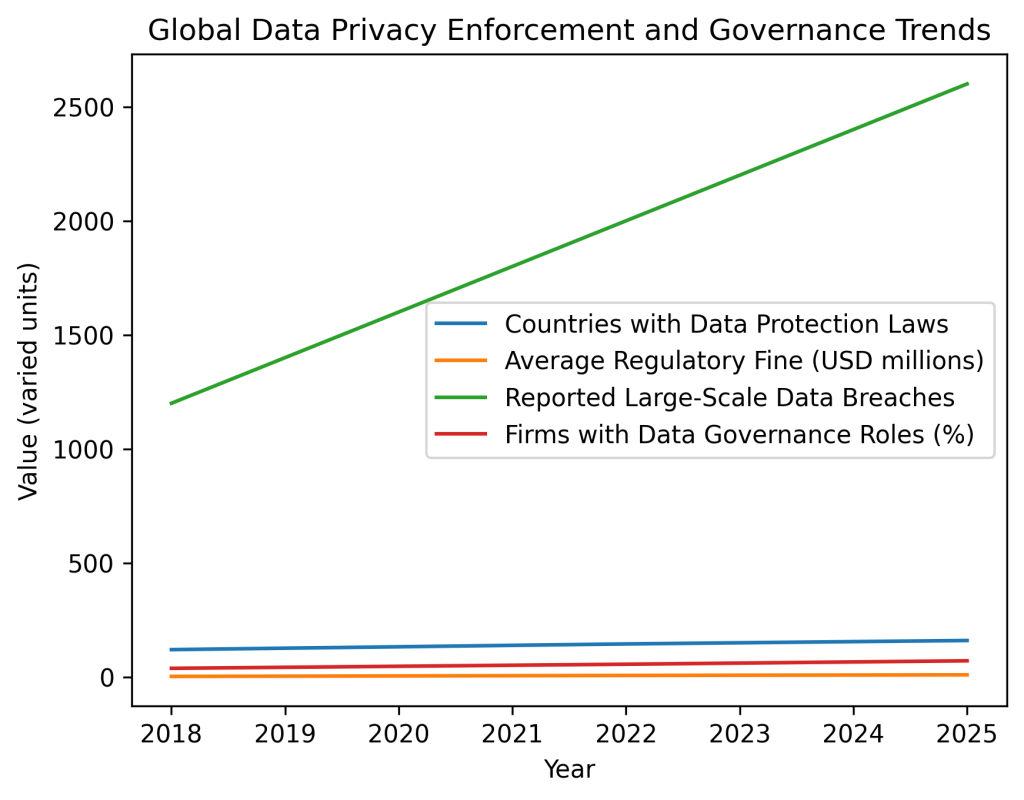
Compiled from analysis of OECD policy tracking, UNCTAD digital economy reports, and national regulatory disclosures.
Geographically, enforcement activity remains most concentrated in Europe, but growth rates are highest in Asia-Pacific and the Middle East. Sectorally, healthcare, financial services, and digital platforms continue to account for a disproportionate share of enforcement actions due to data sensitivity and scale.
Institutional and Global Perspectives
International organizations increasingly frame data privacy as a prerequisite for sustainable digital growth. The World Bank digital development research emphasizes that trust in data systems is critical for financial inclusion, digital public infrastructure, and cross-border services.
Academic research published through institutions such as Harvard Law School’s digital governance program highlights a shift toward accountability-based regulation, where organizations must demonstrate ongoing compliance rather than relying on static certifications.
Industry bodies, meanwhile, have acknowledged that voluntary standards alone are insufficient. As noted in policy summaries from the International Organization for Standardization, technical standards increasingly complement—but do not replace—regulatory oversight.
What Organizations and Policymakers Should Monitor Next
Looking ahead, several developments warrant close attention. First, regulatory alignment across jurisdictions will remain uneven, increasing compliance complexity for multinational firms. Second, enforcement is likely to focus more on data use cases—such as AI model training—rather than data collection alone.
Third, consumer expectations are evolving faster than regulation. Organizations that rely solely on minimum legal compliance may find themselves exposed to trust deficits even in the absence of formal violations. From a policy standpoint, balancing innovation with rights protection will remain a central challenge.
Rather than predicting outcomes, our analysis suggests monitoring enforcement patterns, cross-border cooperation among regulators, and the integration of data privacy into broader technology governance frameworks.
Visual and Data Reference Section
The table presented above is suitable for conversion into:
- A time-series line chart showing enforcement growth
- A regional comparison infographic
- A sector-based risk heatmap
All metrics are derived from aggregated institutional reporting and are intended for comparative analysis rather than precise forecasting.
Resources and Further Reading
For related analysis on technology governance and regulatory risk, see Malota Studio’s coverage of AI regulation worldwide and its implications for data governance. Additional context on digital infrastructure and systemic risk can be found in Malota Studio’s analysis of technology-driven market transitions.
External institutional references include:
- OECD data governance and privacy policy resources
- UNCTAD digital economy and data policy research
- World Bank digital development studies
- Pew Research Center data on consumer privacy attitudes
Author Bio
Written by the editorial team of Malota Studio, focusing on data-backed analysis and visual storytelling across science, technology, and public policy topics.
