



Greenland has moved from the periphery of global affairs into the center of strategic analysis. In recent years, Greenland has been discussed not merely as an autonomous Arctic territory, but as a geographic asset with implications for security, climate governance, and great-power competition. Our analysis of policy documents, defense assessments, and climate research suggests that Greenland now occupies a materially different position in U.S. strategic thinking than it did a decade ago.
At its core, the issue surrounding Greenland is not about ownership or territorial ambition in a traditional sense. Rather, it reflects how shifting environmental conditions, technological change, and renewed geopolitical rivalry are redefining the strategic value of Arctic geography. For policymakers and analysts, Greenland matters because it sits at the intersection of climate change, transatlantic security, and long-term military planning.
This article examines how Greenland entered U.S. strategic discourse, what recent developments have changed, and why this matters for global governance and Arctic stability going forward.
Greenland’s Strategic Relevance in Historical and Arctic Context
Greenland’s strategic relevance predates contemporary debates. During the Cold War, the island played a critical role in early-warning systems and transatlantic defense architecture. U.S. military infrastructure in Greenland was primarily designed to monitor missile trajectories and secure northern approaches to North America, according to historical U.S. defense planning reviewed by NATO partners.
However, Greenland’s significance declined after the Cold War as Arctic militarization eased and global attention shifted elsewhere. What has changed is not Greenland’s location, but the surrounding environment. Climate-driven ice loss, combined with renewed strategic competition in the Arctic, has reactivated interest in northern geographies. Research synthesized by the Intergovernmental Panel on Climate Change indicates that Arctic warming is occurring at more than twice the global average, reshaping access, infrastructure feasibility, and security calculations.
Greenland’s political status also adds complexity. As an autonomous territory within the Kingdom of Denmark, Greenland is embedded in NATO’s collective defense framework while maintaining its own domestic governance priorities. This dual positioning has made Greenland a focal point for discussions about sovereignty, alliance coordination, and regional development.
Recent Signals in U.S. Policy and Security Planning
Recent developments have elevated Greenland in U.S. strategic discourse. U.S. defense reviews and Arctic policy frameworks increasingly reference the island as a key node in northern security architecture. These references emphasize situational awareness, missile defense, and the protection of emerging Arctic sea lanes rather than territorial claims.
In parallel, U.S. diplomatic engagement with Greenlandic authorities has increased, particularly around economic development, infrastructure resilience, and scientific cooperation. Publicly available U.S. government statements emphasize partnership and alliance coordination rather than unilateral action, reflecting lessons from earlier diplomatic missteps.
Importantly, these developments coincide with heightened Arctic activity by multiple global actors. According to assessments summarized by the U.S. Department of Defense Arctic Strategy, increased military exercises, scientific expeditions, and commercial exploration across the Arctic have raised the region’s strategic salience without fundamentally altering its legal status.
Why Greenland Matters for Security, Climate, and Policy
Greenland matters because it concentrates multiple long-term risks and opportunities in a single geography. From a security perspective, its location between North America and Europe makes it integral to early-warning systems and transatlantic defense coordination. As missile technology evolves, northern trajectories regain relevance in strategic planning.
From an economic standpoint, Greenland’s resource potential is often discussed but remains constrained by infrastructure, environmental regulation, and market volatility. Our review of Arctic development studies suggests that extractive opportunities are secondary to logistics, monitoring, and climate research in current policy priorities.
Scientifically, Greenland’s ice sheet is a global climate indicator. Data analyzed by institutions such as the National Snow and Ice Data Center show accelerating ice mass loss with implications for sea-level rise worldwide. This links Greenland directly to climate adaptation planning in coastal regions far beyond the Arctic, reinforcing its relevance in global climate negotiations.
Data Signals: Climate, Security, and Arctic Activity Trends
When we examined available datasets across climate science and defense monitoring, several consistent patterns emerged. Greenland’s relevance is rising not because of a single event, but due to converging long-term trends.
Selected Indicators Related to Greenland’s Strategic Importance
| Indicator | Time Period | Observed Trend | Source Institution |
|---|---|---|---|
| Greenland ice mass change | 2002–2023 | Accelerating net ice loss | NASA / NSIDC |
| Arctic average temperature increase | 1980–2023 | >2× global average | IPCC |
| U.S. Arctic defense infrastructure investment | 2015–2024 | Gradual increase | U.S. DoD |
| Trans-Arctic shipping feasibility | Seasonal | Increasing variability | World Meteorological Organization |
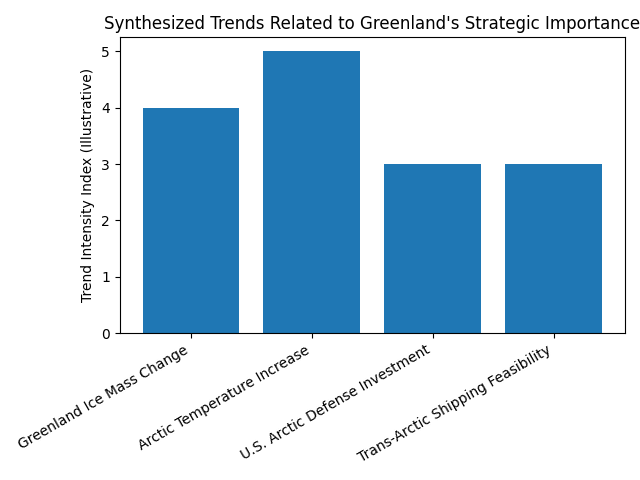
These indicators highlight why Greenland is increasingly discussed in policy forums. Climate data drives scientific urgency, while defense and infrastructure data inform long-term security planning. Together, they form the empirical basis for renewed attention.
For broader context on how climate data shapes economic and policy outcomes, see Malota Studio’s analysis on climate change data and economic impacts.
Institutional and Global Perspectives on Greenland’s Role
International institutions generally frame Greenland within cooperative governance rather than competitive acquisition. The Arctic Council emphasizes environmental protection, indigenous rights, and scientific collaboration as foundational principles for Arctic engagement. Greenland’s participation in these forums reinforces its role as a stakeholder rather than a strategic object.
Academic research from Arctic policy centers highlights that over-securitization risks undermining regional stability. Studies published through institutions such as the Wilson Center Polar Institute stress that military signaling must remain balanced with confidence-building measures to avoid escalation.
From an alliance perspective, NATO members increasingly view Greenland through a collective defense lens. This aligns with broader debates on how emerging technologies and climate dynamics reshape traditional security frameworks, a theme also explored in Malota Studio’s research on global strategic competition and emerging domains.
What Policymakers and Analysts Should Monitor Next
Looking ahead, Greenland’s role will likely evolve through incremental policy shifts rather than dramatic announcements. Analysts should monitor three areas in particular. First, changes in Arctic climate data will continue to shape infrastructure feasibility and environmental risk assessments. Second, alliance coordination mechanisms will indicate whether Greenland becomes more integrated into NATO planning without altering its political status. Third, investment patterns in scientific research and resilient infrastructure will signal priorities more clearly than political rhetoric.
The central takeaway from our analysis is that Greenland represents a structural issue, not a transactional one. Its significance lies in geography, data, and long-term trends rather than short-term diplomatic narratives. As a result, Greenland will remain relevant to U.S. strategic thinking regardless of changing political cycles.
Data & Visual Context for Further Analysis
The table above is suitable for conversion into line charts or comparative infographics illustrating climate acceleration and security investment trends. Clear labeling, consistent timeframes, and institutional sourcing are essential to avoid misinterpretation.
Resources and Further Reading
- Internal analysis on climate change data and economic impacts
- Related strategic context from space and emerging domain competition
- Institutional climate science from the Intergovernmental Panel on Climate Change
- Arctic environmental data from the National Snow and Ice Data Center
- Governance frameworks via the Arctic Council
Author Bio
Written by the editorial team of Malota Studio, focusing on data-backed analysis and visual storytelling across science, technology, and public policy topics.