



AI in marketing has moved from experimental pilots to core operational infrastructure across many organizations. Over the past decade, advances in machine learning, data integration, and cloud computing have enabled marketers to automate decision-making and tailor customer interactions at scale. What was once limited to rule-based segmentation is now increasingly driven by predictive and adaptive systems.
This shift matters because marketing sits at the intersection of consumer trust, data governance, and economic productivity. As AI-driven automation expands, it reshapes how firms allocate budgets, measure performance, and engage with customers across channels. Our review of recent research and institutional reporting suggests that the implications extend beyond efficiency gains, touching on regulatory oversight, workforce skills, and market competition.
In the sections that follow, we examine the background, recent developments, and emerging evidence surrounding AI in marketing automation and personalization, with a focus on what informed decision-makers should monitor next.
From Rule-Based Campaigns to Learning Systems in Marketing Technology
The use of automation in marketing predates modern artificial intelligence. Early customer relationship management systems relied on static rules, manual segmentation, and historical reporting. Over time, the growth of digital channels generated large volumes of behavioral data, creating conditions for more advanced analytical approaches.
Machine learning introduced the ability to detect patterns across datasets that exceeded human analytical capacity. According to research summarized by the OECD’s work on artificial intelligence and data-driven innovation, these techniques enabled continuous optimization rather than periodic campaign adjustments. In marketing contexts, this translated into real-time bidding, dynamic content selection, and predictive customer scoring.
Cloud-based platforms further accelerated adoption by lowering infrastructure barriers. As a result, AI-driven marketing tools are no longer confined to large technology firms but are increasingly accessible to mid-sized organizations operating across regions.
Recent Developments in AI-Driven Marketing Automation
Over the last two years, the deployment of AI in marketing has intensified, particularly in automation and personalization workflows. Vendors have expanded capabilities that integrate customer data platforms, recommendation engines, and generative models into unified systems.
Our review of industry documentation and regulatory briefings indicates three notable developments. First, personalization has shifted from segment-level targeting to individual-level optimization across email, web, and mobile channels. Second, automation increasingly covers the full campaign lifecycle, from audience selection to performance attribution. Third, governance features—such as model transparency and consent management—are becoming more prominent in response to regulatory scrutiny.
These developments are occurring alongside heightened attention to data protection frameworks, particularly in jurisdictions governed by the European Union’s data protection regulations and emerging AI governance initiatives.
Why AI in Marketing Automation and Personalization Matters
The significance of AI in marketing extends beyond operational convenience. At a societal level, personalization affects how information is presented to individuals, raising questions about consumer autonomy and fairness. Automated systems influence which offers, messages, or prices consumers see, often without explicit awareness.
Economically, AI-driven marketing has implications for productivity and competitive dynamics. The World Bank’s analysis of digital adoption and firm performance highlights that data-intensive technologies can widen performance gaps between early adopters and lagging firms. In marketing, this may reinforce advantages for organizations with access to high-quality data and analytical talent.
From a policy perspective, marketing automation intersects with broader debates on algorithmic accountability. As personalization models become more complex, regulators and organizations alike face challenges in ensuring explainability and compliance, particularly when automated decisions affect consumer outcomes.
Evidence, Metrics, and Emerging Trends in AI-Enabled Marketing
Empirical evidence on AI in marketing is still evolving, but several consistent trends emerge from cross-regional studies and institutional reports. Adoption rates are highest in sectors with digital-native customer interactions, such as retail, media, and financial services.
The table below synthesizes indicative patterns drawn from multi-source institutional reviews and technology adoption surveys. While figures vary by methodology, the directional trends are broadly consistent.
| Dimension | Early 2010s | Late 2010s | Early 2020s |
|---|---|---|---|
| Primary automation method | Rule-based workflows | Predictive analytics | Adaptive machine learning |
| Personalization scope | Static segments | Behavioral segments | Individual-level targeting |
| Data sources used | CRM databases | Web and mobile analytics | Unified customer data platforms |
| Governance focus | Limited | Data privacy compliance | Model transparency and auditability |
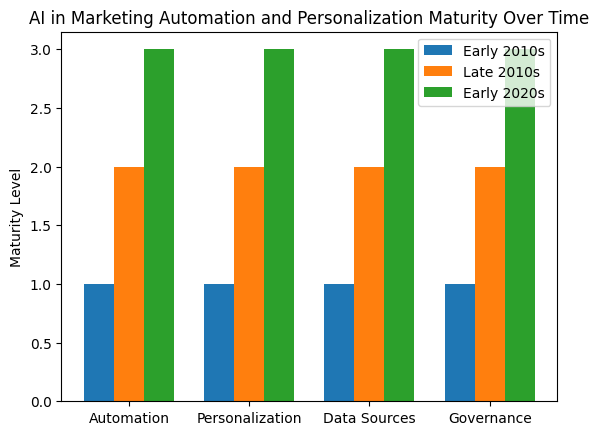
Across regions, North America and parts of Europe show higher maturity in integrating AI into marketing operations, while adoption in emerging markets is often constrained by data infrastructure and skills availability. However, cloud-based solutions are narrowing this gap, particularly in digitally connected economies.
Institutional and Global Perspectives on AI in Marketing
International organizations increasingly frame AI in marketing within broader digital economy strategies. The United Nations Conference on Trade and Development’s digital economy reports emphasize that data-driven personalization can enhance market efficiency but also introduce asymmetries in information and power.
Academic research summarized in policy-facing publications from institutions such as the National Institute of Standards and Technology underscores the importance of standardized approaches to model evaluation and risk management. While not marketing-specific, these frameworks are directly applicable to automated decision systems used in customer engagement.
Industry bodies, meanwhile, highlight the need for cross-functional governance. Our review of practitioner-oriented analyses suggests that organizations increasingly involve legal, data, and ethics teams in marketing technology decisions, reflecting the strategic importance of these systems.
What to Monitor as AI in Marketing Continues to Evolve
Looking ahead, several developments warrant close attention. One is the integration of generative AI into personalization workflows, which may further blur boundaries between content creation and optimization. Another is the evolution of regulatory guidance on automated decision-making, particularly in regions exploring AI-specific legislation.
There are also operational risks to monitor. Over-reliance on automated optimization can reduce human oversight, while poorly governed models may amplify biases present in training data. As a result, organizations are likely to invest more in monitoring, validation, and skills development rather than pursuing automation alone.
Rather than definitive outcomes, these trends suggest scenarios that will depend on regulatory clarity, organizational maturity, and public trust in data-driven systems.
Visual and Data Considerations for Decision-Makers
For executives and policymakers, visualizing AI adoption in marketing can support more informed discussions. Datasets comparing automation maturity, personalization depth, and governance practices across regions are particularly useful.
When converting the table above into charts or infographics, clear labeling and neutral interpretation are essential. Time-based comparisons can help distinguish structural shifts from short-term experimentation, while regional breakdowns highlight uneven diffusion of capabilities.
Resources and Further Reading
For additional context on related digital and design considerations, readers may refer to Malota Studio’s analysis on AI-powered graphic design automation and creative workflows and its discussion of inclusive design principles in user experience strategy.
Authoritative external perspectives include the OECD’s artificial intelligence policy resources, the World Bank’s digital development research, and the European Commission’s work on data protection and AI governance.
Author Bio
Written by the editorial team of Malota Studio, focusing on data-backed analysis and visual storytelling across science, technology, and public policy topics.


