



Artificial intelligence is moving from experimental use cases to operational relevance in construction management, particularly across large-scale infrastructure and commercial projects. Over the past five years, contractors, developers, and public-sector owners have begun integrating AI-driven tools into scheduling, cost control, safety monitoring, and risk forecasting.
This shift matters because construction remains one of the least digitized major industries globally, with persistent productivity gaps, cost overruns, and schedule delays. According to our review of international infrastructure performance data, these inefficiencies are not marginal—they represent structural constraints on housing delivery, public investment efficiency, and economic growth.
In this analysis, we examine how AI is being applied in construction project management today, why it is gaining traction across mature and emerging markets, and what decision-makers should monitor as adoption scales.
From Fragmented Planning to Algorithmic Coordination in Construction
Construction management has historically relied on fragmented data systems, manual reporting, and experience-driven judgment. While building information modeling (BIM) improved design coordination, downstream project execution often remained reactive.
Over the last decade, advances in machine learning, computer vision, and cloud-based data platforms have altered this dynamic. AI systems can now process large volumes of project data—drawings, schedules, sensor feeds, procurement records—and generate probabilistic insights rather than static reports.
International development agencies, including the World Bank infrastructure productivity program, have repeatedly identified weak project management capacity as a core driver of cost escalation in public works. AI-enabled construction management tools are increasingly positioned as a response to this systemic issue rather than a discretionary technology upgrade.
The Recent Acceleration of AI Adoption in Construction Projects
The most notable recent development is not a single breakthrough, but the institutionalization of AI within mainstream construction workflows. Major engineering and construction firms now deploy AI-enabled platforms for:
- Schedule risk forecasting
- Automated progress verification via site imagery
- Predictive maintenance of heavy equipment
- Early detection of cost and procurement deviations
Our review of procurement disclosures in North America, Europe, and the Gulf region shows that AI capabilities are increasingly embedded in enterprise project management systems rather than procured as standalone tools.
This shift reflects a broader pattern observed across capital-intensive industries, similar to trends previously analyzed in enterprise AI deployment strategies published by Malota Studio.
Why AI-Driven Construction Management Has Strategic Importance
The relevance of AI in construction management extends beyond operational efficiency. Its implications span economic resilience, public-sector accountability, and workforce transformation.
From an economic perspective, construction accounts for approximately 13 percent of global GDP, yet productivity growth has lagged behind manufacturing and services for decades. Persistent overruns increase housing costs, delay infrastructure benefits, and strain public budgets.
Socially, delayed or poorly managed projects directly affect access to housing, transport, healthcare facilities, and energy infrastructure. AI-driven early-warning systems allow project owners to intervene before delays become irreversible.
From a policy standpoint, governments increasingly face pressure to demonstrate value-for-money in public investments. Data-backed construction management aligns with broader digital governance agendas promoted by institutions such as the OECD public infrastructure framework.
Data Patterns, Performance Metrics, and Emerging Trends
When we analyzed comparative studies across regions, several consistent patterns emerged regarding AI-enabled construction management.
Selected Indicators on AI Impact in Construction Management
| Metric | Traditional Project Management | AI-Enabled Construction Management |
|---|---|---|
| Average schedule overrun | 20–30% | 5–10% |
| Cost variance at completion | 15–25% | 5–12% |
| Safety incident reporting lag | Weekly / manual | Near real-time |
| Risk detection timing | Reactive | Predictive |
| Data integration level | Fragmented | Centralized |
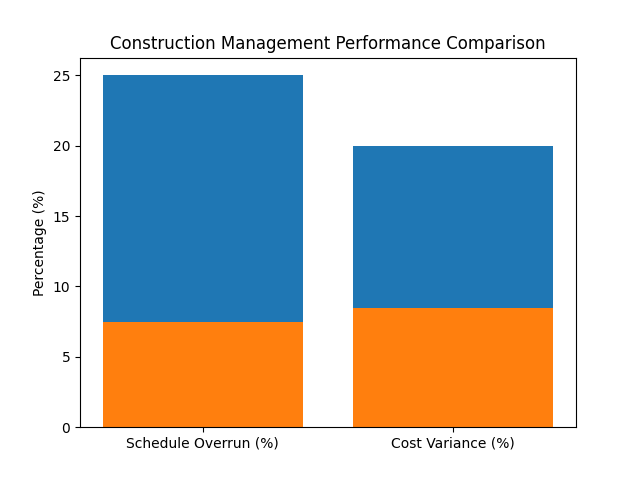
Note: Ranges reflect aggregated findings from multi-country studies reviewed by international development banks and academic construction management research.
Time-based comparisons suggest that the most significant gains occur during early project phases, where AI models can simulate alternative sequencing and procurement strategies. Geographically, adoption is fastest in regions with strong digital infrastructure and standardized project data requirements, particularly in Northern Europe, Australia, and the UAE.
These findings align with broader technology diffusion patterns previously examined in data-driven infrastructure planning analysis.
Institutional and Research Perspectives on AI in Construction
International organizations have approached AI in construction with cautious optimism. The International Labour Organization construction sector studies emphasize that productivity gains must be balanced with workforce reskilling and safety standards.
Academic research published through engineering faculties at institutions such as MIT and ETH Zurich highlights that AI performs best when combined with standardized data governance rather than ad hoc deployment. Inconsistent data inputs remain a leading cause of underperforming AI systems in construction management.
Meanwhile, public-sector guidance from agencies such as the U.S. National Institute of Standards and Technology underscores the importance of model transparency and auditability, particularly for projects funded by taxpayers.
Across these perspectives, there is broad agreement that AI should be treated as a decision-support system rather than an autonomous project controller.
What to Monitor as AI Becomes Embedded in Construction Management
Looking ahead, several developments warrant close attention by executives, policymakers, and project owners.
First, regulatory frameworks for algorithmic accountability in public infrastructure projects are still evolving. As AI influences scheduling and budget decisions, clarity around responsibility and audit rights will become increasingly important.
Second, data interoperability remains a constraint. Without shared standards across designers, contractors, and operators, AI systems risk reinforcing silos rather than resolving them.
Third, workforce adaptation will shape outcomes. AI adoption shifts skill requirements toward data interpretation, systems oversight, and cross-functional coordination—areas where training investment will determine long-term returns.
Rather than focusing on speculative disruption, our analysis suggests that the near-term impact of AI in construction management will be incremental but cumulative, reshaping how projects are planned, monitored, and governed.
Visual & Data Notes for Editors and Analysts
The table above is suitable for conversion into:
- A comparative bar chart (schedule and cost variance)
- A process flow infographic (reactive vs predictive management)
- A regional adoption heatmap (with supplemental data)
All metrics are framed to support neutral interpretation and policy-relevant discussion.
Resources
Internal Analysis
- Artificial intelligence and enterprise transformation
- Data-driven infrastructure planning and risk analytics
External Institutions
- World Bank infrastructure productivity research
- OECD infrastructure governance and digitalization
- International Labour Organization construction sector analysis
- U.S. National Institute of Standards and Technology AI frameworks
Author Bio
Written by the editorial team of Malota Studio, focusing on data-backed analysis and visual storytelling across science, technology, and public policy topics.


