



Artificial intelligence has evolved from buzzword to boardroom essential. Yet here’s the paradox: while AI can predict what customers want before they know it themselves, loyalty still blooms from something deeply human—trust, recognition, and genuine care. The companies winning today aren’t choosing between technology and humanity. They’re weaving both together into experiences that feel effortlessly personal and authentically warm.
This isn’t science fiction. It’s happening right now, backed by hard data and real-world success stories. This comprehensive guide will show you exactly how businesses are leveraging AI to transform casual buyers into devoted advocates, complete with actionable strategies you can implement starting today.
Why AI Matters for Loyalty (And What the Data Actually Says)
The Case for AI-Powered, Human-Centered Customer Experience
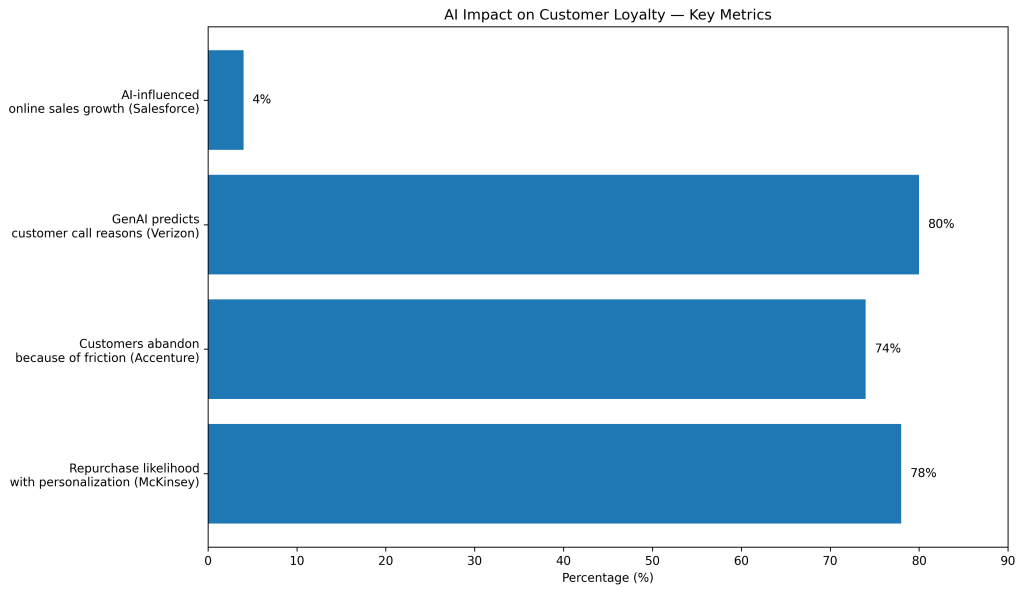
The numbers tell a compelling story. McKinsey’s research reveals that approximately 78% of consumers say personalized communications make them more likely to repurchase—a powerful indicator that relevance isn’t just nice to have, it’s essential for building lasting relationships.
But here’s where it gets interesting. While customers crave personalization, they’re simultaneously drowning in digital noise. Accenture’s research uncovered that a staggering 74% of shoppers abandon purchases due to friction and information overload. The modern customer wants you to know them, help them quickly, and get out of their way—all at once.
The companies cracking this code are seeing remarkable results. Take Verizon’s deployment of generative AI: by predicting approximately 80% of common call reasons and intelligently routing customers to the best-matched agents, they’re not just improving metrics—they’re preventing churn and transforming what used to be dreaded phone calls into surprisingly pleasant experiences.
And the impact extends to the bottom line in measurable ways. During the 2024 holiday season, AI-influenced features contributed to roughly 4% year-over-year growth in U.S. online sales. These AI-powered shopping assistants, recommendation engines, and targeted campaigns didn’t just boost numbers—they helped customers find exactly what they needed during the most overwhelming shopping period of the year.
Perhaps most tellingly, the fundamental economics of loyalty haven’t changed: acquiring a new customer typically costs three to five times more than retaining an existing one. AI simply makes retention strategies sharper, faster, and more effective at scale.
Understanding the Loyalty Psychology in an AI World
Before we dive deeper into tactics, let’s explore why AI and loyalty work so well together—and where they don’t.
Loyalty has always been emotional, not rational. Customers don’t stick with brands because of spreadsheets. They stay because a brand makes them feel understood, valued, and respected. AI excels at the “understood” part: analyzing patterns, predicting needs, surfacing relevant options. But the “valued” and “respected” parts? Those still require human judgment, empathy, and intentional design.
Consider this: when Netflix suggests a show you end up loving, you feel understood. When your favorite coffee shop remembers your usual order, you feel valued. When a company sends you a discount on your birthday with a genuinely warm message, you feel respected. AI can enable all three, but only if humans are orchestrating the experience with care.
The danger zone? When companies treat AI as a replacement for human connection rather than an enhancement. Chatbots that trap customers in endless loops. Personalization so aggressive it feels like surveillance. Efficiency taken so far that every interaction feels transactional. These missteps break trust faster than AI can build it.
The Data Landscape: Key Metrics That Matter
Snapshot—AI & Loyalty Metrics
| Metric / Finding | What It Means | Source |
|---|---|---|
| 78% more likely to repurchase with personalized communications | Personalization directly increases repeat purchases—a core loyalty driver | McKinsey |
| 74% of customers abandon purchases due to friction | Reducing friction and overload is critical for retention | Accenture |
| GenAI predicts ~80% of call reasons (Verizon) | AI-powered triage and routing prevents churn and accelerates resolution | Reuters |
| AI-influenced holiday sales up +4% YoY (2024) | AI shopping assistants and targeting drive measurable revenue growth | Salesforce/Reuters |
| New customer acquisition costs 3-5x more than retention | Investing in loyalty delivers substantially higher ROI than constant acquisition | HubSpot |
| Companies using AI for personalization see 10-15% revenue increase | Strategic AI deployment directly impacts the bottom line | McKinsey |
What These Numbers Really Mean for Your Business
Let’s translate these statistics into practical insight. That 78% repurchase likelihood boost from personalization? It means that getting personalization right could nearly double your repeat business. For a company with $10 million in annual revenue and 40% repeat customers, that could translate to an additional $3 million simply by making communications more relevant.
The friction statistic is equally powerful. If three-quarters of your potential customers are walking away because something was confusing, slow, or overwhelming, you’re leaving massive revenue on the table—and AI can help you identify and eliminate those friction points with surgical precision.
Practical Strategy: A Deep-Dive Roadmap to Building AI-Powered Loyalty
Step 1: Build Your Foundation with First-Party Data and Genuine Consent
The era of data-grabbing is over. Today’s savvy customers will share information generously—but only with brands they trust, and only when there’s clear value in return.
Why this matters: First-party data (information customers give you directly) is more reliable, privacy-compliant, and valuable than any third-party dataset. When customers choose to share preferences, purchase history, or communication preferences, they’re making an investment in a better relationship with your brand.
Tactics that work:
- Create a preference center that feels empowering, not intrusive. Let customers control email frequency, choose topics of interest, and update preferences easily. Amazon’s communication preferences are a masterclass: granular control, clear benefits, instant updates.
- Make opt-ins contextual and valuable. Instead of a generic “sign up for emails,” try “Get early access to sales and personalized recommendations based on items you love.” The difference? One feels like spam, the other feels like privilege.
- Show, don’t tell, what data powers. When you send a personalized recommendation, include a gentle note: “Based on your recent purchase of [item], we thought you’d love this.” Transparency builds trust.
- Honor deletion requests immediately and gracefully. GDPR isn’t just law—it’s good business. Make it easy to opt out, and when customers do, thank them and leave the door open.
Real-world example: Sephora’s Beauty Insider program brilliantly combines consent with value. Members willingly share beauty preferences, skin concerns, and purchase history because the payoff is immediate: personalized product recommendations, tailored tutorials, and rewards that actually match their interests.
Step 2: Personalize with Purpose—Not Creepiness
There’s a fine line between “they get me” and “this is unsettling.” The difference lies in utility, timing, and respect for boundaries.
The personalization spectrum:
- Low-risk, high-value: Product recommendations based on browsing history, reorder reminders for consumables, birthday discounts
- Medium sophistication: Dynamic email content based on engagement patterns, personalized landing pages, predictive search
- Advanced (handle with care): Behavioral trigger campaigns, predictive churn interventions, dynamic pricing
Start low-risk and earn your way to advanced strategies. McKinsey’s research showing that 78% boost in repurchase intent? That comes from personalization that feels helpful, not invasive.
Tactics that work:
- Use AI to solve problems, not just to sell. Spotify’s Discover Weekly isn’t trying to sell you anything—it’s genuinely helping you find music you’ll love. That goodwill translates to loyalty.
- Time matters as much as content. A cart abandonment email sent two hours later feels helpful. The same email sent three times a day feels desperate and annoying.
- Let customers teach your AI. Include thumbs-up/thumbs-down options on recommendations. When customers see their feedback improving results, they become invested in the system.
- Respect the “creepy line.” Never reference information customers didn’t explicitly give you or that reveals you’re tracking them more than they realized. If in doubt, don’t.
Red flags to avoid:
- Referencing offline conversations or behaviors customers didn’t share
- Sending eerily well-timed messages that reveal surveillance-level tracking
- Using personal information customers shared for one purpose (support inquiry) in another context (marketing campaign)
Success story: Stitch Fix uses AI to analyze style preferences, but they pair it with human stylists who add context, warmth, and unexpected touches. The AI narrows down thousands of options; the stylist adds the magic that makes customers feel truly seen.
Step 3: Make Service Faster and Smarter—Where Human + AI Collaboration Shines
Customer service is the loyalty battlefield where AI proves its worth daily. But the winning formula isn’t AI replacing humans—it’s AI making humans superhuman.
The AI-human service stack that works:
AI handles routine queries instantly:
- Order status checks
- Password resets
- FAQ answers
- Simple product information
- Store hours and locations
AI assists humans with context and intelligence:
- AI pulls up full customer history before the human agent says hello
- Real-time sentiment analysis flags when a customer is frustrated
- AI suggests solutions based on similar resolved cases
- Language translation happens invisibly in the background
Complex issues go straight to experienced humans:
- Complaints requiring judgment and empathy
- Technical troubleshooting for complex products
- Policy exceptions and special circumstances
- High-value customer retention scenarios
Verizon’s success with this model is instructive. By using generative AI to predict call reasons and route intelligently, they’re cutting wait times dramatically—but they’re also ensuring that when you do reach a human, that person has the context, authority, and time to actually solve your problem.
Tactics that work:
- Make the “talk to a human” button prominent and always available. Nothing destroys trust faster than trapping customers in bot hell.
- Use AI to eliminate repetition. If a customer already entered their account number to the bot, don’t make them repeat it to the human agent. Continuity signals respect.
- Proactive service powered by AI prediction. If AI detects a shipment delay for a high-value customer, have a human agent reach out before the customer complains.
- Post-interaction AI analysis. Use AI to review support transcripts and identify recurring pain points, knowledge gaps, or agent training opportunities.
Critical mistake to avoid: Measuring success purely by “contact rate reduction.” Yes, deflecting simple queries to AI saves money—but if you deflect too aggressively, customers feel abandoned. Balance efficiency with accessibility.
S
Common Pitfalls (And How Smart Companies Avoid Them)
Pitfall 1: The Over-Automation Trap
The mistake: Replacing every possible touchpoint with bots and automated systems to maximize efficiency.
Why it fails: Customers tolerate automation for simple tasks but crave human connection for complex issues, emotional situations, or high-stakes decisions. Over-automate and your brand feels cold, uncaring, and cheap.
The solution:
- Maintain clear “human checkpoints” throughout the customer journey
- Make escalation to humans easy and judgment-free
- Reserve automation for tasks customers actually want to be efficient (password resets, order tracking) vs. experiences they want to be personal (complaints, major purchases, loyalty rewards)
- Use AI to make human interactions better, not to eliminate them
Red flag example: A customer with a $5,000 annual spend can’t reach a human because the chatbot doesn’t recognize their issue as urgent. They churn. You saved $2 in support costs and lost $5,000 in lifetime value.
Pitfall 2: Privacy Missteps That Destroy Trust Instantly
The mistake: Aggressive data collection, unclear consent, using personal information in ways customers didn’t expect, or failing to honor privacy requests.
Why it fails: Trust is the foundation of loyalty, and privacy violations shatter it instantly. In the age of data breaches and surveillance concerns, customers are hypervigilant about how their data is used.
The solution:
- Crystal-clear privacy policies in plain language
- Explicit consent for data usage with easy opt-outs
- Transparent explanations of how AI uses customer data
- Immediate compliance with deletion and opt-out requests
- Regular privacy audits and proactive communication about protection measures
Best practice example: Apple’s privacy nutrition labels show exactly what data apps collect and why. This transparency has become a competitive advantage.
Pitfall 3: Measurement Blindness—Optimizing for the Wrong Metrics
The mistake: Focusing exclusively on short-term conversion metrics while ignoring long-term loyalty indicators.
Why it fails: AI is exceptionally good at optimizing for whatever metric you tell it to maximize. But if you only measure immediate sales, you might achieve those numbers through tactics that damage long-term relationships—aggressive retargeting, pushy discounting, annoying frequency.
The solution:
- Balance short-term and long-term KPIs in your dashboards
- Include customer health metrics: LTV, churn risk, satisfaction scores
- Monitor negative indicators: unsubscribe rates, support complaints, negative sentiment
- Calculate the true cost of acquisition vs. retention
- Set AI optimization targets that include loyalty signals, not just revenue
Framework to adopt: For every AI-driven campaign, track the “loyalty tax”—any negative impact on long-term customer relationships—alongside immediate gains.
Pitfall 4: The Generic Personalization Paradox
The mistake: Using AI to personalize at scale, but doing it so formulaically that everyone receives the same “personalized” template.
Why it fails: Customers quickly recognize when “personalization” is just mail-merge. “Hi [FIRST_NAME], based on your interest in [GENERIC_CATEGORY]” feels more insulting than helpful.
The solution:
- Invest in personalization that goes deeper than name and last purchase
- Use AI to understand preferences, not just behaviors
- Allow for randomness and discovery (surprise customers with things they didn’t know they’d love)
- Vary message structure and tone, not just content insertions
- Test whether “personalized” messages actually outperform thoughtfully crafted general messages
Pitfall 5: Ignoring the AI Bias Problem
The mistake: Assuming AI recommendations and decisions are neutral and fair.
Why it fails: AI systems reflect the biases in their training data. Without careful monitoring, they can inadvertently discriminate—offering worse deals to certain demographics, providing lower service levels to specific customer segments, or creating loyalty tiers that correlate with problematic patterns.
The solution:
- Regular audits of AI decisions across customer segments
- Diverse teams building and monitoring AI systems
- Explicit fairness constraints in AI optimization
- Human review of edge cases and concerning patterns
- Transparency about AI limitations
Quick-Start Playbook for Small Businesses (The One-Page Version)
Don’t have a huge budget or a team of data scientists? Start here:
: Foundation
- Set up basic customer data collection (email signup with clear value proposition)
- Implement one personalization win (personalized thank-you email post-purchase)
- Add a simple chatbot for FAQs with a prominent “talk to us” button
Rewards & Feedback
- Launch a basic loyalty perk (free shipping on second purchase, or 10% off for repeat customers)
- Survey 50 customers about their experience and what would make them return
Optimization
- A/B test one element (email subject lines, reward types, chatbot vs. human-first)
- Segment your list (new vs. repeat customers) and tailor messages accordingly
- Measure repeat purchase rate and set a goal to increase it by 15%
Ongoing: Human Touch
- Respond personally to every piece of feedback
- Celebrate loyal customers publicly (with permission)
- Share behind-the-scenes content that builds connection
- Never let automation replace genuine appreciation
Budget allocation guide for small businesses:
- 40% – Customer data platform or CRM with AI capabilities
- 30% – Content and creative for personalized campaigns
- 20% – Testing and optimization tools
- 10% – Training and customer feedback programs
Industry-Specific Strategies: Loyalty Looks Different Everywhere
Retail & E-commerce
- AI advantage: Predictive recommendations, dynamic search, visual search
- Human touch: Styling services, personalized customer service, community building
- Loyalty driver: Making discovery effortless while building aspirational brand identity
Financial Services
- AI advantage: Fraud detection, spending insights, personalized financial advice
- Human touch: Complex product guidance, major life event support, trusted advisor relationships
- Loyalty driver: Security, trust, and making money feel less stressful
Healthcare & Wellness
- AI advantage: Appointment reminders, symptom tracking, personalized health recommendations
- Human touch: Empathetic care coordination, complex case management, emotional support
- Loyalty driver: Feeling cared for as a whole person, not just a patient number
SaaS & Technology
- AI advantage: Proactive support, usage optimization recommendations, automated onboarding
- Human touch: Strategic consulting, implementation support, executive relationships
- Loyalty driver: Continuous value delivery and being a true partner in customer success
The Future of AI-Powered Loyalty (What’s Coming Next)
The AI loyalty revolution is just beginning. Here’s what forward-thinking companies are already experimenting with:
Conversational commerce: AI assistants that don’t just answer questions but anticipate needs, make purchases on your behalf, and manage your brand relationships proactively.
Emotional AI: Systems that read sentiment, tone, and context to deliver not just relevant but emotionally appropriate responses.
Predictive loyalty interventions: AI that identifies churn risk before customers themselves realize they’re dissatisfied—and triggers meaningful retention efforts.
Hyper-personalized products: AI-driven customization extending beyond messaging to the actual products and services offered to each customer.
Community-powered loyalty: AI facilitating connections between customers with shared interests, creating loyalty through community rather than just transactions.
Ethical AI as competitive advantage: As AI becomes ubiquitous, companies that use it transparently and ethically will differentiate themselves and earn deeper trust.
Resources & Further Reading (Trusted Sources)
Core research:
- McKinsey — The value of getting personalization right—or wrong—is multiplying
- Accenture — The Empowered Consumer (Consumer Research 2024)
- Reuters — Verizon uses GenAI to improve customer loyalty (June 2024)
- Salesforce / Reuters — AI-influenced shopping boosts online holiday sales (January 2025)
- HubSpot Blog — Customer acquisition vs retention overview
Deep dives:
- Harvard Business Review — “The New Science of Customer Emotions”
- Gartner — “Predicts 2025: Customer Service and Support”
- Forrester — “The State of Customer Experience”
- MIT Sloan Management Review — “Competing on Customer Journeys”
Implementation guides:
- Google Cloud — “Retail AI Solutions Guide”
- Salesforce — “State of the Connected Customer Report”
- Zendesk — “Customer Experience Trends Report”
Closing: The Human Algorithm That Beats Any AI
Here’s the uncomfortable truth that every data scientist knows but rarely admits: the most sophisticated AI in the world can’t replicate genuine human care.
AI can predict that a customer is likely to churn. But it can’t feel the disappointment behind that statistic. AI can recommend the perfect product based on browsing history. But it can’t share the story of why that product matters. AI can automate a thousand touchpoints. But it can’t build the kind of relationship that makes customers become advocates.
The companies winning at loyalty in the age of AI aren’t the ones with the best algorithms. They’re the ones using those algorithms to free up humans to do what humans do best: listen, empathize, surprise, delight, and build genuine relationships.
Technology is a magnifier. It amplifies your best practices and quickly exposes your mistakes. If you treat customers as data points, AI will help you do that faster and at greater scale—and customers will leave faster too. But if you treat customers as people deserving of respect, attention, and care, AI becomes the most powerful ally you’ve ever had.
Start small. Test honestly. Measure what matters. Keep the human conversation alive. And remember: loyalty isn’t about being remembered by an algorithm. It’s about making people feel remembered by you.
The future of loyalty isn’t artificial intelligence. It’s augmented humanity. And that future is yours to build, starting today.