


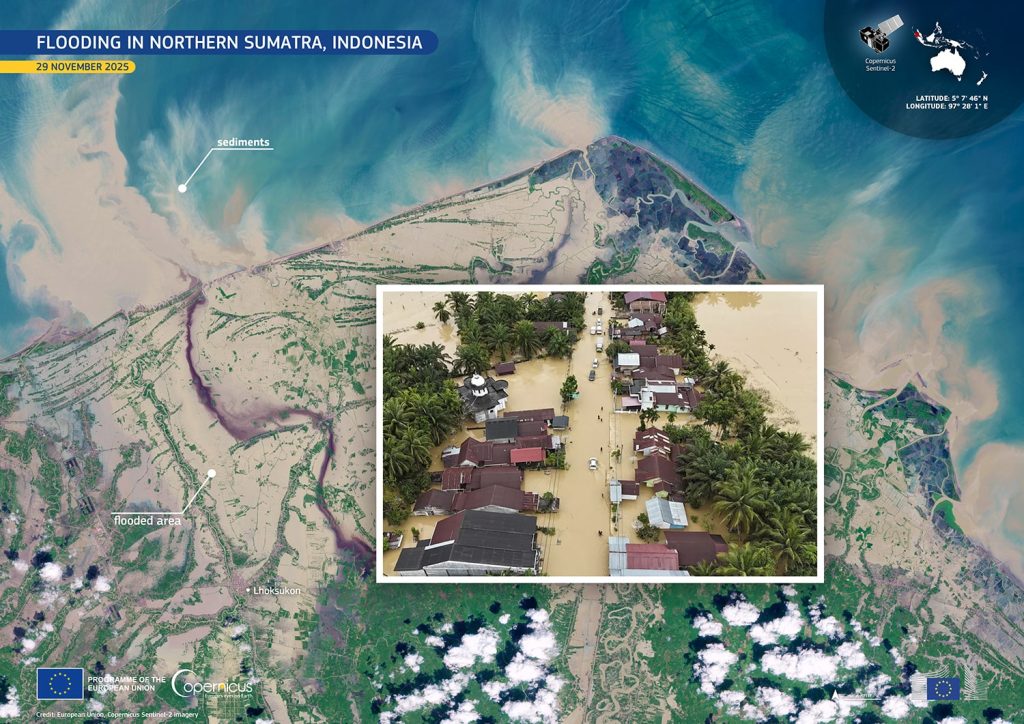
Historic Flooding Strikes Sumatra (November 2025)
In late November 2025, torrential rains from a rare tropical cyclone triggered catastrophic floods and landslides across three provinces of Sumatra (Aceh, North Sumatra, and West Sumatra)timesindonesia.co.idgreenpeace.org. Entire villages were submerged, homes and bridges were washed away, and more than 800 people lost their lives in what became Indonesia’s deadliest disaster since the 2004 tsunamireuters.comtimesindonesia.co.id. By early December, official data from Indonesia’s disaster agency (BNPB) reported at least 807 people killed, 647 missing, and 2,600 injured, with over 582,000 residents evacuated and 3.3 million people affected in Sumatra alonetimesindonesia.co.idtimesindonesia.co.id. Table 1 below provides a breakdown of the human toll by province as initially reported:
| Province | Confirmed Deaths (Dec 2) | People Missing (Dec 2) |
|---|---|---|
| Aceh | 218jatimtimes.com | 227jatimtimes.com |
| North Sumatra | 301jatimtimes.com | 163jatimtimes.com |
| West Sumatra | 193jatimtimes.com | 117jatimtimes.com |
| Total (3 provinces) | 712jatimtimes.com | 507jatimtimes.com |
Table 1: Early official casualty figures in Sumatra’s flood-hit provinces (as of Dec 2, 2025)jatimtimes.comjatimtimes.com. The death toll continued to rise in subsequent days, surpassing 800 by Dec 3timesindonesia.co.id.
Survivors describe apocalyptic scenes. “Those raindrops do not cause wood to fall,” exclaimed Reliwati Siregar, a 62-year-old resident of hardest-hit Tapanuli, as she gestured at piles of logs and debris that washed into her villagereuters.comreuters.com. She and others sheltered in makeshift camps after their homes were buried by mud and timber. While extreme rainfall from Tropical Cyclone Senyar was the immediate trigger, many Indonesians believe the disaster’s severity was man-madereuters.comtimesindonesia.co.id. “Mischievous hands cut down trees… now we’re paying the price,” Siregar said bitterly, noting how floodwaters carried huge logs downstream – clear evidence of upstream deforestationreuters.comreuters.com.
Environmental Destruction Fuels the Disaster
Experts and environmental watchdogs agree: massive deforestation and illegal logging in Sumatra’s highlands greatly amplified the floods’ impacttimesindonesia.co.idindependent.co.uk. “This is not just the result of extreme weather – it is a disaster magnified by greed,” warned Farwiza Farhan, chair of Forest, Nature & Environment of Aceh (HAkA)independent.co.uk. For decades, loggers (many operating illegally or under lax permits) have stripped Sumatra’s forests, especially in critical watershed areas like the Leuser Ecosystem in Acehindependent.co.uk. The hills have lost their “natural sponge” of tree cover that once absorbed rainfall. “When cyclone-driven downpours came, there was nothing left to absorb the water, so the floods turned into a lethal wave,” Farhan said, describing valleys choked with mud, boulders, and felled trees in Acehindependent.co.ukindependent.co.uk.
Indonesian authorities are now investigating these claims. The Attorney General’s Office has convened a task force to probe whether illegal logging or mining operations contributed to the disasterreuters.com. Indonesia’s Environment and Forestry Ministry summoned eight companies – involved in logging, mining, and oil palm plantations – after floodwaters in Sumatra were found littered with logs and debris traced to concession areasreuters.com. “The rain did cause the flood, but it’s impossible for it to sweep away this much wood,” one local official noted, pointing to indications of both legal and illicit forest clearing upstreamreuters.com. Another regional leader, Gus Irawan Pasaribu, revealed he had protested to the Ministry of Forestry about excessive forest conversion permits in North Sumatra before the disaster – but his warnings were ignoredreuters.com.
Deforestation by the Numbers
Sumatra has endured decades of forest loss driven by logging, palm oil expansion, mining, and infrastructure projects. According to Global Forest Watch data, North Sumatra province lost 1.6 million hectares of tree cover from 2001 to 2024, equivalent to 28% of its forested areareuters.com. Sumatra island as a whole saw 4.4 million hectares of forest cleared in the same period – an area larger than Switzerlandreuters.com. Environmental organizations note that only about 25–30% of Sumatra’s natural forest remains intact todaygreenpeace.orggreenpeace.org. In fact, Sumatra has suffered more deforestation than any other island in Indonesia in recent yearsreuters.com. Table 2 illustrates the scale of forest loss and remaining cover in the affected provinces:
| Region | Forest Cover Loss | Remaining Forest Cover |
|---|---|---|
| North Sumatra | 1.6 million ha lost (2001–2024)reuters.com | ~29% of area still forested (2024)timesindonesia.co.id |
| Aceh | >700,000 ha deforested since 1990timesindonesia.co.id | (Significant loss in Leuser ecosystem) |
| West Sumatra | “Hundreds of thousands” of hectares lost (2001–2024)timesindonesia.co.id | (Marked decline in tree cover) |
| Sumatra (overall) | 4.4 million ha lost (2001–2024)reuters.com | <30% of island remains forestedgreenpeace.org |
Table 2: Deforestation in Sumatra’s flood-affected regions. Loss figures from official and NGO sources underscore the weakened state of Sumatra’s watershedsreuters.comgreenpeace.org.
This environmental degradation has weakened natural defenses. Scientists explain that healthy forests anchor soil and regulate water – preventing landslides and moderating runoff. But in Sumatra’s uplands, large-scale land clearing – whether through illegal logging or permissive licensing – has left slopes bare and rivers siltedtimesindonesia.co.idtimesindonesia.co.id. When Tropical Cyclone Senyar dumped extreme rainfall on November 25–27, the denuded hills simply could not hold back the delugegreenpeace.orggreenpeace.org. Hydrology experts note that intense rains were the spark, “but the destructive impact came from the loss of forest cover” that normally acts as a natural spongetimesindonesia.co.id. In many places, landslides sent torrents of logs and mud crashing into rivers, forming natural dams that later burst and unleashed flash floods on communities belowtimesindonesia.co.id.
Indonesia’s own forestry data confirm the pattern: large portions of upstream catchments in North Sumatra, West Sumatra, and Aceh now have forest cover below 25%, far below safe levelsgreenpeace.org. One striking example is the Batang Toru watershed (South Tapanuli), where construction of a hydroelectric dam and mining concessions have fragmented one of the island’s last rainforestsreuters.comgreenpeace.org. Over 70,000 hectares in that catchment were deforested between 1990 and 2022, leaving only half the area forested and significantly increasing erosion and flood riskgreenpeace.org.
Government Response and the Debate Over “National Disaster” Status
Facing the immense scale of the calamity, many Indonesians have called on the central government to declare the Sumatra floods a National Disaster. Such a designation, under Indonesian law, would formally elevate the emergency, allowing greater mobilization of resources and even international aidtimesindonesia.co.idtimesindonesia.co.id. Parliamentarians and regional leaders argued that local governments are overwhelmed – with dozens of districts devastated and critical infrastructure destroyed – and need all the help they can gettimesindonesia.co.idtimesindonesia.co.id. “The situation is very dire… To speed up relief and recovery, the central government must set a national disaster status,” urged Abidin Fikri, Deputy Chair of the national legislature’s Commission VIII, on December 2timesindonesia.co.idtimesindonesia.co.id. This sentiment has been echoed by civil society coalitions in Aceh and environmental groups like Greenpeace, which noted that an official disaster declaration could open the door for structured international assistance and spotlight the crisis globallytimesindonesia.co.idgreenpeace.org.
However, as of early December, President Prabowo Subianto’s administration had not declared the floods a national disastertimesindonesia.co.idyoutube.com. Government officials defended the decision, claiming it was a matter of semantics rather than neglect. “The most important thing is not the status but how we handle it. The government has already given full support – personnel and funding – to the regions,” stated State Secretary Prasetyo Hadi on Dec 3timesindonesia.co.idtimesindonesia.co.id. Indeed, the central government did deploy substantial aid: military aircraft (including Hercules C-130s and an A-400 transport plane) ferried supplies to isolated areas, and agencies sent food, medicine, tents, and rubber boats to assist the hundreds of thousands displaceden.wikipedia.orgen.wikipedia.org. President Prabowo himself visited the flood zones, promising that “we’re doing everything we can to overcome this” and praising citizens’ resilience in the face of catastrophereuters.comreuters.com.
Nonetheless, the hesitation to invoke national disaster status has drawn criticism. Some observers suspect political and economic calculations at play. Declaring a national disaster can implicitly acknowledge that local capacity was overwhelmed – and by extension, that policy failures (such as environmental mismanagement) worsened the crisis. Activists point out that high-ranking officials and business elites have long been involved in Sumatra’s resource extraction industries, from logging to plantationsgreenpeace.org. “The government must admit they have been wrong in their forest and land governance… corporate greed and government mismanagement have severely depleted Sumatra’s forests, and now the people pay the price,” said Arie Rompas of Greenpeace Indonesiagreenpeace.org. He noted that some authorities have been quick to blame rogue illegal loggers, whereas in reality “massive deforestation for industry is legalized by the state, from one administration to the next”greenpeace.org. In other words, successive governments have permitted large-scale forest clearing – a fact that complicates the narrative of the disaster being purely a natural or criminal phenomenon.
Indonesia’s government insists that whether or not the term “national disaster” is used, it is addressing the emergency. Officials also argue that existing mechanisms are sufficient and that they remain “open to international aid” if needed, even without a formal status changetimesindonesia.co.idtimesindonesia.co.id. By law, the President has sole authorityto declare a national disaster, considering factors like death toll, damage, and regional capacity to respondtimesindonesia.co.idtimesindonesia.co.id. The administration indicated that, so far, it believes the combined efforts of provincial and national agencies are handling the situation, hence no presidential decree has been issuedtimesindonesia.co.idtimesindonesia.co.id. Still, the debate underscores a trust gap: communities and watchdogs are not fully convinced, given the systemic issues that led to the tragedy.
A Regional Disaster: Comparisons with Thailand and Malaysia
The Sumatra floods were part of a wider pattern of extreme weather across Southeast Asia in late 2025. In fact, Cyclone Senyar did not stop at Indonesia’s borders – it also wreaked havoc in southern Thailand and peninsular Malaysia, though with far less loss of life than in Sumatrareuters.comreuters.com. Table 3 compares the impact of this disaster across countries:
| Country | Deaths | Missing | Evacuated/Displaced | Population Affected |
|---|---|---|---|---|
| Indonesia (Sumatra) | 807+timesindonesia.co.id | 647timesindonesia.co.id | ~582,500timesindonesia.co.id | ~3.3 milliontimesindonesia.co.id |
| Thailand(South) | 176reuters.com | Not reported | Thousands (military-assisted evacuations)reuters.com | ~3.0 millionreuters.com |
| Malaysia(Peninsula) | 3reuters.com | 0 | ~34,000en.wikipedia.orgen.wikipedia.org | Tens of thousands |
Table 3: Impact of the late-November 2025 cyclone-induced floods by country. (Indonesia figures as of Dec 3; Thailand and Malaysia figures as of Dec 1)reuters.comtimesindonesia.co.id.
In Thailand, heavy monsoon rains intensified by Cyclone Senyar caused severe flooding across 8 southern provinces, affecting about 3 million people and forcing a major military mobilization for rescuesreuters.com. At least 176 people were killed in Thailandreuters.com, with the worst devastation in Songkhla province where flash floods claimed 138 livesreuters.com. Parts of the regional hub Hat Yai were inundated under 2 meters of water after receiving 335 mm of rain in a single day – the city’s highest one-day rainfall in 300 yearsreuters.com. The Thai government declared disaster zones and by early December had restored most utilities in affected areasreuters.com. Even so, Bangkok’s response came under criticism domestically; the floods dented public confidence in Prime Minister Anutin Charnvirakul’s administration due to perceptions of a slow initial reactionreuters.com. (Anutin has defended his government, stating “I am only thinking about how to help the people” amid plans for recoveryreuters.com.)
In Malaysia, the same storm system brought torrential rains to peninsular states like Kelantan and Terengganu. The impact there, while significant, was far more contained: three deaths were reportedreuters.com, but over 34,000 peoplewere evacuated as rivers overfloweden.wikipedia.orgen.wikipedia.org. By the first week of December, about 11,600 Malaysians remained in evacuation centers as authorities stayed on alert for potential second and third waves of floodingreuters.com. The Malaysian government’s disaster agency coordinated relief, and the relatively low casualty count has been partly attributed to effective early warnings and the country’s long experience with annual monsoon floods. However, like Indonesia, Malaysia also faces questions about how land-use practices (such as deforestation or unchecked development in floodplains) might be worsening its flood risks in the long term.
Climate Crisis and Accountability – Lessons for Southeast Asia
Climate scientists warn that the series of disasters in late 2025 may be a grim preview of a “new normal” in Southeast Asiaindependent.co.uk. Unusually warm ocean temperatures in the Indian Ocean and Pacific that month fueled back-to-back cyclonic storms – Typhoon Koto in the Philippines/Vietnam, Cyclone Senyar in the Malacca Strait, and Cyclone Ditwah in the Bay of Bengal – all within a span of two weeksindependent.co.ukindependent.co.uk. Such clustering of storms is highly atypical, and it overwhelmed communities from Sri Lanka to Thailand. Regional meteorologists observed that seas around Indonesia and Thailand were “warmer than normal, 29–30°C”, creating energy for storms to rapidly intensifyindependent.co.uk. This resulted in record-breaking rains and widespread floods.
Yet, as stark as the role of climate change is, the catastrophe in Sumatra highlights that human actions can make the difference between a heavy storm and a full-blown humanitarian disaster. Indonesia’s floods were vastly more lethal than those in neighboring countries, despite experiencing the same cyclone. Environmental analysts note that Sumatra’s ecosystems had been weakened by years of unsustainable practices: clearing forests, expanding plantations into peatlands, and loosening environmental regulations. A 2020 deregulation (the controversial “Omnibus Law”) and other policies enabled faster licensing of land exploitation – moves which critics say prioritized economic growth over environmental protection, further eroding natural buffersnu.or.idnu.or.id. In short, the root causes of this tragedy were long in the making.
There is now growing public pressure in Indonesia for accountability and change. Police and prosecutors are exploring criminal charges if negligence or illicit activities are proven to have exacerbated the floodsidntimes.com. At the same time, voices from academia, NGOs, and even religious organizations are urging the government to fundamentally rethink its approach to land management. “The state must choose: restore our forests, or continue facilitating destruction that endangers millions,” an editorial by an Indonesian civil society group argued pointedlynu.or.id. This catastrophe has underscored that disaster mitigation is not just about emergency response – it begins with proper stewardship of the environment and enforcement of laws before tragedy strikes.
Conclusions: “Never Again” Requires Reform
As Sumatra digs out from layers of mud and wreckage, the focus is turning to preventing the next disaster. Communities and activists are calling for a moratorium on further deforestation in critical watersheds, stricter enforcement against illegal logging, and re-evaluation of permits for mines and plantations in sensitive areas. The Prabowo administration faces a pivotal test: whether it will heed this wake-up call. Greenpeace Indonesia urged that the floods “should be the final warning… to totally overhaul [Indonesia’s] forest governance, environmental and climate policies”greenpeace.org. They and others emphasize that strengthening environmental protections is not a luxury but a necessity in an era of intensifying climate extremes.
In broader Southeast Asia, the 2025 floods have been a shared trauma and a shared warning. Countries in the region are increasingly recognizing that climate resilience must go hand-in-hand with combating corruption and unsustainable exploitation of natural resources. Reforestation, proper urban planning, and disaster preparedness will be key. As the Independent noted in its analysis, without serious investment in resilience – from restoring forests to enforcing land-use rules – such catastrophic events may “become regular rather than rare” in the futureindependent.co.ukindependent.co.uk.
For the survivors in Sumatra, the hope is that this disaster’s legacy will be more than just heartbreak and rebuilding. It must also be a catalyst for change. The muddy car wrecks and uprooted trees strewn across the island are a visceral reminder that nature’s fury, amplified by human folly, can exact an unbearable cost. Ensuring that cost is not paid again will require honesty about the causes and bold action to address them – from Jakarta to every provincial capital in Indonesia. In the words of one Indonesian villager picking through the flood debris: “We have nothing left, but we have to start over”reuters.com. Starting over, many argue, should also mean doing things differently – valuing forests as life-saving infrastructure, holding those who destroy them accountable, and treating such warnings with the urgency they deserve.


