

The world of business has changed dramatically over the past decade. If you’re running a small or medium enterprise—what Indonesians call UMKM—you’ve probably felt the pressure mounting. The market is moving faster than ever before. Customers are shopping differently. Competitors are popping up from places you’ve never even heard of. And everywhere you look, there’s another headline about “going digital” or “embracing technology.”
It can feel overwhelming, honestly. But here’s the thing: while digitalization brings challenges, it also opens doors that were previously locked tight for small businesses. You no longer need a massive budget or a corporate headquarters to reach customers across the country—or even around the world. The playing field has been leveled in ways that would have seemed impossible just twenty years ago.
This article isn’t about abstract theories or buzzwords. It’s about real strategies, backed by actual data, that small and medium enterprises can use not just to survive in this digital age, but to genuinely thrive. Let’s dive in.
Why Digitalization Matters for SMEs—And Why It’s Not Just Hype
Before we get into the “how,” let’s talk about the “why.” Because understanding why digitalization matters will help you make smarter decisions about where to invest your limited time and resources.
SMEs form the backbone of Indonesia’s economy—and honestly, of most economies worldwide. The numbers are staggering when you really look at them:
| Indicator | Value / Share |
|---|---|
| Proportion of economy represented by SMEs in Indonesia | ~ 61.07% of national GDP (medcom.id) |
| Share of total workforce employed by SMEs in Indonesia | ~ 97% of workforce (Antara Megapolitan) |
| Number of SMEs in Indonesia (approximate) | ~ 64–66 million units (micro, small, medium) (Antara Megapolitan) |
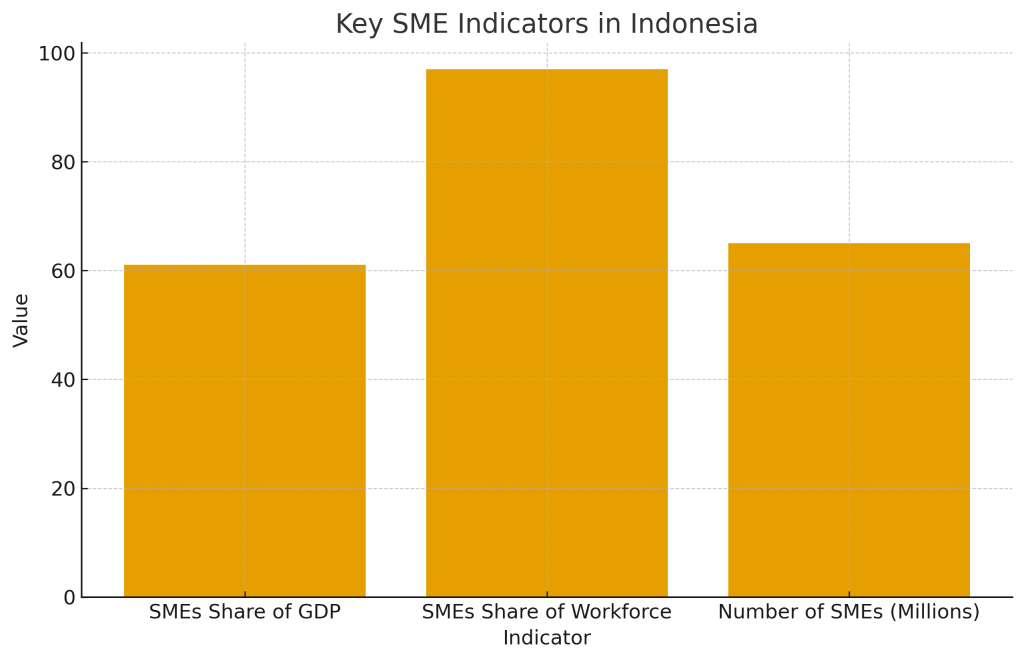
Think about that for a moment. Nearly two-thirds of Indonesia’s entire economic output comes from small and medium businesses. Almost every working person in the country is connected to an SME in some way. This isn’t just about individual businesses anymore—when SMEs succeed or fail, it ripples through entire communities, regions, and ultimately the nation.
So what does digitalization actually give you? It’s not magic, but it is transformative:
Broader market reach: Remember when your customer base was limited to whoever could physically walk or drive to your shop? Those days are gone. Online platforms let you reach customers in other cities, other provinces, even other countries. A craftsperson in a small town in Central Java can now sell directly to buyers in Jakarta, Singapore, or San Francisco. That’s not theoretical—it’s happening every day.
Cost-efficient marketing and operations: Traditional advertising was expensive. Running ads in newspapers, printing flyers, renting billboards—it all added up fast. Digital marketing, when done right, costs a fraction of that. You can reach thousands of potential customers through social media posts that cost you nothing but time. Transaction processes become faster, reducing the hours you spend on paperwork and manual bookkeeping. Digital tools often pay for themselves quickly through these efficiency gains.
Increased competitiveness: Here’s the reality—you’re not just competing with the shop down the street anymore. Your customers can buy similar products from anyone, anywhere. But that sword cuts both ways. Digital presence means you can compete too, even against much larger companies. A small business with great products, smart digital strategy, and authentic engagement can win customers away from faceless corporations.
The challenge? Digital adoption among SMEs is still uneven. Some businesses have embraced it fully. Others are just getting started. And many haven’t started at all. This gap creates both risk and opportunity—if you can navigate digitalization effectively, you gain a real competitive advantage.
The State of Digital Adoption among SMEs—A Reality Check
Let’s be honest about where things actually stand. The narrative around digitalization often swings between two extremes: either “everyone’s already digital and you’re being left behind” or “digital doesn’t really matter for small traditional businesses.” The truth, as usual, is more nuanced.
Digitalization Progress & Penetration
The data paints an interesting picture:
| Year / Source | Metric / Finding |
|---|---|
| Mid-2024 (Indonesia) | ~ 25.5 million SMEs reported as “go digital” — representing roughly 39.7% of total SMEs (~64.2 million) (Antara News) |
| 2025 (survey report) | Approx. 63% of Indonesian MSMEs reportedly use digital tools for business operations (e.g. marketing, e-commerce, payments) (marketresearchindonesia.com) |
| 2024–2025 (education/literacy survey) | Digital literacy among SMEs measured at ~38.7% (improved from ~34% previously) |
What does this tell us? First, there’s been real acceleration. The percentage of SMEs using digital tools has jumped significantly in just a few years. If you’re thinking “everyone else has already figured this out and I’m too late,” you’re wrong. We’re still in the relatively early stages of this transformation.
Second, there’s a big difference between “using digital tools” and actually being digitally literate. About 63% of SMEs use some digital tools, but only 39% have meaningful digital literacy. That gap is important. It means many businesses have adopted technology without fully understanding how to leverage it effectively. They might have a social media account that rarely gets updated, or a marketplace listing with poor product photos and descriptions. They’re technically “digital” but not really getting the benefits.
This is actually good news if you’re willing to invest in learning. The bar isn’t impossibly high—you don’t need to be a tech genius. You just need to be thoughtful and consistent in how you use digital tools.
Challenges in Digital Transition—The Real Obstacles
Now let’s talk about what actually holds SMEs back, because understanding these barriers helps you plan around them:
Low digital literacy: This is the big one. Many SME owners and employees simply haven’t had the opportunity to develop digital skills. They might know how to use Facebook personally but have no idea how to use it effectively for business. They’ve heard of e-commerce platforms but find the setup process confusing and intimidating. This isn’t about intelligence—it’s about access to knowledge and training.
Unequal access to infrastructure: If you’re in a major city, you probably take reliable internet for granted. But in many smaller towns and rural areas, internet connectivity is still spotty. Connections drop during crucial moments. Upload speeds are painfully slow. This creates a real disadvantage for SMEs outside urban centers, even when they have the skills and desire to go digital.
Dependence and over-reliance on platforms: This one sneaks up on businesses. You start selling on one marketplace because it’s easy and has lots of traffic. Soon, 80% or 90% of your sales come from that single platform. Then the platform changes its fee structure, or its algorithm buries your products, or your account gets suspended for some unclear reason. Suddenly, you’re at the mercy of a company that doesn’t really care about your individual business. Platform dependence is a serious strategic risk.
Resource constraints: Let’s be real—small businesses run on tight margins. Every dollar spent on digital tools is a dollar not spent on inventory, equipment, or hiring help. Many SME owners are already working 12-hour days and can’t imagine where they’d find time to learn new skills or manage another sales channel. These constraints are legitimate, and any digital strategy needs to acknowledge them rather than pretending they don’t exist.
These challenges aren’t insurmountable, but they do require honest planning and realistic expectations. Digitalization is a journey, not a destination you reach overnight.
Data-Driven Strategies for SMEs to Survive Digital Competition
Alright, enough context. Let’s get into the concrete strategies that actually work. These aren’t based on guesswork—they’re drawn from data, research, and the experiences of thousands of SMEs that have successfully navigated digital transformation.
1. Build an Online Presence—Website, Marketplace & Social Media
If people can’t find you online, you basically don’t exist to a huge portion of potential customers. That sounds harsh, but it’s true. When someone hears about a product or service, their first instinct is to search for it online. If you’re not there, they’ll find your competitor instead.
The good news? Getting online doesn’t require a huge investment. You have options:
- Social media accounts: Free to create and can be incredibly powerful if used consistently. Instagram and Facebook work well for visual products. TikTok has become surprisingly effective for businesses willing to embrace video content.
- Marketplace listings: Platforms like Tokopedia, Shopee, or Bukalapak in Indonesia (or regional equivalents elsewhere) already have massive customer bases. You’re paying a commission on sales, but you’re also tapping into their traffic and trust.
- Your own website: This gives you the most control and builds your own brand equity. It doesn’t need to be fancy—a simple site with clear product information, prices, and contact details is infinitely better than nothing.
Many successful SMEs use a combination of all three. They have social media for engagement and awareness, marketplace listings for easy transactions, and a simple website as their “home base” that they control.
The key insight from the data is this: for many Indonesian SMEs, joining platforms and creating digital presence was the primary way they “went digital.” It’s not complicated or expensive—it’s just a matter of actually doing it and maintaining it consistently.
2. Adopt Digital Payments & Digital Transaction Tools
Cash might still be king in some contexts, but it’s rapidly losing its crown. Digital payment capabilities—whether that’s online transfers, e-wallet integration, or QR-based systems—do several important things:
They reduce friction: Customers don’t need to have exact change. They can pay from anywhere at any time. The easier you make it to pay you, the more likely people are to complete the purchase.
They build trust: Professional payment systems signal that you’re a legitimate, serious business. They also provide automatic receipts and records, which customers appreciate.
They improve cash flow: Money arrives faster than with checks or invoices. Your bank account updates automatically. You spend less time handling physical cash and running to the bank.
They provide automatic records: Every transaction is logged digitally, making bookkeeping dramatically easier and more accurate.
Studies from various markets have shown that SMEs adopting digital payments often see business growth as a direct result. It’s not that the payment method itself generates sales—it’s that it removes barriers and creates a smoother customer experience.
Start simple if this feels overwhelming. Many SMEs begin by just adding one or two e-wallet options like GoPay or OVO. You can expand from there as you get comfortable.
3. Improve Digital Literacy & Skills—Invest in Learning
Here’s a truth that’s sometimes uncomfortable: having digital tools available doesn’t help if you don’t know how to use them effectively. A social media account that posts once a month with blurry photos isn’t going to drive business. An e-commerce listing with a generic description copied from the manufacturer won’t stand out.
Digital literacy isn’t about becoming a programmer or tech expert. It’s about understanding:
- How to take appealing product photos with just your smartphone
- How to write product descriptions that actually sell
- How to respond to customer inquiries quickly and professionally
- How to use basic analytics to understand what’s working and what isn’t
- How to run simple ad campaigns on social media
- How to use spreadsheets or basic software for inventory and bookkeeping
The data shows that low digital literacy remains one of the biggest barriers for SMEs, even as more businesses adopt digital tools. This creates an opportunity—businesses that invest in learning, even just a few hours a week, gain a significant advantage.
Look for free resources first. YouTube has countless tutorials. Many platforms offer their own training materials. Local business associations sometimes provide workshops. Government programs occasionally offer subsidized training. And if you can’t attend formal training, partner with someone who knows digital—maybe a younger family member, an employee, or even a friend willing to trade skills.
Think of digital skill development as an investment with compound returns. Every skill you learn this month makes you more effective next month. The SME owner who commits to learning something new each week will be dramatically more capable in a year than they are today.
4. Leverage Data and Analytics—Let Numbers Guide Decisions
One of the most powerful advantages of digital business is that almost everything can be measured. And what gets measured can be improved.
Traditional retail was often based on intuition and rough estimates. You had a sense of which products were popular, which times were busy, what customers seemed to like. But it was fuzzy.
Digital tools give you clarity:
- Which products are actually selling best? Not which ones you think should sell best, but which ones customers are actually buying.
- Where are customers dropping off? Are they viewing products but not purchasing? Adding to cart but not completing checkout?
- What time of day or day of week sees the most activity?
- Which marketing efforts are actually driving sales versus just making you feel busy?
- How much inventory do you actually need based on real sales patterns rather than guesses?
You don’t need fancy expensive analytics software. Most e-commerce platforms include basic analytics for free. Social media platforms show you which posts got the most engagement. Even a simple spreadsheet where you track daily sales can reveal patterns you’d never notice otherwise.
The smartest SMEs check their numbers regularly—maybe weekly or even daily for key metrics. They ask questions: “Why did sales spike on Tuesday?” “Why did that particular post perform so well?” “Why is this product not moving?” Then they adjust based on what the data tells them.
This isn’t about being a data scientist. It’s about being curious and letting actual evidence guide your decisions rather than assumptions. The data from various studies shows a growing number of SMEs now use data-driven decision-making, and they tend to be more adaptive and efficient as a result.
5. Unique Value Proposition & Customer Engagement—Stand Out from the Crowd
Here’s where digital competition gets interesting. Yes, you’re competing with more businesses than ever before. But you also have more opportunity to differentiate yourself and connect with customers who specifically value what makes you special.
When everyone is selling similar products on similar platforms, what makes someone choose you? Usually, it’s one or more of these factors:
Unique or specialized products: Maybe you offer customization that mass producers can’t match. Maybe you use traditional techniques or local materials that have their own story. Maybe your product serves a specific niche that bigger companies ignore.
Local authenticity and story: People increasingly value knowing where products come from and who makes them. Your local identity, your personal story, your connection to traditional craftsmanship or sustainable practices—these aren’t weaknesses in a digital world. They’re strengths. Large corporations struggle to create genuine personal connections. You don’t.
Exceptional service and engagement: How quickly do you respond to questions? How friendly and helpful are your interactions? Do you remember repeat customers? Do you go the extra mile to ensure satisfaction? In an age of automated responses and impersonal service, genuine human engagement stands out dramatically.
Transparency and honesty: Being upfront about your capabilities, honest about limitations, and transparent about your process builds trust faster than any marketing claim.
The data suggests this matters more than ever. When Indonesian SMEs were asked what helped them compete against larger companies and foreign products, unique value propositions and local authenticity consistently ranked high. Customers are often willing to pay a bit more or wait a bit longer for products that feel personal, meaningful, and authentic.
Use your digital presence to tell your story. Share behind-the-scenes glimpses of how products are made. Introduce the people who work with you. Explain why you chose to focus on this particular product or service. Engage genuinely with comments and questions rather than just broadcasting sales messages.
The irony is that digital tools work best when used to create very human connections.
6. Combine Online & Offline (Omnichannel)—Don’t Put All Eggs in One Basket
There’s sometimes an assumption that “going digital” means abandoning physical presence entirely. That’s rarely the best approach, especially for SMEs.
An omnichannel strategy—combining online and offline presence—offers several advantages:
Reach different customer preferences: Some customers love online shopping. Others strongly prefer seeing and touching products before buying. Why not serve both groups?
Reduce platform dependency risk: If your online marketplace changes its terms or experiences technical issues, you still have other channels operating. If foot traffic is slow at your physical location, online sales can compensate.
Create convenient options: Customers can browse online and pick up in person. Or see products in your physical store and order different colors or sizes online. Flexibility enhances customer experience.
Build stronger local presence while expanding reach: Your physical location builds community relationships and local brand awareness. Your online presence extends beyond geographic limitations.
Several analyses have noted that SMEs which rely too heavily on single platforms face serious risks. The algorithm changes. The fees increase. Competitors flood in. Having multiple channels—including both digital and physical—creates resilience.
Think of it as diversification. You wouldn’t invest all your money in one stock, so why build your entire business on one platform or channel?
Real-World Scenario: How This Plays Out in Practice
Let’s walk through a realistic example to see how these strategies come together:
Meet Siti, who runs a small batik workshop in a town outside Yogyakarta.
Initially, Siti sells her batik products only from a small shop on a local street. She has regular customers who appreciate her craftsmanship, but growth is limited. She can only reach people who happen to walk by or hear about her through word of mouth.
Then Siti decides to go digital, step by step:
Month 1-2: She creates an Instagram account and starts posting photos of her batik pieces. She learns about good lighting and angles by watching YouTube tutorials. She writes captions explaining the traditional motifs and techniques. She posts 3-4 times per week consistently.
Month 3: She sets up accounts on Tokopedia and Shopee. She carefully photographs her best pieces, writes detailed descriptions, and prices competitively but fairly. She enables digital payment options including e-wallets and bank transfers.
Month 4-6: She learns to respond quickly to customer inquiries—usually within a few hours. She starts noticing patterns: certain motifs sell better, weekends see more traffic, customers often ask about customization. She keeps notes on all this.
Month 7: She creates a simple website using a free platform. It’s basic but professional—showing her story, her process, contact information, and links to her marketplace stores. She includes it in her Instagram bio.
Month 8 onwards: She starts using the analytics in her marketplace accounts and Instagram. She notices her posts featuring the batik-making process get more engagement than simple product shots. She sees that her custom-designed batik gets premium prices. She tracks which products sell quickly and which sit unsold.
What happens over the first year:
- Her Instagram following grows to several thousand, including people from Jakarta, Bali, even international followers interested in Indonesian crafts
- She makes sales through marketplaces from customers in cities she’s never visited
- Her digital payment setup means transactions are smoother and faster—no more waiting for bank transfers to clear or dealing with incorrect change
- Her bookkeeping becomes easier because all digital transactions are automatically recorded
- She discovers a niche: younger customers who want modern batik designs but appreciate traditional techniques. She starts creating fusion pieces specifically for this market
- She differentiates herself by sharing her story—three generations of batik makers in her family, sustainable natural dyes, each piece taking days to complete
- She keeps her physical shop because locals still prefer to see the batik in person, and it serves as a workspace where she sometimes posts “live” videos of the creation process
The results after one year:
- Revenue increased by roughly 60-70% compared to pre-digital levels
- Customer base expanded from primarily local to nationwide, with a few international orders
- Marketing costs stayed low—mostly just time for social media, no expensive advertising
- She hired one assistant to help with production and shipping, creating a job in her community
- She still faces challenges (competition, platform fees, occasional shipping issues) but feels more resilient because she has multiple revenue streams
- She maintains both online and offline presence, reducing dependency on any single channel
This scenario aligns with what the data shows: SMEs that thoughtfully adopt digital tools, invest in learning, and stay authentic tend to see meaningful improvements in reach, efficiency, and resilience—even in challenging economic conditions.
What SMEs Should Watch Out For—Real Risks and How to Mitigate Them
Digital transformation isn’t all sunshine and success stories. There are legitimate risks and potential pitfalls. Being aware of them helps you avoid or minimize problems:
Risk 1: Overreliance on a Single Platform
The problem: You build your entire business on one marketplace or social media platform. Then they change their algorithm, increase fees, or suspend your account, and suddenly your income drops by 70%.
The mitigation: Diversify deliberately. Use multiple platforms. Build an email list of customers you can contact directly. Create your own website even if it’s simple. Think of platforms as valuable channels but not the foundation of your business. Your brand, your customer relationships, your reputation—those are the foundation.
Risk 2: Low Digital Literacy and Support
The problem: You adopt digital tools without really understanding them. You use maybe 10% of their capabilities. You make preventable mistakes. You get frustrated and give up.
The mitigation: Treat learning as part of the business, not separate from it. Schedule time each week specifically for developing digital skills. Find mentors—maybe other SME owners slightly ahead of you on the digital journey. Join online communities where people share tips and troubleshoot problems together. Consider hiring or partnering with someone digitally savvy, even part-time.
Risk 3: Infrastructure Limitations
The problem: You try to run a sophisticated online business but your internet connection is unreliable. Or shipping services in your area are limited and expensive. Or digital payment systems don’t work smoothly in your region.
The mitigation: Work within your constraints while advocating for improvements. Choose offline-online hybrid models if infrastructure is weak. Use offline preparation—write social media posts and prepare materials when connection is good, then post them during stable periods. Connect with other local SMEs to collectively advocate for better infrastructure. Consider whether certain business models are realistic in your current context.
Risk 4: Sacrificing Quality or Authenticity for Scale
The problem: Digital tools make it easier to scale, and you get tempted to grow too fast. Quality slips. The personal touch that made you special disappears. You become just another generic seller.
The mitigation: Be intentional about what you’re willing to scale and what needs to stay hand-crafted or personal. Maintain quality standards even as you grow. Remember that sustainable growth is better than rapid growth that collapses. Use digital tools to enhance your authentic strengths, not replace them.
Risk 5: Privacy and Security Concerns
The problem: You’re collecting customer data, processing payments, storing information—and you’re not sure how to keep it secure. Or you accidentally violate customer privacy.
The mitigation: Use reputable, established platforms that handle security for you when possible. Learn basic digital security practices—strong passwords, two-factor authentication, secure wifi connections. Be transparent with customers about how you handle their information. If you’re handling sensitive data, invest in proper security or work with services that provide it.
Risk 6: Burnout from Always Being “On”
The problem: Digital business can feel like it never stops. Messages come in at midnight. Customers expect instant responses. You check your phone every few minutes. The boundary between work and personal life dissolves.
The mitigation: Set clear boundaries and communicate them. Establish business hours for responses even if you’re online. Use auto-responders to set expectations (“Messages received outside business hours will be answered the next day”). Schedule specific times to check and respond to messages rather than being reactive all day. Remember that sustainable business requires sustainable practices—burning out helps no one.
Looking Ahead: The Future of SMEs in the Digital Economy
Where is all this heading? While we can’t predict the future with certainty, some trends are becoming clear:
Continued platform evolution: New platforms will emerge. Existing ones will change. SMEs that stay adaptable and willing to experiment with new channels will have advantages over those that resist change.
Increasing importance of video: Short-form video content is becoming dominant across platforms. SMEs that learn to create simple, authentic video content will likely reach more customers than those relying only on static images and text.
Growing consumer interest in authenticity and sustainability: Mass-produced, impersonal products are losing appeal for many consumers. SMEs with genuine stories, sustainable practices, and personal connection have growing market opportunity.
AI and automation becoming accessible: Tools that were once available only to large corporations—customer service chatbots, automated inventory management, personalized marketing—are becoming available to small businesses at affordable prices. SMEs that thoughtfully adopt these tools will gain efficiency advantages.
Community and niche markets strengthening: While globalization continues, there’s also a countertrend toward supporting local businesses and niche products. Digital tools help SMEs find and serve these specific communities, wherever they are.
Continued infrastructure improvement: Internet access will expand and improve, even in currently underserved areas. This will gradually reduce one of the major barriers facing SMEs outside urban centers.
The key is to view digitalization not as a one-time transformation but as an ongoing journey. The SMEs that thrive will be those that commit to continuous learning, stay true to what makes them unique, and adapt thoughtfully to new opportunities and challenges.
Conclusion—Digital Is Not Optional, It’s Essential (But You Can Start Small)
If there’s one message to take from all this data, research, and analysis, it’s this: digitalization is no longer optional for SMEs that want to remain competitive and relevant. The world has changed. Customer behaviors have changed. Competition has changed.
But—and this is equally important—you don’t have to do everything at once. You don’t need to become a tech expert overnight. You don’t need massive investment or perfect knowledge before you start.
What you need is:
- A willingness to begin: Start somewhere, even if it’s small. One social media platform. One marketplace listing. One digital payment option. The hardest part is usually just starting.
- Commitment to learning: Treat digital literacy as an ongoing investment in your business. A little learning, consistently over time, compounds into significant capability.
- Focus on your strengths: Use digital tools to amplify what makes you special—your craftsmanship, your local knowledge, your customer relationships, your unique products. Don’t try to become something you’re not.
- Patience and persistence: Digital success rarely happens overnight. It’s built through consistent effort, learning from mistakes, and gradual improvement.
- Strategic thinking: Don’t just adopt tools because everyone else is. Think about which tools actually serve your specific business needs and customer base.
For SMEs in Indonesia and around the world, the path forward involves embracing digital—not as a trend to jump on, but as fundamental infrastructure for modern business. Build your online presence thoughtfully. Adopt digital payments to smooth transactions. Invest in learning and literacy. Use data to make smarter decisions. Tell your authentic story and engage genuinely with customers. Combine online and offline presence for resilience.
With the right strategy—adapted to your specific context, capabilities, and goals—you can turn digital competition from a threat into an opportunity. The small businesses that survive and thrive in coming years won’t necessarily be the biggest or best-funded. They’ll be the ones that adapt intelligently, learn continuously, and use digital tools to enhance rather than replace their human strengths.
The digital age rewards authenticity, adaptability, and genuine connection. As an SME, those are advantages you already have. Now it’s about leveraging them through the right tools and strategies.
The time to start is now. Not someday when you feel fully ready (you never will), not when you have more resources (there’s always a constraint), but now—with what you have, where you are. Begin small, learn constantly, and build from there.
Your business, your community, and your customers will all benefit from the journey.
Resources / References
- KemenKop UKM – “25,5 million UMKM have gone digital” (2024) Antara News+1
- “Transformasi UMKM melalui digitalisasi” — UMKM Indonesia (2025) UMKM Indonesia+1
- “Simak 6 Tantangan UMKM di Era Digital dan Cara Mengatasinya” — Kompas (2024) KOMPAS.com
- “Indonesia Digital SME Adoption Is Accelerating” — MarketResearchIndonesia (2025) marketresearchindonesia.com
- “The digital pathway to growth for MSMEs” — BusinessToday (global context) Business Today+1
- “BRIN Soroti Rendahnya Adopsi Teknologi Digital oleh UMKM Indonesia” — Medcom (2025) medcom.id