


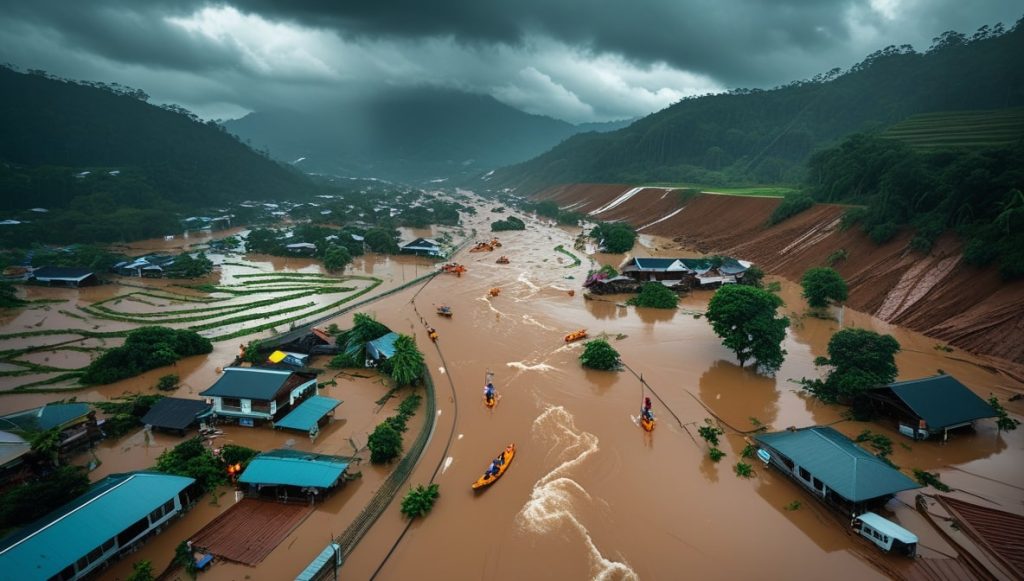
Introduction: A Disaster Foretold
The last week of November 2025 will be etched in Indonesia’s collective memory as one of its darkest chapters. As families prepared for year-end celebrations and farmers anticipated the harvest season, nature unleashed its fury upon Sumatra—an island that has witnessed countless monsoons but had never seen devastation quite like this.
The catastrophe began quietly, as most do, with meteorologists noting unusually heavy rainfall patterns. But within days, what started as seasonal rains transformed into a nightmare of biblical proportions. Rivers that had nourished communities for generations became instruments of destruction. Hillsides that had stood for millennia collapsed like sandcastles. And in the span of less than a week, more than 300 lives were lost, nearly 300 people vanished without a trace, and tens of thousands were forced to flee their homes.
This wasn’t just another natural disaster to be catalogued and forgotten. This was a wake-up call—a brutal reminder that when human ambition collides with environmental limits, nature always has the final word.
The Storm Gathers: Timeline of a Catastrophe
November 24, 2025: The First Warnings
The Indonesian Meteorology, Climatology, and Geophysical Agency (BMKG) issued heavy rainfall warnings for northern and western Sumatra. Local officials, accustomed to seasonal monsoon alerts, prepared standard response protocols. Few could have anticipated what was coming.
November 25-26: The Deluge Begins
Rain fell with an intensity that older residents claimed they’d never witnessed. In some areas, daily rainfall exceeded monthly averages within 24 hours. Rivers swelled rapidly, their muddy waters carrying uprooted trees, debris, and the remnants of upstream communities.
The tropical storm system—later designated as Cyclone Senyar, which had evolved from a tropical disturbance known as INVEST 95B—made its approach, drawing moisture from the Indian Ocean and dumping it onto already saturated terrain.
November 27-28: Breaking Point
This was when the earth gave way. In North Sumatra’s mountainous regions, slopes that had been destabilized by years of deforestation and recent heavy rains simply collapsed. Entire hillsides transformed into rivers of mud, sweeping away everything in their path—homes, vehicles, livestock, and human beings.
In the lowlands, rivers burst their banks with explosive force. The Deli River, Asahan River, and countless smaller waterways became raging torrents that recognized no boundaries. Floodwaters surged through residential neighborhoods at heights reaching 3-4 meters in some areas, turning streets into deadly rapids.
Communication networks began failing. Roads and bridges—the lifelines connecting remote villages to emergency services—crumbled or were swept away. Rescue teams found themselves racing against time and terrain, often unable to reach those who needed help most desperately.
November 29-30: The Grim Accounting
As the rains finally began to subside, the true scale of the catastrophe emerged. Search and rescue teams, hampered by damaged infrastructure and lingering flood conditions, began the heartbreaking work of recovering bodies and searching for survivors.
The numbers told a story of unimaginable loss: over 300 confirmed dead, nearly 300 missing, and approximately 80,000 people displaced from their homes. But behind each statistic was a human story—families torn apart, children orphaned, livelihoods destroyed.
Geographic Scope: A Multi-Province Disaster
North Sumatra: The Epicenter of Tragedy
North Sumatra bore the brunt of nature’s assault, recording at least 116 fatalities and 42 missing persons by November 28. The province’s unique geography—a mix of coastal plains, river valleys, and steep mountain terrain—created the perfect conditions for disaster.
Districts like Deli Serdang, Karo, and Langkat were particularly devastated. In some villages, entire neighborhoods simply disappeared under mud and water. The city of Medan, North Sumatra’s capital and Indonesia’s third-largest city, found itself partially paralyzed as floodwaters inundated major thoroughfares and knocked out power to thousands of residents.
What made rescue efforts especially challenging here was the province’s mountainous interior, where landslides had cut off access to numerous remote villages. Helicopter rescue operations became essential, but weather conditions often made flying impossible. Ground teams attempting to reach stranded communities found roads blocked by debris or simply washed away entirely.
Aceh: When History Repeats
For Aceh province, the floods were a painful reminder of past traumas. This region, which suffered catastrophic losses in the 2004 Indian Ocean tsunami, found itself once again facing nature’s destructive power. Approximately 35 people lost their lives as floods swept through both coastal and inland areas.
The disaster affected numerous regencies, including Aceh Tamiang, South Aceh, and Southeast Aceh. What struck observers was the speed at which normally placid rivers transformed into killers. Villagers reported having mere minutes to escape as flash floods roared through their communities.
In some areas, the combination of tidal flooding and riverine floods created a devastating pincer effect, leaving communities with nowhere to flee.
West Sumatra: Cultural Heritage Under Water
West Sumatra, home to the proud Minangkabau people and their distinctive traditional architecture, reported at least 23 deaths and extensive property damage. The province’s picturesque valleys and terraced hillsides—tourist attractions under normal circumstances—became deadly traps.
Cities like Padang, Bukittinggi, and Payakumbuh experienced severe flooding. The iconic Anai Valley, famous for its waterfalls and scenic beauty, witnessed destructive floods that older residents compared to the legendary “galodo” disasters of the colonial era.
Perhaps most heartbreaking was the damage to cultural heritage sites. Traditional Minangkabau houses (rumah gadang), some centuries old, were damaged or destroyed. Rice terraces that represented generations of agricultural knowledge were swept away, their terracing systems obliterated.
The Human Toll: Beyond Statistics
The Missing: Families in Limbo
Perhaps no aspect of the disaster is more agonizing than the nearly 300 people still listed as missing. For their families, the uncertainty is unbearable—caught between hope and despair, unable to grieve properly or move forward.
Search teams continue their grim work, but the reality is stark: many of those swept away by landslides or carried downstream by floodwaters may never be found. The terrain is simply too vast, the rivers too powerful, and the destruction too complete.
The Displaced: Losing Everything
For the estimated 80,000 people evacuated from disaster zones, survival came at a terrible cost. Many fled with nothing but the clothes on their backs, watching from high ground as their homes were swallowed by muddy water.
Evacuation centers—schools, mosques, government buildings—quickly became overcrowded. Families slept on floors, supplies ran short, and the psychological trauma of what they’d witnessed began to manifest. Children cried for toys swept away by floods. Adults struggled with the reality that entire lifetimes of accumulation—photos, heirlooms, documents—had vanished in hours.
Economic Devastation: Livelihoods Destroyed
The disaster’s economic impact extends far beyond immediate property damage. Sumatra’s economy depends heavily on agriculture, and thousands of hectares of rice paddies, palm oil plantations, and rubber estates were destroyed.
For subsistence farmers—already operating on thin margins—the loss of crops meant not just immediate hunger but the destruction of seed stock needed for replanting. Many faced the prospect of months or years before they could return to productivity.
Infrastructure damage compounded the economic crisis. With roads and bridges destroyed, even areas that escaped direct flood damage found themselves economically isolated, unable to bring products to market.
The Perfect Storm: Understanding the Causes
Meteorological Mayhem: When Systems Converge
The 2025 disaster resulted from an almost perfect alignment of adverse meteorological conditions. The Northeast Monsoon, which typically brings heavy rainfall to Sumatra between November and March, was already in full swing. But this year, something different happened.
Cyclone Senyar formed over unusually warm waters in the Indian Ocean, drawing enormous amounts of moisture into its circulation. As it approached Sumatra, it didn’t make direct landfall—instead, it stalled offshore, continuously pumping moisture-laden air onto the island’s western and northern coasts.
The result was rainfall of extraordinary intensity and duration. Some areas recorded more than 500mm of rain in 48 hours—the equivalent of several months’ worth of precipitation compressed into two days. The ground, already saturated from earlier monsoon rains, simply couldn’t absorb any more water.
Topography’s Double-Edged Sword
Sumatra’s dramatic topography, which makes it ecologically rich and scenically beautiful, also makes it dangerously vulnerable to water-related disasters. The island’s spine is the Bukit Barisan mountain range, with peaks exceeding 3,000 meters. Rain falling on these mountains has nowhere to go but down—fast.
Steep slopes mean rapid runoff. Rivers draining the mountains can go from gentle streams to raging torrents within hours. And when hillsides are destabilized—whether by rainfall, seismic activity, or human interference—they fail catastrophically, sending millions of tons of earth, rock, and vegetation crashing into valleys below.
The geological composition of many slopes in Sumatra includes layers of volcanic ash and weathered rock that, when saturated, lose cohesion and slip. This creates the deadly landslides that claimed so many lives in November 2025.
The Human Factor: Environmental Degradation Amplifies Disaster
Here’s where natural disaster becomes preventable tragedy. Scientists and environmental advocates have been sounding alarms for decades about Sumatra’s accelerating deforestation and environmental degradation. Their warnings went largely unheeded.
Deforestation at Scale: Sumatra has lost more than 50% of its forest cover over the past 50 years. Forests that once covered the Bukit Barisan mountains—acting as giant sponges that absorbed rainfall and stabilized slopes—have been cleared for timber, agriculture, and development.
Without forest cover, rain hits the ground with full force, causing erosion. Root systems that once held soil in place are gone. The land’s ability to absorb water is dramatically reduced, causing more runoff and faster flooding downstream.
Watershed Degradation: River watersheds (Daerah Aliran Sungai or DAS in Indonesian) have been systematically degraded. Upper watersheds have been cleared for agriculture, including steep slopes that should never have been cultivated. Riverbanks have been stripped of vegetation. Rivers have been narrowed by encroachment.
Environmental groups documented that many of the hardest-hit watersheds had been flagged as “critical” for years—meaning they’d lost their capacity to regulate water flow. The 2025 floods proved them devastatingly correct.
Uncontrolled Development: Perhaps most tragically, thousands of people were living in areas that should have been designated as high-risk zones. Settlements built on floodplains, housing constructed at the base of unstable slopes, communities established along riverbanks that flood regularly—these represent failures of land-use planning and enforcement.
Population pressure and economic necessity drove people to settle in dangerous areas. Weak zoning enforcement allowed it to continue. And when disaster struck, those who could least afford to lose everything paid the highest price.
Historical Echoes: Lessons Ignored
The Colonial-Era Galodo Disasters
The term “galodo” in Minangkabau refers to devastating floods and landslides in the Anai Valley. Historical records describe catastrophic events in 1892 and 1904, when the Anai River swelled to impossible proportions, washing away bridges, destroying the colonial railway line, and flooding villages.
Reading accounts from 1875’s “Great Flood” in Tanah Datar is eerily familiar—settlements inundated, warehouses destroyed, infrastructure overwhelmed. The parallels to 2025 are unmistakable.
What’s striking is how little changed. Despite over a century of technological advancement, the basic vulnerabilities remained. In fact, they worsened, as population growth and environmental degradation increased exposure to these recurring natural phenomena.
Modern Disasters: A Troubling Pattern
The 2025 floods weren’t unprecedented in recent decades either:
- December 2021: Flash floods in South Tapanuli killed dozens
- January 2020: Jakarta and surrounding areas experienced catastrophic flooding
- September 2018: The Palu earthquake and tsunami devastated Central Sulawesi
- December 2016: Aceh earthquake killed hundreds
Indonesia sits at the intersection of multiple natural hazard zones—volcanic activity, earthquakes, tsunamis, and tropical storms. Add degraded environments and inadequate infrastructure, and you have a disaster waiting to happen. The 2025 floods were just the latest manifestation of this ongoing crisis.
The Climate Change Dimension: A Glimpse of the Future?
Extreme Weather, More Frequently
Climate scientists have long predicted that global warming would increase the frequency and intensity of extreme weather events. The 2025 Sumatra floods fit this pattern disturbingly well.
Warmer ocean temperatures fuel more powerful storms. Atmospheric warming increases the amount of moisture air can hold, leading to more intense rainfall. Changing circulation patterns can cause weather systems to stall, dumping precipitation on the same areas for extended periods.
While attributing any single event definitively to climate change requires careful analysis, the 2025 disaster bears all the hallmarks of climate-amplified extreme weather. And if projections are correct, this may be a preview of Indonesia’s future—more frequent disasters, more extreme impacts, more communities at risk.
The Adaptation Imperative
Indonesia cannot prevent climate change single-handedly, but it must adapt to its consequences. This means:
Reimagining infrastructure: Bridges, roads, and drainage systems designed for historical rainfall patterns may be inadequate for future conditions. Infrastructure must be built for the climate we’re going to have, not the one we used to have.
Relocating vulnerable communities: Some areas may simply be too dangerous for human habitation in a climate-changed world. Difficult as it is, planned relocation may be necessary—and preferable to the chaotic displacement disasters cause.
Ecosystem-based adaptation: Restoring forests, rehabilitating watersheds, and protecting mangroves aren’t just environmental priorities—they’re critical infrastructure for disaster risk reduction.
Lessons Learned: A Blueprint for Resilience
1. Early Warning Systems Save Lives
The most immediate priority is strengthening early warning systems. Technology exists to predict heavy rainfall, monitor river levels in real-time, and issue alerts to at-risk communities. Indonesia must invest in:
- Enhanced meteorological monitoring
- Automated river and rainfall gauges
- Community-based early warning networks
- Mobile phone alert systems
- Regular drills and public education
Minutes of advance warning can mean the difference between life and death in a flash flood scenario.
2. Watershed Rehabilitation: The Long Game
Restoring degraded watersheds is perhaps the most critical long-term intervention. This means:
- Reforestation programs: Replanting native species in upper watersheds
- Agroforestry promotion: Helping farmers adopt practices that maintain tree cover while producing income
- Strict protection: Designating critical watersheds as protected areas with serious enforcement
- Community involvement: Engaging local communities in watershed management through economic incentives
This work takes decades and requires sustained commitment, but it’s essential for reducing future flood risk.
3. Land-Use Planning and Enforcement
Technical hazard maps exist for most of Indonesia, clearly identifying flood-prone areas, landslide zones, and other high-risk locations. The problem is enforcement.
Recommendations:
- Strict zoning laws prohibiting development in high-risk areas
- Relocation assistance for communities in dangerous locations
- Criminal penalties for officials who permit illegal development
- Public access to hazard maps so people can make informed decisions
4. Infrastructure Resilience
Indonesia’s infrastructure must be designed for extreme events:
- Bridges: Built higher with flood-resistant foundations
- Roads: Elevated causeways in flood-prone areas, with alternative routes
- Drainage: Massive upgrade of urban drainage systems
- Buildings: Enforced building codes requiring flood-resistant construction
5. Community Preparedness
The most sophisticated systems fail if communities don’t know what to do when disaster strikes. Needed:
- Regular evacuation drills
- Community-maintained evacuation routes
- Prepositioned emergency supplies
- Training in first aid and search-and-rescue
- Community-based disaster response teams
6. Integrated Climate Adaptation
Climate adaptation must be mainstreamed into all development planning:
- Environmental impact assessments that consider climate change
- Development plans that prioritize resilience
- Economic policies that account for disaster risk
- Building codes updated for future climate scenarios
The Way Forward: From Tragedy to Transformation
The 2025 Sumatra floods represent one of Indonesia’s worst natural disasters in recent history. The loss of life, the displacement, the economic damage—all are staggering in scale. But amid the tragedy, there must be transformation.
This disaster has exposed systemic failures—in environmental management, urban planning, disaster preparedness, and infrastructure resilience. It has revealed the deadly consequences of ignoring environmental limits and the catastrophic cost of weak enforcement and political expediency.
But awareness is the first step toward change. The 2025 floods have captured national and international attention. There is political will to act, resources being mobilized, and genuine recognition that business-as-usual is no longer acceptable.
The question is whether this moment will be seized or squandered. Will the 2025 floods be remembered as a tragedy that changed everything, or as another in a long line of preventable disasters that prompted only temporary concern before returning to old patterns?
The answer lies in the choices Indonesia makes in the coming months and years:
- Will degraded watersheds be rehabilitated or further exploited?
- Will high-risk zones be evacuated or continue growing?
- Will building codes be enforced or remain paper promises?
- Will climate adaptation be prioritized or perpetually deferred?
Conclusion: The Disaster That Demands a Response
Nature didn’t create the 2025 disaster alone. Yes, the rains were heavy and the storm was powerful. But human decisions—to clear forests, build in floodplains, neglect watersheds, and ignore warnings—amplified what should have been a manageable weather event into a catastrophe.
This is actually good news, in a sense. It means these disasters aren’t inevitable. Human decisions created the conditions for tragedy; different human decisions can create resilience.
The people of Sumatra—and all of Indonesia—deserve better than a cycle of disaster, recovery, and waiting for the next catastrophe. They deserve communities built to withstand extreme weather, environments restored to their protective capacity, and governments that prioritize long-term resilience over short-term expediency.
The 2025 floods have written a painful chapter in Indonesian history. What comes next—whether this becomes a turning point or another missed opportunity—is still being written.
The waters have receded, but the choice remains: continue down a path that guarantees future catastrophes, or embrace the difficult work of building true resilience.
For the sake of the 303 who died, the 279 still missing, and the 80,000 who lost their homes, Indonesia must choose transformation. The next disaster is already forming. The only question is whether Indonesia will be ready.
References & Resources
- AHA Centre, “FLASH UPDATE No. 2 – Flooding and Landslides in Northern Parts of Sumatra, Peninsular Malaysia, and Southern Thailand – 30 Nov 2025” AHA Centre
- The Guardian / Associated Press, “Flash flooding in Sumatra kills 69 as rescue crews search rivers for survivors” — 27 Nov 2025 The Guardian
- Al Jazeera, “Flood deaths rise to 174 in Indonesia, surge across Southeast Asia” — Nov 28, 2025 Al Jazeera
- Katadata / Databoks, “North Sumatra Floods and Landslides Update: 116 Dead” — 28 Nov 2025 Databoks
- HeadTopics / Local environmental analysis, “Bencana di Sumatera: Banjir Bandang Diduga Akibat Tambang Ilegal dan Krisis Ekologis” — 2025 Headtopics
- Historical flood data: “Sejarah Banjir Bandang di Sumatera dan Update Terbaru Bencana 2025,” Malang Times. Malang Times


