



Introduction
Infrastructure reporting for public and private projects has become a strategic priority for enterprise organisations managing complex capital portfolios. With global infrastructure demand continuing to rise, transparency and performance visibility are no longer optional. According to the Global Infrastructure Hub, the world faces an infrastructure investment gap of approximately $15 trillion by 2040, underscoring the scale and scrutiny surrounding major projects.
For executives, sustainability leaders, and programme management offices, the challenge is not only delivering assets on time and on budget, but also communicating progress clearly to stakeholders. Poor reporting can obscure risks, delay decisions, and erode stakeholder confidence. In contrast, mature infrastructure performance reporting frameworks enable faster interventions and stronger governance.
In this article, we examine how enterprise teams approach modern public infrastructure reporting, where the friction points typically appear, and what professional organisations are doing to improve reporting maturity.
Business context and industry background
Across transport, energy, water, and digital infrastructure, reporting expectations have expanded significantly. Large enterprises and government partners now operate under multi-layered scrutiny from regulators, investors, lenders, and the public.
In PPP environments especially, reporting obligations are formalised through concession agreements and financing covenants. The World Bank notes that Public-Private Partnership (PPP) contracts often include monthly and quarterly performance reporting requirements covering service levels, financial metrics, and risk registers (source: https://ppp.worldbank.org).
Within enterprise organisations, infrastructure reporting typically involves:
- Executive leadership and boards
- PMOs and capital project teams
- ESG and sustainability functions
- Finance and investor relations
- IT and data governance teams
- External partners and concession authorities
As infrastructure portfolios grow more digital and data-rich, capital project reporting is increasingly expected to support near real-time oversight rather than retrospective summaries.
Key challenges companies face
Fragmented data across project ecosystems
Large infrastructure programmes often span multiple contractors, jurisdictions, and legacy systems. Data fragmentation remains one of the most persistent barriers to effective PPP project reporting.
Research from McKinsey & Company indicates that more than 75% of large capital projects experience data silos that limit decision visibility (source: https://www.mckinsey.com/capabilities/operations/our-insights/capital-projects).
When project controls, financial systems, and ESG tracking tools are not integrated, leadership teams receive inconsistent performance signals.
Limited forward-looking risk visibility
Many organisations still rely on backward-looking reports that focus on what has already happened. However, mature infrastructure performance reporting should highlight emerging risks.
In complex transport and energy projects, early warning indicators such as schedule variance trends or contractor productivity metrics often provide four to eight weeks of advance risk visibility when properly monitored. Without predictive reporting, executive teams are forced into reactive decision-making.
Inconsistent PPP reporting standards
Public infrastructure reporting requirements vary widely across jurisdictions. Even within the same organisation, different PPP contracts may define KPIs differently.
This creates challenges for:
- Portfolio-level benchmarking
- Executive dashboards
- Investor communications
- ESG disclosures
The lack of standardisation often increases manual reconciliation work and introduces reporting risk.
Growing ESG and stakeholder pressure
Infrastructure assets are now evaluated not only on delivery performance but also on environmental and social impact. According to the OECD, over 70% of infrastructure investors now incorporate ESG considerations into project evaluation (source: https://www.oecd.org/finance).
This shift requires reporting frameworks that integrate sustainability metrics alongside traditional cost and schedule KPIs.
Best practices and professional approaches
Establishing a unified reporting architecture
Leading enterprises invest in integrated data models that connect:
- Project controls
- Financial systems
- Risk registers
- ESG metrics
- Asset performance data
In mature environments, unified reporting architectures can reduce manual consolidation effort by 30–50%, while improving data confidence across executive dashboards.
The key is governance: data ownership, definitions, and refresh cycles must be clearly defined at programme level.
Designing tiered executive dashboards
Not all stakeholders need the same level of detail. Mature capital project reporting frameworks typically include:
- Board-level strategic summaries
- Executive portfolio dashboards
- PMO operational views
- Contractor performance reports
We have observed that organisations using tiered dashboards often reduce executive review time by up to 40%, because decision-makers can focus on material risks rather than operational noise.
Embedding predictive performance indicators
Forward-looking indicators are increasingly standard in high-performing infrastructure programmes. Examples include:
- Schedule performance index trends
- Earned value forecasting
- Risk exposure heatmaps
- Contractor productivity velocity
Organisations that implement predictive analytics in infrastructure performance reporting often detect major delivery risks one to two reporting cycles earlier than peers.
Aligning PPP metrics with contract obligations
In PPP environments, reporting should map directly to contractual service levels and payment mechanisms. High-performing organisations maintain a single source of truth linking:
- Contract KPIs
- Availability metrics
- Payment deductions
- Service performance
This alignment reduces disputes and improves audit readiness.
Data, reporting, and documentation perspective
From a governance standpoint, infrastructure reporting is as much about decision discipline as it is about data visualisation.
In large enterprises, we typically see the following reporting cadence:
| Reporting Layer | Typical Frequency | Primary Audience | Purpose |
|---|---|---|---|
| Project controls reports | Weekly | PMO, delivery teams | Monitor schedule and cost performance |
| Portfolio dashboards | Monthly | Executives, finance | Track cross-project risk exposure |
| PPP compliance reports | Monthly or quarterly | Authorities, lenders | Demonstrate contract compliance |
| ESG and sustainability reports | Quarterly or annually | Investors, regulators | Disclose environmental and social impact |
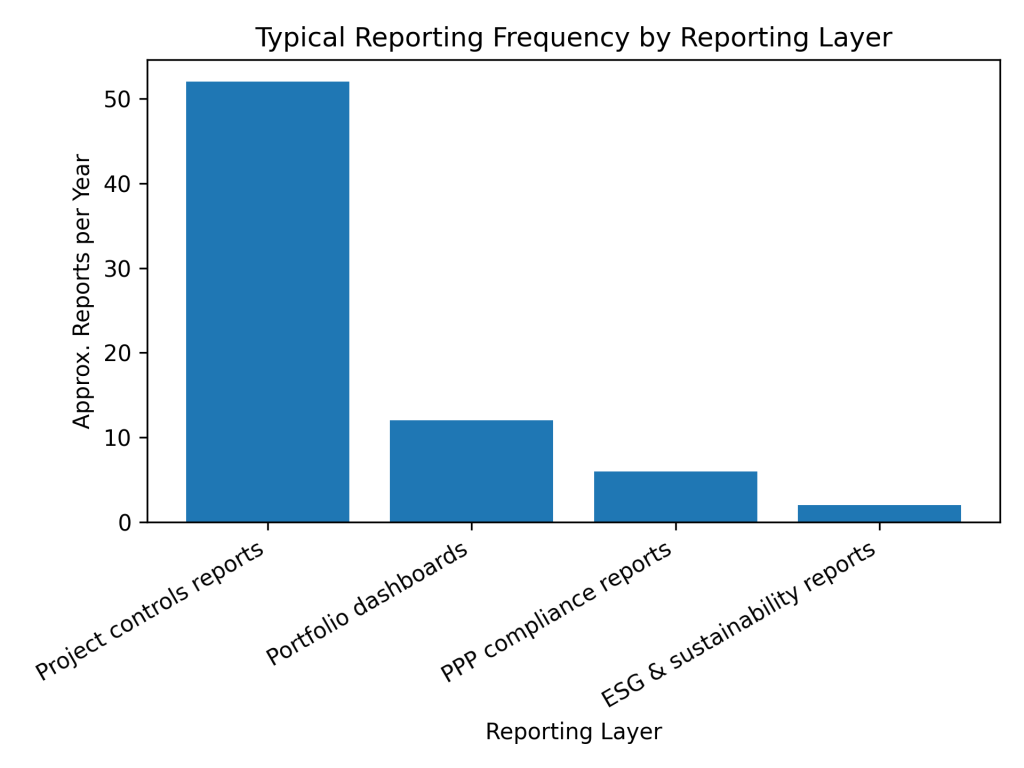
Source: Compiled from public PPP guidance by the World Bank and OECD.
Clarity is critical. High-quality infrastructure reporting for public and private projects typically includes:
- Clearly defined KPI dictionaries
- Consistent time horizons
- Version-controlled dashboards
- Documented data lineage
- Formal review workflows
Without these controls, reporting can quickly lose credibility at the executive level.
Common mistakes to avoid
Treating reporting as a compliance exercise
When organisations view reporting purely as a contractual obligation, the outputs often become backward-looking and overly detailed. This reduces strategic value.
The measurable impact is slower executive decision cycles and delayed risk response.
Overloading dashboards with operational noise
A frequent issue in capital project reporting is excessive granularity at the executive level. When dashboards contain too many indicators, signal quality drops.
In some programmes, executive teams spend more than half of review time clarifying data rather than making decisions.
Ignoring data governance and ownership
Many reporting failures trace back to unclear data ownership. Without defined stewards for cost, schedule, and ESG metrics, inconsistencies emerge across reports.
This can lead to audit findings, lender concerns, and reputational risk in PPP environments.
Failing to integrate ESG metrics early
Organisations sometimes bolt on sustainability reporting late in the project lifecycle. This creates gaps in baseline data and weakens credibility.
Given rising investor scrutiny, incomplete ESG reporting can affect financing conditions and stakeholder trust.
Conclusion
For enterprise organisations managing complex capital portfolios, infrastructure reporting for public and private projects is no longer a back-office function. It is a strategic capability that directly influences risk visibility, stakeholder confidence, and delivery performance.
As infrastructure ecosystems become more data-intensive and ESG-driven, organisations that invest in unified, forward-looking reporting frameworks will be better positioned to manage complexity. With the global infrastructure gap projected in the trillions, even modest improvements in reporting clarity and decision speed can translate into significant financial and operational impact.
References and data sources
- Global Infrastructure Hub – Infrastructure investment gap analysis: https://www.gihub.org
- World Bank PPP Knowledge Lab – Reporting and monitoring guidance: https://ppp.worldbank.org
- OECD – ESG and infrastructure investment insights: https://www.oecd.org/finance
- McKinsey & Company – Capital projects performance research: https://www.mckinsey.com/capabilities/operations/our-insights/capital-projects