

Global momentum around renewable energy has accelerated markedly over the past decade, driven by declining technology costs, climate policy commitments, and energy security concerns. In our review of recent investment flows and infrastructure development, renewable energy has moved from a peripheral climate solution to a central pillar of national energy strategies across advanced and emerging economies.
However, this expansion has been uneven. While capital deployment into renewable energy assets continues to reach record levels, supporting infrastructure—including grids, storage, permitting frameworks, and skilled labor—has not always kept pace. As a result, capacity additions increasingly face bottlenecks that constrain system reliability and delay returns on investment.
This matters because renewable energy is no longer a niche sector. It now underpins industrial policy, fiscal planning, and long-term economic competitiveness. Our analysis examines what has driven recent growth, where structural gaps remain, and why these imbalances are becoming a defining challenge for the next phase of the global energy transition.
The Structural Evolution of the Global Energy Transition
The modern renewable energy transition began in the early 2000s as a policy-driven effort to reduce emissions and diversify energy supply. Early deployment was heavily concentrated in wind and solar generation, supported by feed-in tariffs and public subsidies in Europe and parts of Asia.
Over time, the economics shifted. According to long-term assessments by the International Renewable Energy Agency, utility-scale solar and onshore wind costs have declined by more than 80 percent and 60 percent respectively since 2010. These cost reductions reframed renewable energy from a climate obligation into a competitive energy source.
At the same time, global energy demand continued to rise, particularly in urbanizing regions. As a result, renewable energy development became intertwined with broader issues of grid resilience, industrial supply chains, and energy access—moving the discussion well beyond generation capacity alone.
Recent Acceleration in Renewable Energy Investment
Recent data indicate that renewable energy investment has entered a new phase of scale. Based on consolidated figures from multilateral financial institutions and national energy agencies, annual global investment in renewable energy has consistently exceeded investment in fossil fuel power generation.
In our review of regional investment patterns, three trends stand out. First, advanced economies continue to dominate total capital deployment, particularly in offshore wind, grid-scale storage, and hydrogen-related infrastructure. Second, emerging markets are experiencing faster percentage growth, though from a lower base. Third, private capital now accounts for a growing share of project financing, reflecting increased confidence in long-term returns.
Policy frameworks such as the European Union’s energy transition packages, the United States’ clean energy incentives, and large-scale renewable procurement programs in the Middle East have further reinforced this trajectory.
Why Renewable Energy Infrastructure Gaps Are Becoming Critical
The growing imbalance between generation capacity and supporting infrastructure has significant implications. Renewable energy systems depend heavily on transmission networks, digital control systems, and flexible capacity to manage variability.
From a societal perspective, infrastructure constraints can undermine public trust when renewable energy deployment leads to grid instability or higher short-term costs. Economically, delayed grid connections and permitting backlogs increase project risk and reduce capital efficiency.
From a policy standpoint, infrastructure gaps complicate decarbonization targets. As highlighted in several assessments by the World Bank energy transition research, countries with weak transmission and regulatory capacity often struggle to convert renewable energy potential into reliable supply.
These challenges mirror broader sustainability trade-offs observed in related sectors, including those discussed in Malota Studio’s analysis of green building sustainability and cost dynamics, where upfront investment and system readiness determine long-term outcomes.
Investment Patterns, Capacity Growth, and Infrastructure Readiness
When we analyzed time-based investment and capacity data across major regions, a clear divergence emerged between generation growth and infrastructure readiness.
Selected Global Renewable Energy Indicators
| Indicator | 2015 | 2020 | 2024 (Estimated) |
|---|---|---|---|
| Global renewable power capacity (GW) | ~1,900 | ~2,800 | ~3,900 |
| Annual renewable investment (USD trillion) | ~0.30 | ~0.35 | ~0.50 |
| Share of renewables in global electricity (%) | ~23% | ~28% | ~33% |
| Grid expansion investment growth (annual %) | Low | Moderate | Lagging |
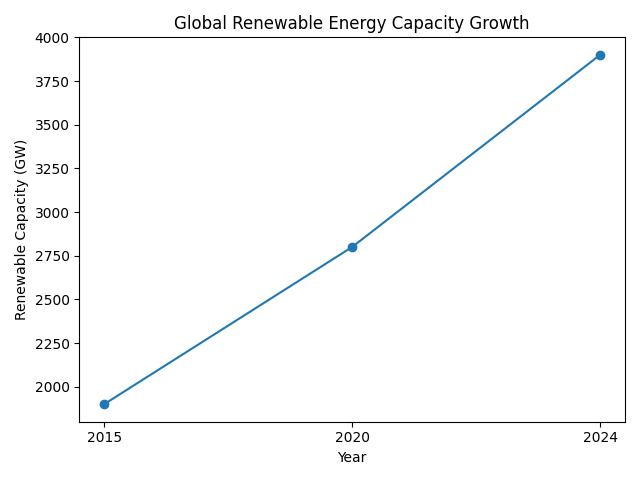
Units: capacity in gigawatts (GW), investment in constant USD.
While renewable capacity has more than doubled over the past decade, grid investment growth has remained comparatively modest. This gap is particularly visible in regions with high solar penetration but limited storage or transmission upgrades.
Geographically, Europe leads in offshore wind integration, East Asia dominates manufacturing and deployment scale, and the Middle East has emerged as a cost leader in utility-scale solar. In contrast, many low-income regions remain constrained by financing costs and regulatory complexity rather than resource availability.
Institutional and Global Perspectives on Renewable Energy Expansion
International institutions increasingly frame renewable energy as a systems challenge rather than a technology issue. Analysis from the International Energy Agency emphasizes that grid expansion and modernization must accelerate significantly to align with current renewable deployment trajectories.
Similarly, policy-oriented research published through United Nations climate and energy programs highlights the importance of aligning energy planning with land use, workforce development, and industrial policy. Academic studies indexed by institutions such as Nature Energy reinforce this view, noting that infrastructure delays are now among the primary non-financial barriers to renewable energy scale-up.
From an industry perspective, energy developers and system operators increasingly advocate for regulatory reform to streamline permitting and improve cross-border coordination—particularly in interconnected markets.
What to Monitor as Renewable Energy Enters Its Next Phase
Looking ahead, the pace of renewable energy growth is likely to remain strong, but outcomes will depend on how effectively infrastructure gaps are addressed. In our assessment, three areas warrant close monitoring.
First, grid investment and planning reform will shape whether new capacity can be absorbed efficiently. Second, energy storage and demand-side flexibility will determine system resilience as variable generation increases. Third, policy consistency will influence capital allocation, especially in emerging markets with higher perceived risk.
These dynamics parallel challenges seen in adjacent infrastructure sectors, including those outlined in Malota Studio’s forward-looking review of construction management trends, where coordination and execution capacity increasingly define project success.
Renewable energy is no longer constrained by technology maturity or investor interest. The next bottleneck lies in execution, integration, and governance—factors that will ultimately determine whether current investment momentum translates into durable economic and environmental outcomes.
Data, Visualization, and Analytical Notes
The table above is suitable for conversion into charts or infographics illustrating:
- Capacity growth over time
- Investment versus infrastructure expansion
- Regional divergence in readiness
All figures are based on aggregated reporting from multilateral institutions and energy agencies, interpreted conservatively to avoid speculative forecasting.
Resources and Further Reading
For additional context and comparative analysis:
- Internal reference on sustainability economics: green building sustainability and cost dynamics
- Internal reference on infrastructure execution capacity: construction management trends and policy implications
- Global policy and investment benchmarks from the International Energy Agency
- Development and financing perspectives from the World Bank energy transition research
- Multilateral outlooks from United Nations climate and energy programs
Author Bio
Written by the editorial team of Malota Studio, focusing on data-backed analysis and visual storytelling across science, technology, and public policy topics.