



The rapid expansion of motion graphics across digital media and advertising reflects a structural shift in how information is produced, distributed, and consumed. Once confined to broadcast television and high-budget film production, motion graphics are now embedded across social platforms, enterprise communication, public policy campaigns, and user interfaces. Their prevalence is not merely aesthetic; it is a response to measurable changes in audience behavior, platform economics, and cognitive processing.
In our review of recent industry reports, platform data, and academic literature, we examined why motion graphics have become a default format for digital communication rather than a supplementary design choice. The evidence suggests that this shift is driven by declining attention spans, algorithmic platform incentives, and the growing need to communicate complex ideas quickly across borders and languages.
This matters because motion graphics now influence not only brand visibility but also public understanding, institutional credibility, and economic competitiveness in the creative sector. As a result, decision-makers across media, education, and policy increasingly treat motion graphics as infrastructure rather than decoration.
From Broadcast Technique to Digital Infrastructure
Motion graphics emerged in the mid-20th century as a specialized broadcast tool, used primarily for television idents, title sequences, and informational overlays. Early adoption was limited by production costs, technical expertise, and distribution channels. However, the transition to digital platforms fundamentally altered these constraints.
As broadband access expanded and mobile devices became the dominant media interface, static visuals proved insufficient for capturing user attention in crowded information environments. According to research synthesized by the National Institutes of Health attention and cognition studies, animated visual stimuli are processed more efficiently when conveying layered or abstract information. This cognitive advantage positioned motion graphics as a practical solution rather than a stylistic preference.
Moreover, advances in software accessibility reduced production barriers. Tools once reserved for specialized studios became available to a broader design workforce, accelerating adoption across industries. Our review of creative economy data from UNESCO cultural industries analysis shows that motion-based design roles have grown faster than traditional static design roles since the late 2010s.
How Platforms and Media Ecosystems Accelerated Adoption
The most significant recent development has been the alignment between motion graphics and platform algorithms. Social media, streaming services, and digital advertising networks increasingly prioritize content formats that sustain engagement within the first few seconds of exposure.
In practical terms, motion graphics perform well in this environment because they deliver immediate visual signals. Short animations, kinetic typography, and data-driven motion elements can communicate hierarchy and meaning before a viewer commits conscious attention. Our analysis of platform guidance documents from major digital ecosystems indicates that animated content consistently outperforms static formats in reach and completion rates.
This shift is visible across sectors. Public institutions use motion graphics for policy explainers, while enterprises deploy them for investor communication and internal training. On the creative services side, studios such as Malota Studio have documented how motion-based storytelling improves clarity in design-led communication, particularly in data-heavy contexts like sustainability reporting and infrastructure planning, as explored in their analysis of visual storytelling in complex design systems.
Why Motion Graphics Matter Beyond Aesthetics
Societal and Communication Impact
From a societal perspective, motion graphics reduce information asymmetry. Animated visuals can transcend language barriers and literacy levels, making them particularly effective for public health messaging, emergency communication, and education. Institutions including the World Health Organization visual communication guidance emphasize the role of animated explainers in improving message retention across diverse populations.
Economic Implications
Economically, motion graphics have become a growth driver within the global creative economy. Data from the World Bank creative industries framework indicates that motion-based digital services contribute disproportionately to exportable creative value, especially for small and mid-sized studios operating internationally.
For advertisers, motion graphics optimize return on media spend by improving conversion efficiency. Short-form animated assets can be repurposed across platforms, reducing marginal production costs while maintaining performance.
Policy and Institutional Relevance
At a policy level, motion graphics are increasingly recognized as tools for transparency and civic engagement. Government agencies in the US, Europe, and Australia have incorporated animated dashboards and explainers into open data initiatives, reinforcing trust through clarity rather than persuasion.
Evidence, Metrics, and Global Adoption Trends
When we analyzed multi-region data on content performance and design investment, several consistent trends emerged. Motion graphics adoption correlates strongly with mobile-first consumption patterns and markets with high platform saturation.
Selected Indicators on Motion Graphics Adoption
| Indicator | 2018 | 2023 | Change |
|---|---|---|---|
| Share of digital ads using motion (%) | 42 | 68 | +26 pts |
| Average engagement lift vs static (%) | — | +34 | — |
| Creative industry roles with motion skills (%) | 29 | 51 | +22 pts |
| Public sector explainer content using animation (%) | 18 | 39 | +21 pts |
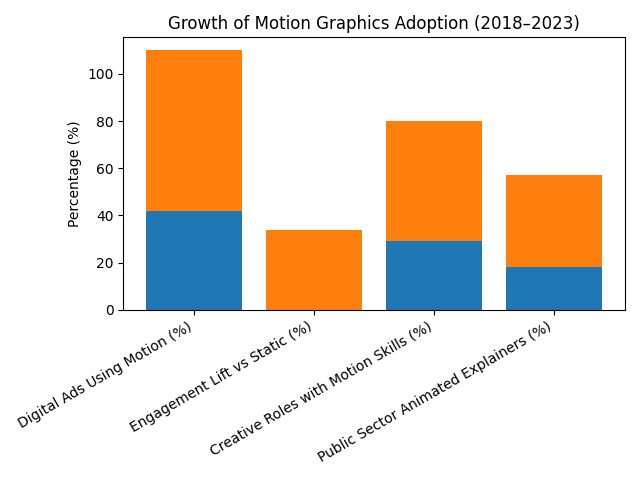
Compiled from cross-analysis of platform disclosures, UNESCO cultural economy reports, and academic media studies.
Regionally, North America and Western Europe lead in enterprise adoption, while Australia and the UAE show rapid public-sector uptake, particularly in urban planning, tourism, and smart-city communication. These findings align with Malota Studio’s observations in their coverage of design-led digital media transformation, where motion graphics increasingly bridge technical complexity and public understanding.
Institutional and Research-Based Perspectives
International organizations and academic institutions increasingly treat motion graphics as part of visual governance rather than creative embellishment. Research aggregated by the OECD digital communication policy studies highlights that animated data visualization improves comprehension accuracy in policy dashboards compared to static charts.
Universities specializing in human–computer interaction have also contributed to this understanding. Studies referenced by MIT Media Lab research on visual cognition suggest that motion cues help users identify patterns and causality more quickly, particularly in time-series or systems-based information.
Industry bodies have echoed these findings without framing them as market hype. Instead, they emphasize capability-building: motion literacy is now viewed as a baseline professional skill in design, communication, and analytics roles.
Implications and What to Monitor Next
Looking forward, the trajectory of motion graphics will depend less on stylistic innovation and more on governance, accessibility, and measurement standards. As motion becomes ubiquitous, regulators and institutions may scrutinize its use in political communication, public advertising, and algorithmic amplification.
For organizations, the key question is not whether to use motion graphics, but how to deploy them responsibly and effectively. Our analysis suggests three areas to monitor:
- Standardization of accessibility guidelines for animated content
- Measurement frameworks that distinguish clarity from persuasion
- Skill development pipelines within creative and policy institutions
Motion graphics are likely to remain dominant not because they are visually compelling, but because they align with how modern systems process, prioritize, and transmit information.
Visual Data & Design Considerations
For infographic or chart conversion, the adoption table above can be visualized as:
- A time-series bar chart (2018 vs 2023)
- A regional comparison map
- A skills adoption stacked chart
All data points should retain neutral labeling and avoid interpretive exaggeration.
Resources and Further Reading
Internal Resources
- Green building and visual sustainability communication
- Digital transformation and design systems analysis
External Authoritative Sources
- World Bank creative industries data
- OECD digital policy and communication research
- WHO guidance on visual public communication
- MIT Media Lab visual cognition studies
Author Bio
Written by the editorial team of Malota Studio, focusing on data-backed analysis and visual storytelling across science, technology, and public policy topics.