


Opening:
The evolving landscape of zero-emission mobility places hydrogen vs. electric vehicles at the center of technology, infrastructure, and policy debates across major markets including the US, Europe, Australia, and the UAE. In our analysis of recent developments and research, battery electric vehicles (BEVs) have seen rapid adoption and infrastructure growth, while hydrogen fuel cell electric vehicles (FCEVs) remain niche due to structural and economic barriers. This contrast matters because transport electrification is critical to corporate decarbonization targets, national climate commitments, and industrial strategy frameworks shaping investment and regulatory priorities.
Our review of data suggests that while both pathways contribute to reductions in tailpipe emissions, they differ significantly in energy efficiency, infrastructure readiness, and lifecycle impacts. We explore these differences to inform policymakers, industry strategists, and analysts evaluating where and how each technology may play a role in the transition to greener transport.
Historical Foundations of Zero-Emission Vehicle Technologies
Electric vehicles (EVs) and hydrogen fuel cell electric vehicles (FCEVs) both emerged from efforts to reduce reliance on internal combustion engines and cut greenhouse gas emissions. BEVs, powered by onboard batteries recharged from the electrical grid, gained early momentum through advances in lithium-ion technology and supportive regulatory frameworks in Europe, North America, and Asia. Over the past decade, global charging infrastructure has expanded rapidly, with millions of public charging points deployed worldwide by 2024, reflecting both market demand and policy incentives for zero-emission mobility.
In parallel, hydrogen technologies—especially proton exchange membrane (PEM) fuel cells—have long been pursued within research communities and select industrial deployments for their potential to provide rapid refueling and high energy density. Hydrogen’s appeal has been strongest in contexts where battery storage poses limitations, such as heavy-duty transportation or long-haul freight, where energy density and quick refueling are operational priorities.
Despite early promise, infrastructure and production constraints have limited FCEVs’ penetration relative to BEVs. Hydrogen must be produced and compressed—often at high energy cost—before it can be distributed and dispensed at specialized fueling stations, while electricity leverages existing grids and increasingly low-carbon generation.
Current Developments in Zero-Emission Vehicle Deployment
Recent industry developments illustrate diverging trajectories for EVs and hydrogen vehicles. Electric vehicle adoption continues to accelerate across major markets, with substantial growth in public charging networks backed by policy incentives such as infrastructure funding in the US and mandates for fast chargers along major roadways in the EU.
In contrast, several automotive manufacturers have recently scaled back hydrogen passenger vehicle programs to focus on BEVs and hybrids, citing limited refueling infrastructure and modest consumer uptake. The Stellantis group, for example, has discontinued its hydrogen fuel cell vehicle initiatives in favor of electrified powertrains, deeming the hydrogen segment economically unsustainable in the near term.
Nevertheless, hydrogen technology persists in targeted niches. Manufacturers such as Toyota and Hyundai continue to develop new FCEV models and expand applications in commercial fleets and heavy vehicles where battery limitations pose operational challenges.
Significance of the Hydrogen-EV Technology Comparison
Understanding the hydrogen vs. electric vehicles landscape is significant on multiple fronts:
Societal adoption and consumer experience: Widespread EV charging access and home charging options have helped normalize BEV use for everyday commuting. Conversely, hydrogen refueling points remain scarce, concentrated in limited regions (notably parts of California) with fewer than 100 publicly available stations in the US.
Economic and industrial implications: Infrastructure deployment costs differ dramatically. Hydrogen fueling stations can cost millions of dollars each to install, while EV chargers—particularly level 2 and fast chargers—are relatively inexpensive and benefit from grid and private investment scalability.
Policy and climate relevance: BEVs can achieve substantial reductions in lifecycle emissions when charged with low-carbon electricity, whereas FCEVs’ environmental benefits depend heavily on the carbon intensity of hydrogen production, which currently remains dominated by fossil-based processes. However, green hydrogen pathways are an active focus of government and industry strategy, including investment in renewable electrolysis.
Interpreting Data: Energy, Infrastructure, and Emissions
The following table summarizes key comparative metrics of EVs and hydrogen FCEVs based on peer-reviewed research and authoritative datasets:
| Metric | Battery EVs (BEVs) | Hydrogen Fuel Cell EVs (FCEVs) | Notes |
|---|---|---|---|
| Energy Efficiency (well-to-wheel) | ~85–95% | ~25–60% | BEVs convert more grid energy to motion; hydrogen conversion involves production and compression losses. |
| Refueling/Recharging Time | 20–60 min (fast) | 3–5 min | EV charging depends on grid and charger speed; hydrogen can refuel rapidly at dedicated stations. |
| Vehicle Range (typical) | ~290–400 mi | ~300–400+ mi | EV ranges vary by battery size; FCEVs can offer competitive range. |
| Public Infrastructure | >1.3M global charging points | <100 U.S. hydrogen stations | Charging deployment far exceeds hydrogen fueling infrastructure. |
| Lifecycle GHG Emissions | As low as ~52–63 g CO₂e/km with renewables | Potentially ~50 g CO₂e/km with green H₂ | Emissions depend on energy sources and production pathway. |
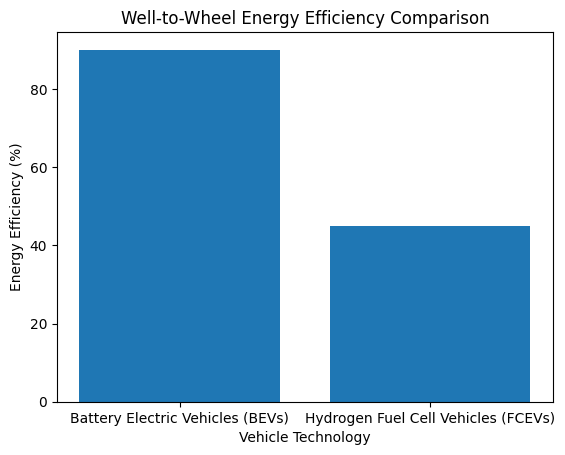
Table: Comparative metrics for BEVs vs. FCEVs (units reflect typical ranges and research consensus).
This data underscores the near-term advantage of BEVs in terms of infrastructure readiness and energy efficiency, while also highlighting the conditional potential of hydrogen in low-emission scenarios provided renewable hydrogen supply scales.
Global and Institutional Perspectives on Transport Electrification
International institutions and research bodies emphasize differentiated roles for battery and hydrogen pathways in clean transport strategies. The International Energy Agency’s Global EV Outlook details substantial increases in public charging deployment worldwide, reinforcing the systemic momentum behind BEV adoption.
Meanwhile, research into hydrogen is positioned within broader decarbonization frameworks, particularly for heavy-duty freight, maritime, and industrial energy storage, where battery solutions are less practical. Analysis by US and European energy departments situates hydrogen as part of a long-term energy portfolio that complements electrification rather than directly competing in all transport segments.
It is also notable that lifecycle emission comparisons vary with regional energy mixes. Modeling studies show that BEVs generally produce lower emissions when powered by clean grids, but that FCEVs fueled with renewable hydrogen can approach or surpass these benchmarks in lifecycle assessments.
What to Watch Next: Strategic Indicators and Risks
Looking ahead, several indicators will shape the evolution of hydrogen vs. electric vehicles:
Hydrogen production decarbonization: The pace at which green hydrogen production scales—and associated costs fall—will determine FCEVs’ environmental competitiveness. Government programs and private investment in electrolyzer capacity, especially in regions with abundant renewables, warrant close monitoring.
Infrastructure build-out: Policy commitments on charging and fueling networks will continue to influence adoption. EV charging station growth remains robust, while hydrogen station deployment requires targeted incentives and regulatory frameworks to be viable at scale.
Cost trajectories: The total cost of ownership—including vehicle purchase price, fueling or charging costs, and maintenance—will remain a key decision factor for fleets and individual owners. Innovations in battery technology and hydrogen production will both figure into cost curves.
Segment-specific roles: FCEVs may find earlier economic viability in heavy transport, logistics fleets, and remote regions where grid constraints limit battery charging, suggesting a coexistence of technologies rather than a binary outcome.
Resources
For actionable insights and context on related topics:
- Explore Global EV Charging Deployment Trends from the International Energy Agency.
- Review the US EPA’s overview of hydrogen in transportation for policy and emissions context.
- For deeper infrastructure cost comparisons, see analysis of hydrogen fueling and vehicle charging infrastructure (Wikipedia).


