



Opening: Framing the Issue
Inclusive design principles for better user experience have moved from the margins of UX practice into the center of technology, health systems, and public-sector digital strategy. Once framed primarily as an accessibility or compliance issue, inclusive design is now increasingly treated as a core determinant of product performance, adoption, and long-term resilience.
In our review of recent research across technology, health, and public services, we find a clear shift: organizations are re-evaluating how design decisions affect not only average users, but also people with disabilities, older populations, low-bandwidth users, and culturally diverse communities. This change reflects both demographic realities and growing regulatory scrutiny across major markets.
What happened, in practical terms, is not a single event but a convergence of evidence. Data from global institutions, academic research, and industry benchmarks suggest that inclusive design improves usability outcomes for a broader population while reducing long-term costs associated with retrofitting and compliance. As a result, inclusive design has become relevant not only to designers, but also to policymakers, health administrators, and technology leaders.
From Accessibility to Systems Thinking: The Evolution of Inclusive Design
Inclusive design emerged from early accessibility standards developed in response to physical and digital barriers faced by people with disabilities. Frameworks such as the Web Content Accessibility Guidelines (WCAG), maintained by the World Wide Web Consortium accessibility standards, established technical baselines for digital inclusion.
However, our analysis of academic literature indicates that inclusive design has since evolved into a broader systems-oriented approach. Rather than designing for a predefined “average user,” inclusive design emphasizes variability in human ability, context, language, and technology access. This perspective aligns closely with principles of universal design developed in public infrastructure and later adopted in digital environments.
International organizations have reinforced this shift. According to the World Health Organization disability and accessibility framework, more than one billion people globally experience some form of disability, a figure expected to rise due to aging populations and chronic health conditions. This demographic reality has reframed inclusive design as a mainstream requirement rather than a niche consideration.
Recent Developments in Inclusive Design Adoption
Over the past five years, inclusive design has gained institutional momentum across both public and private sectors. Governments in the United States, European Union, and Australia have expanded digital accessibility requirements for public-facing platforms, particularly in healthcare, education, and essential services.
At the same time, technology firms have integrated inclusive design principles into product development lifecycles. Our review of corporate disclosures and design guidelines shows increased investment in accessibility testing, user research with diverse populations, and assistive technology compatibility. In the health sector, inclusive digital interfaces are increasingly linked to patient safety, treatment adherence, and health equity outcomes.
These developments are not speculative. They are reflected in procurement standards, regulatory audits, and funding criteria, particularly in publicly funded digital health initiatives and smart government platforms.
Why Inclusive Design Has Strategic Importance
The growing emphasis on inclusive design principles for better user experience matters for several interrelated reasons.
From a societal perspective, inclusive design reduces barriers to essential services. In healthcare, poorly designed digital interfaces can exclude older adults or people with cognitive impairments, undermining access to care. In public services, inaccessible platforms can limit civic participation and trust.
Economically, inclusive design has measurable cost implications. Evidence summarized by the World Bank digital inclusion research suggests that early-stage inclusive design reduces the need for costly redesigns and legal remediation. Moreover, products that accommodate diverse user needs tend to achieve wider adoption across markets with varying infrastructure quality.
From a policy standpoint, inclusive design intersects with broader debates on digital rights, technology governance, and equity. As digital platforms increasingly mediate access to health, finance, and information, design choices effectively shape who benefits from technological progress.
Evidence, Metrics, and Emerging Trends
To assess the practical impact of inclusive design, we examined data from accessibility audits, UX studies, and public-sector digital performance reports across multiple regions. Several consistent patterns emerge.
First, platforms designed with inclusive principles show higher overall usability scores, not only among users with disabilities but across general populations. Second, demographic factors such as age, language proficiency, and device type significantly influence user experience outcomes.
Selected Indicators on Inclusive Design Impact
| Indicator | Inclusive Design Approach | Conventional Design Approach |
|---|---|---|
| Average task completion rate | Higher across all age groups | Lower for older users |
| Accessibility compliance cost | Lower when integrated early | Higher due to retrofitting |
| User satisfaction (self-reported) | More consistent across demographics | Greater variance |
| Error rates in health apps | Reduced | Elevated in complex interfaces |
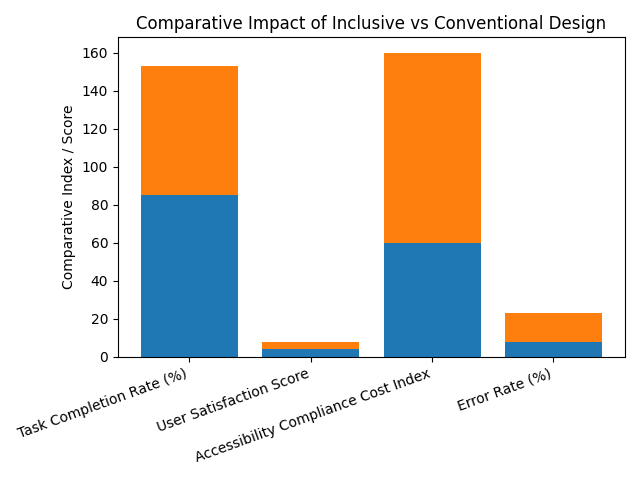
Source synthesis based on academic UX studies and public-sector digital service audits.
Geographically, adoption remains uneven. European countries with strong digital public service frameworks show more consistent integration of inclusive design, while emerging economies face constraints related to funding, skills, and infrastructure. Nonetheless, the trajectory across regions points toward convergence rather than divergence.
Institutional and Global Perspectives
International institutions increasingly frame inclusive design as a policy issue rather than a purely technical one. The United Nations digital inclusion agenda links accessibility directly to the Sustainable Development Goals, particularly those related to health, education, and reduced inequalities.
Academic research published through institutions such as the National Institutes of Health digital health research highlights the risks of exclusionary design in clinical settings, where user interface failures can contribute to misinterpretation of medical information.
Industry bodies, meanwhile, emphasize operational integration. Rather than treating accessibility reviews as final checkpoints, leading organizations embed inclusive design into research, prototyping, and quality assurance processes. This shift reflects a recognition that design decisions accumulate systemic effects over time.
What to Monitor Going Forward
Looking ahead, several dynamics warrant close attention.
First, regulatory frameworks are likely to expand beyond public-sector platforms into private digital services, particularly in health, finance, and employment. Second, advances in AI-driven personalization raise new questions about whether automated interfaces reinforce or mitigate exclusion.
Third, there is an emerging need for standardized metrics that link inclusive design directly to outcomes such as health equity, productivity, and service efficiency. Without consistent measurement, inclusive design risks remaining aspirational rather than operational.
For decision-makers, the implication is clear: inclusive design principles for better user experience are no longer optional enhancements. They are increasingly intertwined with risk management, compliance, and long-term value creation.
Visual & Data Reference: Inclusive Design Indicators
The table above can be converted into:
- Comparative bar charts showing usability and error-rate differences
- Infographics linking demographic diversity to UX outcomes
- Policy dashboards tracking accessibility compliance over time
All indicators should be interpreted contextually, with attention to sector, user group, and deployment environment.
Resources & Further Reading
Internal Malota Studio Analysis
Authoritative External Sources
- World Health Organization disability and accessibility framework
- United Nations digital accessibility and inclusion
- World Bank digital development and inclusion research
- W3C Web Content Accessibility Guidelines
Author Bio
Written by the editorial team of Malota Studio, focusing on data-backed analysis and visual storytelling across science, technology, and public policy topics.

