



Introduction
A robust fintech product communication strategy has become a defining capability for financial technology firms operating at enterprise scale. As platforms become more API-driven, AI-enabled, and compliance-sensitive, product success increasingly depends on how clearly value, risk, and differentiation are communicated across complex stakeholder groups.
The market signals are clear. According to the <a href=”https://www.statista.com/statistics/1344010/fintech-market-size-worldwide/” target=”_blank” rel=”noopener”>Statista global fintech market outlook</a>, the worldwide fintech market is expected to exceed $300 billion in revenue by 2028, reflecting sustained double-digit growth. Yet growth alone does not ensure adoption. Many enterprise fintech initiatives stall because messaging fails to align technical capability with business outcomes.
In this analysis, we examine how leading organizations structure digital finance product communication, where breakdowns typically occur, and what mature teams do differently.
Business context and industry background
In enterprise settings, fintech product communication is a multi-disciplinary function rather than a traditional marketing activity. Large financial institutions and B2B fintech providers typically involve:
- Chief product officers and platform teams
- Risk, legal, and compliance functions
- Enterprise sales leadership
- IT architecture and data teams
- Corporate communications and investor relations
- ESG and governance stakeholders
This cross-functional complexity reflects the regulatory and operational weight of financial technology. The <a href=”https://www2.deloitte.com/global/en/pages/financial-services/articles/global-fintech-survey.html” target=”_blank” rel=”noopener”>Deloitte Global Fintech Survey</a> reports that over 70% of financial services executives view regulatory scrutiny as increasing year over year, reinforcing the need for precise, defensible product messaging.
From what we see across enterprise programs, organizations with disciplined financial technology marketing practices tend to achieve:
- Faster enterprise deal progression
- Stronger internal alignment
- Lower compliance revision cycles
- Higher credibility with procurement teams
These outcomes elevate communication strategy into a core element of enterprise fintech execution.
Key challenges companies face
Cross-functional message fragmentation
Enterprise fintech products often involve distributed ownership. Product teams emphasize features, sales teams emphasize ROI, and compliance teams emphasize risk controls.
Without a unified narrative, organizations produce inconsistent external messaging. According to research from Forrester, B2B buyers encounter conflicting information in nearly 65% of complex technology purchases, which can materially slow decision-making.
Regulatory language constraints
Unlike general SaaS offerings, digital finance product communication must satisfy strict regulatory expectations. Claims about performance, security, or risk mitigation often require legal validation.
In large financial institutions, internal reviews can add multiple weeks to content approval cycles, particularly for cross-border offerings or embedded finance products.
Difficulty translating technical value
Many fintech platforms rely on infrastructure concepts such as real-time settlement rails, open banking APIs, or machine learning risk scoring.
However, enterprise buyers—especially in procurement and finance functions—prioritize business outcomes over architecture. McKinsey research indicates that more than half of B2B technology buyers prefer outcome-led messaging over feature-led narratives, highlighting a persistent translation gap.
Multi-channel consistency pressures
Enterprise fintech communication must perform across investor materials, product documentation, sales enablement assets, and partner ecosystems.
Maintaining consistency across these touchpoints becomes increasingly difficult as product portfolios expand and global teams contribute content.
Best practices and professional approaches
Build an enterprise-wide narrative architecture
Leading fintech firms establish a formal messaging architecture that aligns product, risk, and commercial positioning.
In mature environments, this typically includes:
- Core value propositions tied to measurable outcomes
- Standardized risk and compliance language
- Technical proof frameworks
- Industry-specific use cases
- Executive-level positioning statements
Organizations that institutionalize this approach often report more consistent sales enablement performance and fewer late-stage message revisions.
Prioritize evidence-based fintech storytelling
High-performing teams treat fintech storytelling as a data discipline rather than a creative exercise. Enterprise buyers expect quantified proof.
Common high-impact metrics include:
- Fraud loss reduction percentages
- Payment processing latency improvements
- Customer onboarding time reductions
- Platform uptime and reliability benchmarks
Teams that maintain verified metric libraries typically see stronger engagement in fintech B2B marketing campaigns and enterprise sales conversations.
Integrate compliance early in content workflows
Mature organizations embed legal and compliance review into the early stages of content development.
Typical enterprise practices include:
- Pre-approved claims repositories
- Jurisdiction-specific messaging variants
- Structured risk disclosure templates
- Compliance checklists embedded in workflows
This approach reduces last-minute content rework and supports faster launch readiness.
Design modular communication systems
Enterprise fintech portfolios evolve rapidly. Leading firms move away from static documents toward modular communication frameworks.
Examples include:
- Component-based product sheets
- Dynamic digital sales assets
- API documentation layers
- Reusable visual data modules
Modular systems improve scalability and help maintain consistency across global teams.
Data, reporting, and documentation perspective
In enterprise fintech environments, communication effectiveness is increasingly measured through formal reporting structures. Product and marketing leaders track both operational and commercial indicators.
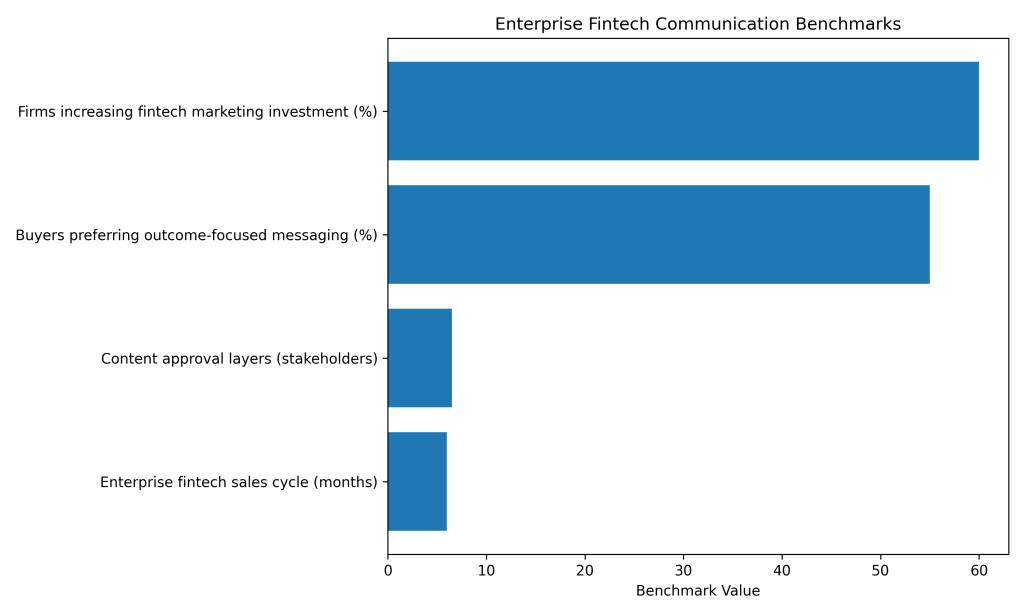
Below is a reusable benchmark table based on publicly reported industry research.
Table: Enterprise Benchmarks for Digital Finance Product Communication
| Indicator | Typical Enterprise Benchmark | Strategic Implication | Source |
|---|---|---|---|
| Average enterprise fintech sales cycle | 4–8 months | Requires sustained messaging consistency | Forrester B2B research |
| Content approval layers in financial firms | 5–8 stakeholders | Drives governance complexity | Deloitte FS insights |
| Buyers preferring outcome-focused messaging | 55%+ | Supports narrative shift | McKinsey B2B Pulse |
| Firms increasing investment in fintech marketing | ~60% | Signals rising competition | Deloitte Fintech Survey |
How enterprises operationalize this data
In most mature organizations, communication metrics are embedded into:
- Monthly go-to-market reviews
- Quarterly product performance dashboards
- Executive steering committee updates
- Sales enablement effectiveness tracking
This reporting discipline ensures that communication strategy remains tightly connected to business outcomes rather than operating as a standalone marketing function.
Common mistakes to avoid
Treating communication as a late-stage activity
When product messaging begins only near launch, organizations often face significant rework. This can delay go-to-market timelines and create approval bottlenecks across legal and compliance teams.
Overemphasizing features over outcomes
Feature-heavy messaging may resonate with technical teams but often fails with executive buyers. The result is longer enterprise sales cycles and weaker differentiation in competitive evaluations.
Allowing regional inconsistencies
Global fintech firms sometimes allow regional teams to localize messaging without sufficient governance. This creates brand fragmentation and can introduce regulatory exposure.
Neglecting measurement frameworks
Without defined KPIs, organizations cannot determine whether communication improvements are working. This frequently leads to inefficient marketing spend and unclear ROI attribution.
Conclusion
For large financial technology organizations, a disciplined fintech product communication strategy is a strategic enabler rather than a supporting function. As regulatory pressure rises and product complexity increases, enterprises must align product, compliance, and commercial narratives with far greater precision.
The data reinforces the urgency: with a majority of B2B buyers now prioritizing outcome-led messaging, firms that invest in structured fintech storytelling and governance-driven communication are better positioned to accelerate enterprise adoption and reduce friction across the product lifecycle.
References
- Statista — Global fintech market outlook: https://www.statista.com/statistics/1344010/fintech-market-size-worldwide/
- Deloitte — Global Fintech Survey: https://www2.deloitte.com/global/en/pages/financial-services/articles/global-fintech-survey.html
- Forrester — B2B Buying Studies
- McKinsey — B2B Pulse and Digital Sales research
