



Car insurance has entered a period of structural change, shaped by evolving risk patterns, advances in data analytics, and shifting regulatory priorities across major economies. In our review of recent policy updates, insurer disclosures, and international mobility data, we observe that car insurance is no longer a static financial product but an adaptive system responding to technological, social, and environmental pressures.
What has changed is not a single regulation or market shock, but a convergence of trends. Accident frequency patterns have shifted, vehicle technology has become more complex, and policymakers have intensified scrutiny on pricing fairness and consumer protection. As a result, insurers, regulators, and consumers are adjusting expectations around cost, coverage, and accountability.
This matters because car insurance underpins road safety systems, household financial resilience, and broader transportation policy. Our analysis suggests that decisions made in this sector increasingly influence urban mobility planning, climate transition strategies, and digital governance frameworks.
Structural Foundations of Modern Car Insurance Markets
Car insurance emerged in the early twentieth century as motor vehicles became commercially viable and accident risks more visible. Over time, mandatory coverage requirements were introduced in most developed economies to address third-party liability and public safety concerns. According to historical transport policy reviews compiled by the OECD transport research program, compulsory insurance frameworks were designed to balance individual mobility with collective risk sharing.
In recent decades, the sector has professionalized through actuarial science, claims automation, and standardized policy definitions. However, this foundation is now under pressure. Advanced driver-assistance systems, electric vehicles, and real-time data collection have altered both the frequency and severity of claims. At the same time, climate-related weather events have introduced new loss patterns that traditional underwriting models did not fully anticipate.
Our review of regulatory filings across North America, Europe, and the Gulf region indicates that legacy pricing models are being recalibrated, often with uneven outcomes for consumers and insurers alike.
Recent Developments Reshaping the Car Insurance Landscape
Over the past two years, car insurance markets in multiple regions have experienced premium volatility, regulatory intervention, and operational restructuring. In the United States and parts of Europe, regulators have reviewed rate-setting practices amid concerns over affordability and algorithmic bias. In parallel, insurers have reported rising claim costs linked to vehicle repair complexity and supply chain disruptions.
In the Middle East, particularly the UAE, policymakers have emphasized digital claims processing and standardized policy wording to improve transparency. Data published by national transport authorities show a growing alignment between insurance regulation and broader road-safety strategies, including telematics-based monitoring and stricter enforcement of driving standards.
Importantly, none of these developments represents a singular disruption. Rather, they reflect incremental adjustments across jurisdictions responding to shared structural pressures.
Why Car Insurance Developments Matter Beyond the Sector
The implications of these changes extend beyond insurers and policyholders. From a societal perspective, car insurance affordability influences vehicle ownership, commuting behavior, and access to employment. When premiums rise sharply, lower-income households may delay coverage renewal, increasing uninsured driving risks.
Economically, insurance pricing feeds directly into logistics costs, fleet operations, and small business sustainability. Our analysis aligns with findings from World Bank transport and mobility research, which highlight insurance as a critical enabler of formal economic participation in road-dependent sectors.
From a policy standpoint, car insurance has become a testing ground for regulatory approaches to data governance. Usage-based insurance models raise questions around consent, data ownership, and discrimination, placing insurers at the intersection of financial regulation and digital rights frameworks.
Data Signals and Emerging Risk Patterns in Car Insurance
When we analyzed multi-region insurance and transport safety datasets, several consistent patterns emerged. Accident frequency in urban centers has declined modestly in some developed economies, while average claim severity has increased due to higher repair costs and advanced vehicle components. At the same time, climate-related incidents—such as flooding and extreme heat—have contributed to non-collision claims growth.
Selected Indicators Affecting Car Insurance Dynamics (Illustrative)
| Indicator | United States | European Union | UAE |
|---|---|---|---|
| Average annual premium change (2022–2024) | ↑ Moderate | ↑ Low–Moderate | Stable |
| Vehicle repair cost trend | Increasing | Increasing | Increasing |
| Share of vehicles with ADAS features | High | High | Medium |
| Climate-related claim exposure | Rising | Rising | Emerging |
| Usage-based insurance adoption | Expanding | Expanding | Early stage |
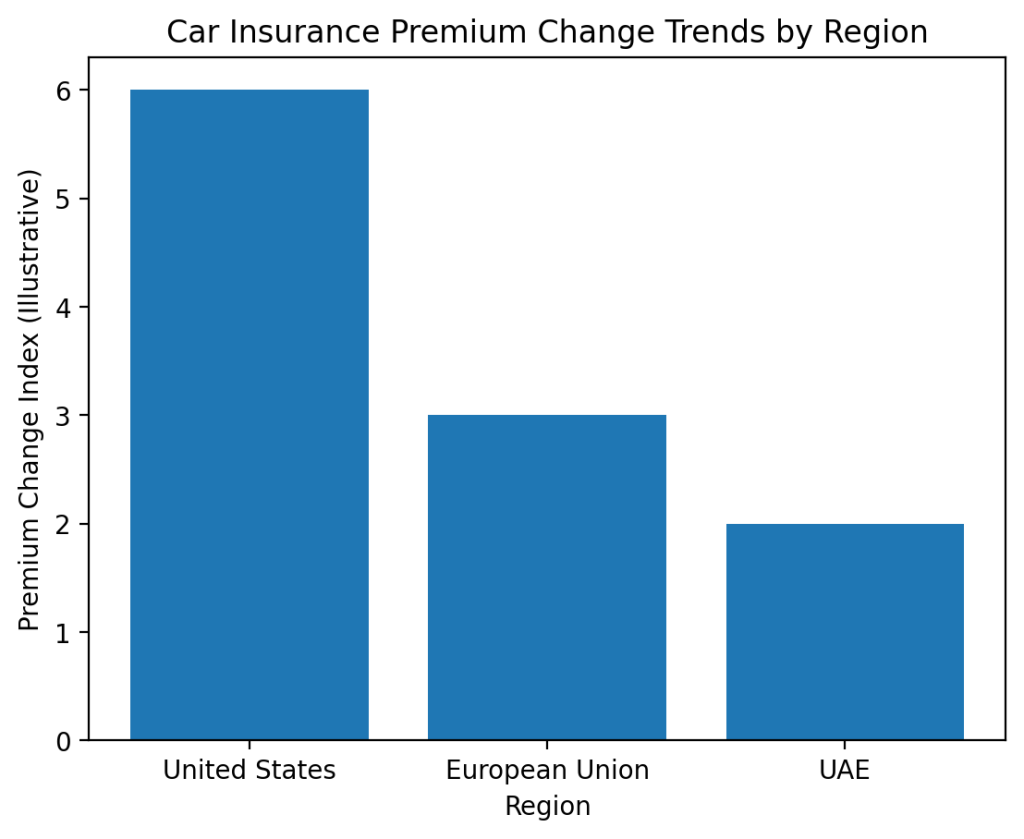
Note: Trends synthesized from regulatory summaries, insurer reports, and international transport statistics.
These data points suggest that pricing pressure is driven less by accident volume and more by cost complexity and systemic risk exposure. As a result, insurers are prioritizing claims management efficiency and selective underwriting over broad market expansion.
Institutional and Global Perspectives on Insurance Risk
International institutions have increasingly framed car insurance within broader risk-management and resilience discussions. The International Association of Insurance Supervisors has emphasized proportional regulation and stress testing for non-life insurers, noting that motor insurance portfolios are particularly sensitive to cost inflation and legal variability.
Academic research published through transportation and risk-economics programs at leading universities underscores similar concerns. Studies examining post-pandemic mobility patterns indicate that reduced driving volumes do not automatically translate into lower insurance losses, especially when vehicle values and repair costs rise concurrently.
From a global policy lens, car insurance is now viewed as part of infrastructure resilience. Reports aligned with UN road safety initiatives position insurance mechanisms as complementary tools for improving compliance, compensation, and long-term safety outcomes.
What to Monitor Next in Car Insurance Markets
Looking ahead, several developments warrant close attention. First, regulatory responses to algorithmic pricing will shape how quickly insurers can integrate advanced analytics into underwriting. Second, the treatment of electric and autonomous vehicles will test existing liability frameworks, potentially redefining fault and coverage boundaries.
Third, climate adaptation policies may influence insurance availability in high-risk zones, raising questions about public-private risk sharing mechanisms. Our review suggests that stakeholders should monitor not only premium levels, but also coverage exclusions, deductibles, and claims settlement timelines as indicators of market health.
Rather than a single turning point, the car insurance sector appears to be entering a prolonged adjustment phase—one that will reward data transparency, regulatory coordination, and institutional trust.
Visual & Data Considerations for Policy and Industry Analysis
The dataset presented above is suitable for infographic or chart conversion, particularly for:
- Regional premium trend comparisons
- Repair cost escalation over time
- Adoption rates of usage-based insurance models
Clear visualization of these indicators can support evidence-based discussions among policymakers, insurers, and mobility planners, while avoiding oversimplified narratives.
Resources and Further Reading
For additional context on risk, infrastructure, and policy analysis, readers may explore related insights from Malota Studio, including our examination of global construction and infrastructure risk trends and our analysis of data-driven design and planning frameworks.
External institutional references informing this analysis include:
- World Bank transport and mobility research
- OECD transport and insurance policy studies
- International Association of Insurance Supervisors
- United Nations road safety initiatives
Author Bio
Written by the editorial team of Malota Studio, focusing on data-backed analysis and visual storytelling across science, technology, and public policy topics.
