


Opening Summary
Over the past decade, solar panels have transitioned from a niche renewable technology to one of the world’s fastest-growing sources of electricity generation. In 2025, multiple structural shifts in production, policy, and installation patterns are reshaping both global markets and local energy strategies.
In our analysis, we examine the latest data on solar panels deployment, manufacturing concentrations, and policy frameworks. We find that while capacity installations continue to expand rapidly worldwide, the global supply chain is experiencing consolidation, geopolitical tensions, and price volatility. These dynamics have immediate implications for energy security, industrial competitiveness, and climate mitigation pathways.
This article unpacks what has happened, why it matters, and what professionals across energy, policy, and investment sectors should monitor next.
Historical and Industrial Context of Solar Panels Manufacturing
Evolution of Solar Panels Deployment
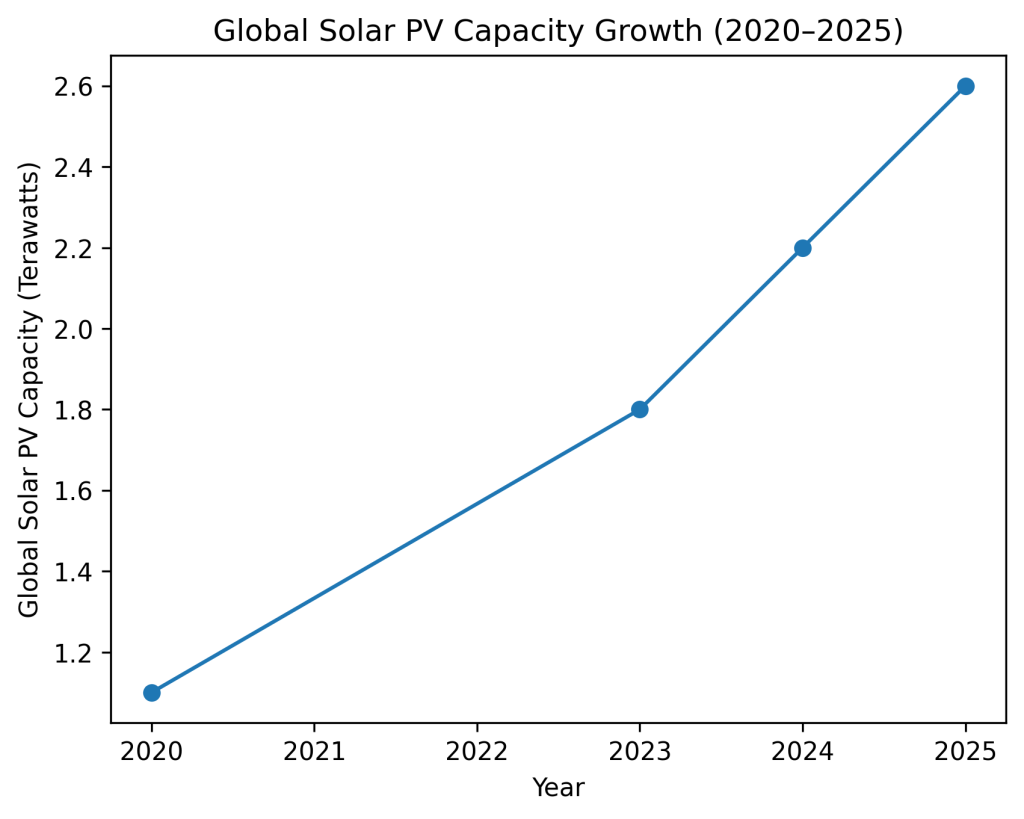
Solar photovoltaic (PV) technology has progressed from early demonstration projects in the 1990s to mainstream deployment in the 2010s and 2020s. Driven by cost declines, policy incentives, and climate commitments, global installations have scaled dramatically. According to industry data, cumulative PV capacity surpassed 2.2 terawatts by the end of 2024 — representing a transformative shift in the global energy mix.
The basic components of conventional solar panels — wafers, cells, and modules — are embedded in complex value chains. Historically, polysilicon and wafer production were high-cost bottlenecks; however, innovative supply chain strategies and technological improvements have gradually reduced material costs and expanded manufacturing capacity.
Market Concentration and Supply Chain Patterns
Despite global demand growth, production has become geographically concentrated. As of 2023–2024, Chinese manufacturers accounted for approximately 85% of global solar module output. Market share concentration has also increased at higher echelons of the supply chain, where the top 10 producers control more than 80% of output.
This concentration has benefitted from state support, integrated industrial strategies, and economies of scale. Conversely, it has posed challenges for diversification and cost stability as policy frameworks in the U.S., Europe, and other regions increasingly emphasize supply chain resilience.
Policy and Economic Drivers
Policy interventions such as feed-in tariffs, tax incentives, and production-linked incentives have historically stimulated solar panel adoption. For example, national schemes aimed at boosting local manufacturing and deployment have emerged in large markets, reflecting broader industrial and energy policy objectives.
As bulk solar deployment has matured, the emphasis in many jurisdictions has shifted toward integration with grid planning, energy storage, and sustainable industrial development.
Recent Developments in the Solar Panels Sector
Market Reports and Capacity Trends
According to Enerdata’s 2025 executive briefing, shipments from the largest 25 global module manufacturers more than tripled between 2021 and 2024, increasing from 172 GW to 687 GW. Despite intense competition and price pressure, total production capacity estimates have surpassed 800 GW, with Europe and the U.S. expanding domestic manufacturing to balance supply chain risks.
In utilities and distributed generation segments, installation growth remains robust. Independent estimates suggest that global installations were on track for a strong year in early 2025, with new capacity additions outpacing the same period in 2024.
Supply Chain Pressures and Oversupply
Recently, oversupply and low profitability have become central themes. Reports indicate that module prices — which had plunged in prior years — rebounded modestly due to tariff changes and regulatory scrutiny on Southeast Asian suppliers.
Simultaneously, oversupply has left substantial inventories in markets such as Europe, where project delays and logistical bottlenecks have slowed deployment rates.
Industrial Strategy and Geopolitical Shifts
Policy shifts are prompting industrial restructuring in major economies. In the United States, initiatives aiming at domestic supply chain development — such as agreements to produce fully American-made solar panels — reflect a strategic focus on energy independence and job creation.
In contrast, China’s solar manufacturing sector has faced financial stress due to overcapacity and weak domestic demand, prompting government intervention to enhance competitiveness and rationalize production.
Implications: Why This Matters
Economic and Industrial Relevance
The economics of solar panels remain central to energy transitions globally. Continued cost declines have supported solar PV’s competitiveness with conventional energy sources in many regions. Yet, supply chain disruptions, material cost shifts, and regional policy divergence introduce new uncertainties for investors and developers.
Manufacturing concentration in China — combined with geopolitically motivated trade policies — highlights strategic vulnerabilities in global energy infrastructure. Diversification efforts in Europe and the U.S. aim to develop localized production ecosystems, but these efforts come with higher unit costs in the short term.
Energy and Climate Policy Impact
Solar panels are key to meeting internationally agreed climate targets under frameworks such as the Paris Agreement. Rapid deployment helps reduce carbon emissions from electrical grids, particularly in regions with high solar irradiation potential.
Simultaneously, the scale of solar PV growth influences ancillary infrastructure needs, including grid integration, storage capacity, and workforce development. Policy coherence across energy, industry, and trade sectors is crucial to optimizing these interdependencies.
Societal and Environmental Outcomes
Expanded solar deployment carries social implications including job creation in manufacturing and installation sectors, particularly where domestic incentives catalyze local industry growth. However, localized environmental considerations — such as land use and end-of-life recycling — require integrated planning and regulatory frameworks.
Data, Evidence & Trends: Statistical Overview
Key Global Solar Panels Metrics
| Metric | 2020 | 2023 | 2024 | 2025(e) |
|---|---|---|---|---|
| Global PV capacity (TW) | ~1.1 | ~1.8 | ~2.2 | >2.6¹ |
| Module manufacturing capacity (GW) | 326 | 1,300 | – | –² |
| Top 25 manufacturers shipments (GW) | 172 | 450 | 687 | –³ |
| China % share of module output | ~80% | ~85% | ~85% | –³ |
Sources: Enerdata global solar PV report, Statista global solar PV supply chain data.
Notes: Estimates for 2025 are based on growth trends; comprehensive final figures will be published in year-end industrial reports.
Visualization Interpretation:
A chart of PV capacity growth from 2020–2024 would illustrate surging adoption. A separate bar chart of module shipments highlights concentration among leading manufacturers.
Institutional and Global Perspectives
International Organizations
The International Energy Agency (IEA) continues to track renewable energy deployment extensively, noting that solar PV has become the largest source of new power capacity in recent years. IEA outlooks emphasize the need for supportive policies to sustain growth and integrate solar with storage and grid modernization.
Policy Bodies and Regional Frameworks
In Europe, the European Commission’s climate and industrial strategies aim to reduce dependence on external supply chains while accelerating renewables uptake through mechanisms such as the Green Deal Industrial Plan. Similarly, U.S. energy policy initiatives under the Inflation Reduction Act reinforce domestic manufacturing and deployment incentives.
Academic and Industry Research
Energy research institutions emphasize ongoing innovation in materials and efficiency improvements. Studies on advanced silicon technologies and next-generation PV materials indicate pathways to higher performance and lower lifecycle emissions, although commercialization timelines vary.
Looking Ahead: What Comes Next for Solar Panels
Market Risks and Opportunities
Professionals should monitor several vectors:
- Supply Chain Diversification: Expansion of non-Chinese manufacturing hubs remains a priority for many investors and policymakers.
- Innovation Trajectories: Research into tandem cells, perovskites, and silicon alternatives could influence future performance benchmarks and cost structures.
- Regulatory Environments: Trade policies, tariffs, and sustainability standards will shape competitive dynamics and deployment costs.
Indicators to Watch
Key metrics that will signal emerging trends include:
- Annual global installed capacity and shipment volumes.
- Regional manufacturing investments and facility commissioning timelines.
- Policy shifts related to clean energy incentives and trade measures.
Resources & Recommended Reading
- Enerdata Solar PV Market Overview — comprehensive data on module shipments and capacity trends.
- Statista: Global Solar PV Supply Chain — statistics on production and installation.
- International Energy Agency Renewable Energy Reports — sectoral insights and deployment projections. (external authoritative)
- European Commission Green Industrial Plan — policy context for EU renewables strategy. (external authoritative)
Author Bio:
Written by the editorial team of Malota Studio, focusing on data-backed analysis and visual storytelling across science, technology, and public policy topics.