



Introduction
In this environment, carbon accounting reporting for enterprises is no longer only about sustainability narratives. It is about risk management, capital access, supply chain resilience, and long-term competitiveness.
Business Context and Industry Background
In large organisations, corporate carbon accounting sits at the intersection of sustainability, finance, operations, IT, procurement, and risk management.
Most enterprises structure their GHG inventory reporting in line with the https://ghgprotocol.org/sites/default/files/standards/ghg-protocol-revised.pdfGHG Protocol Corporate Standard</https://ghgprotocol.org/sites/default/files/standards/ghg-protocol-revised.pdf>, which categorises emissions into Scope 1, 2, and 3. Scope 1 covers direct emissions from owned or controlled assets, Scope 2 includes purchased electricity and energy, and Scope 3 spans value-chain emissions.
Scope 3 is typically the most material. According to https://www.cdp.net/en/research/global-reports/transparency-to-transformationCDP’s Global Supply Chain Report</https://www.cdp.net/en/research/global-reports/transparency-to-transformation>, supply chain emissions are on average 11.4 times higher than operational emissions (Scope 1 and 2 combined). For multinational manufacturers, technology firms, and consumer brands, this fundamentally shifts the scale and complexity of emissions data reporting.
Stakeholders involved in carbon accounting reporting for enterprises commonly include:
- Chief Sustainability Officers and ESG teams
- CFOs and financial reporting functions
- IT and data governance teams
- Procurement and supply chain leaders
- Internal audit and compliance teams
In mature organisations, emissions data is increasingly reviewed at board level. A 2023 survey by https://www.pwc.com/gx/en/services/sustainability/publications/global-investor-survey.htmlPwC’s Global Investor Survey</https://www.pwc.com/gx/en/services/sustainability/publications/global-investor-survey.html> found that 75% of investors believe companies should address ESG risks even if it reduces short-term profitability. This directly reinforces the need for credible carbon data.
Key Challenges Companies Face
Data fragmentation across systems
Enterprise emissions data is rarely stored in a single system. Energy data may sit in facilities management tools, logistics data in ERP platforms, and supplier data in procurement systems.
According to https://www2.deloitte.com/global/en/pages/risk/articles/esg-reporting-survey.htmlDeloitte’s ESG Reporting Survey</https://www2.deloitte.com/global/en/pages/risk/articles/esg-reporting-survey.html>, over 50% of organisations rely on manual spreadsheets for parts of their ESG reporting. This increases error risk and reduces audit readiness.
Fragmented data architectures can extend reporting cycles by several weeks and create reconciliation issues between sustainability and finance teams.
Scope 3 measurement complexity
This 1 and 2 reporting is largely based on direct energy consumption data. Scope 3 reporting, however, requires emissions estimation across purchased goods, transportation, product use, and end-of-life treatment.
The GHG Protocol identifies 15 distinct Scope 3 categories. For global enterprises with thousands of suppliers, primary data collection is often incomplete. As a result, many organisations depend on spend-based estimation models, which may introduce significant variance.
The challenge is not only technical but contractual. Procurement teams must integrate emissions reporting requirements into supplier agreements and onboarding processes.
Regulatory divergence and assurance pressure
While frameworks such as the GHG Protocol provide methodological guidance, regulatory regimes differ across jurisdictions. The EU’s CSRD requires alignment with European Sustainability Reporting Standards, while other markets follow ISSB or local requirements.
Enterprises operating across regions must reconcile multiple disclosure formats. In addition, limited or reasonable assurance requirements are becoming standard. This means that GHG inventory reporting must withstand external audit scrutiny similar to financial statements.
Organisational ownership and governance gaps
Carbon accounting often begins as a sustainability initiative but gradually becomes a cross-functional governance issue.
Without clear executive sponsorship, reporting responsibilities may be diffused. This can lead to inconsistent methodologies, unclear boundaries between subsidiaries, and delayed disclosures. In complex corporate structures, boundary definitions alone can take months to finalise.
Best Practices and Professional Approaches
Establishing clear organisational boundaries
Mature enterprises define operational or financial control boundaries early in the reporting process, consistent with the GHG Protocol. This reduces restatement risk and enhances comparability year over year.
In practice, organisations that formalise boundary definitions during the first reporting cycle reduce subsequent methodological adjustments and improve year-on-year data consistency by measurable margins.
Integrating carbon data into enterprise systems
Rather than treating emissions data reporting as an isolated sustainability task, leading companies integrate carbon data into ERP, procurement, and asset management systems.
This integration supports near real-time tracking and shortens reporting cycles. Enterprises that automate data ingestion typically reduce manual reconciliation time and reporting lead time, often by several weeks per cycle.
Building supplier engagement programs
Then, Given that Scope 3 often dominates emissions profiles, structured supplier engagement programs are essential.
CDP data indicates that companies engaging suppliers on emissions achieve measurable reductions in value-chain emissions intensity over time. Leading enterprises implement phased supplier data collection, starting with top-emitting categories and gradually expanding coverage.
Aligning carbon metrics with financial planning
Advanced organisations link internal carbon pricing or shadow pricing mechanisms to capital allocation decisions.
According to the https://www.worldbank.org/en/programs/pricing-carbonWorld Bank’s Carbon Pricing Dashboard</https://www.worldbank.org/en/programs/pricing-carbon>, over 70 carbon pricing instruments are in operation globally. Enterprises that simulate carbon cost exposure internally are better prepared for regulatory or market-based pricing impacts.
Data, Reporting, and Documentation Perspective
From a documentation standpoint, carbon accounting reporting for enterprises should be treated with the same discipline as financial reporting.
Key elements typically include:
- Documented methodologies and emission factors
- Version-controlled calculation files
- Defined data owners and review checkpoints
- Audit trails for adjustments and restatements
Reporting frequency varies. Many enterprises conduct quarterly internal reviews and annual external disclosures. Board-level sustainability committees increasingly review emissions KPIs alongside financial performance.
The following table summarises typical emission distribution patterns observed across sectors, based on CDP and GHG Protocol analyses:
Table: Typical Emissions Distribution by Scope (Indicative Ranges)
| Scope Category | Description | Typical Share of Total Emissions* |
|---|---|---|
| Scope 1 | Direct emissions from owned assets | 5–20% |
| Scope 2 | Purchased electricity and energy | 5–25% |
| Scope 3 | Value chain emissions | 60–90% |
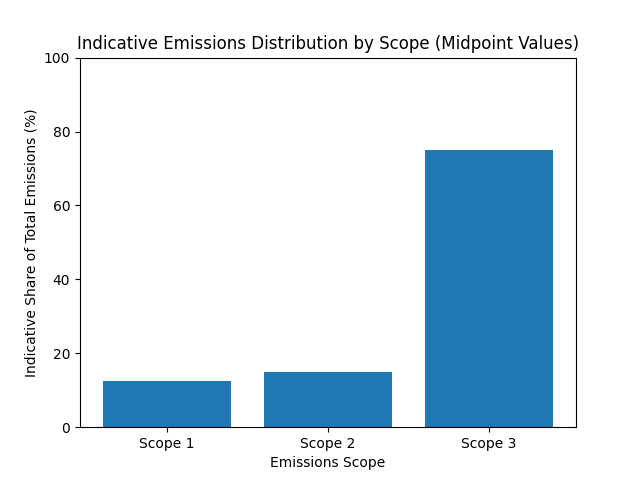
*Source: CDP Global Supply Chain Report; GHG Protocol Technical Guidance.
For enterprise readers, the implication is clear: governance frameworks, dashboards, and executive summaries must make Scope 3 visibility accessible, not buried in appendices.
Clarity in emissions reporting supports better capital allocation, supplier negotiations, and transition planning. Without structured documentation, data loses strategic value.
Common Mistakes to Avoid
Treating carbon reporting as a communications exercise
When reporting is led solely by marketing or communications teams, methodological rigor often suffers. This can result in inconsistent baselines and reputational risk.
Underestimating Scope 3 exposure
Organisations that focus only on operational emissions may overlook up to 80% or more of their total footprint, depending on sector. This creates material blind spots in transition planning.
Delaying IT and data governance involvement
Without early IT integration, emissions data reporting remains spreadsheet-driven. This increases error probability and reduces audit confidence, especially under assurance requirements.
Failing to align finance and sustainability
If finance teams are not embedded in GHG inventory reporting, carbon data may not reconcile with financial disclosures. In regulated environments, such misalignment can lead to disclosure delays or restatements.
Conclusion
For large organisations, carbon accounting reporting for enterprises is no longer optional or peripheral. It sits at the core of regulatory compliance, investor expectations, and operational resilience.
With Scope 3 emissions often representing between 60% and 90% of total corporate footprints, the strategic importance of robust data systems and governance structures cannot be overstated. Enterprises that invest early in integrated corporate carbon accounting frameworks are better positioned to manage regulatory risk, respond to stakeholder scrutiny, and make informed capital decisions.
In a market environment shaped by tightening disclosure regimes and increasing assurance standards, the quality of carbon accounting reporting for enterprises is becoming a defining feature of credible corporate leadership.
References
- IPCC Sixth Assessment Report: Synthesis Report
https://www.ipcc.ch/report/ar6/syr/downloads/report/IPCC_AR6_SYR_SPM.pdf - GHG Protocol Corporate Standard
https://ghgprotocol.org/sites/default/files/standards/ghg-protocol-revised.pdf - CDP Global Supply Chain Report
https://www.cdp.net/en/research/global-reports/transparency-to-transformation - EU Corporate Sustainability Reporting Directive (CSRD)
https://eur-lex.europa.eu/legal-content/EN/TXT/?uri=CELEX:32022L2464 - U.S. SEC Climate Disclosure Rule
https://www.sec.gov/files/rules/final/2024/33-11275.pdf - PwC Global Investor Survey
https://www.pwc.com/gx/en/services/sustainability/publications/global-investor-survey.html - World Bank Carbon Pricing Dashboard
https://www.worldbank.org/en/programs/pricing-carbon