



Introduction
Climate risk reporting for enterprises has moved from a niche sustainability exercise to a core component of enterprise risk management. Regulatory pressure, investor scrutiny, and operational exposure to climate events are converging rapidly.For large enterprises, climate risk reporting is no longer about reputational positioning. It directly informs capital allocation, supply chain resilience, insurance costs, and long-term strategy. Executives increasingly expect structured insights from physical climate risk assessment, transition risk reporting, and climate scenario analysis reporting to guide decision-making at scale.
Business context and industry background
In enterprise environments, climate risk reporting typically sits at the intersection of several functions. Sustainability teams lead methodology, risk and compliance teams ensure regulatory alignment, finance teams evaluate financial exposure, and IT or data teams support analytics infrastructure.
Enterprise adoption is accelerating:
Table: Global Climate Risk Disclosure Adoption
| Metric | Latest Figure | Source |
|---|---|---|
| Organizations supporting TCFD | 4,000+ | TCFD |
| Large companies disclosing climate risks in financial filings | ~60% of S&P 500 | MSCI research |
| Investors considering climate risk in decisions | 75%+ | PwC Global Investor Survey |
| Companies using scenario analysis | ~45% | CDP |
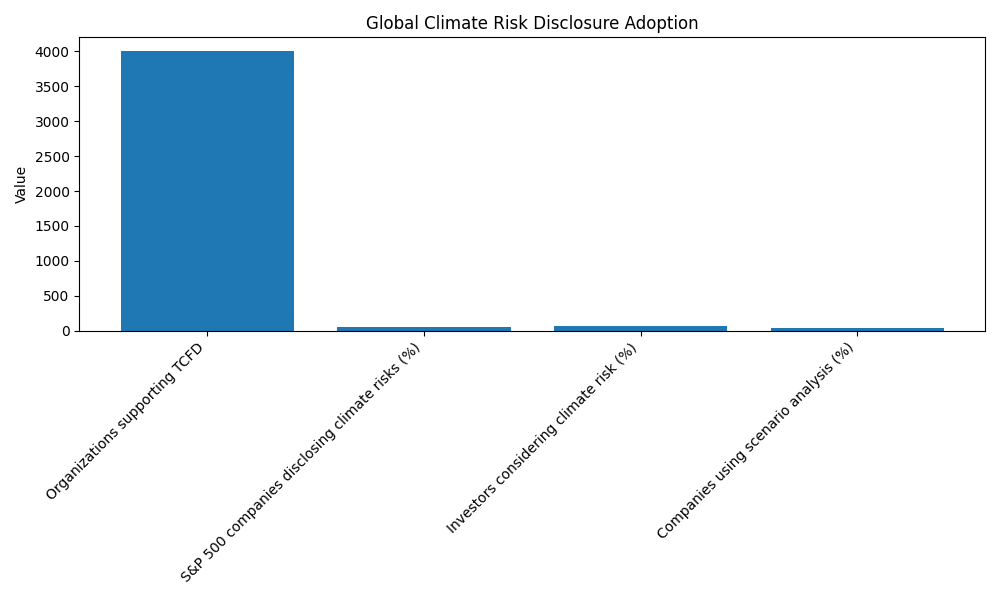
Table designed for easy visualization.
These numbers indicate that climate risk reporting is becoming embedded in mainstream enterprise governance rather than remaining a sustainability niche.
Key challenges companies face
Fragmented climate data across the enterprise
Large organizations often struggle with dispersed data sources. Physical asset exposure data may sit in operations systems, emissions data in sustainability platforms, and financial risk data in ERP environments.
CDP reports that many enterprises still rely on manual data aggregation for climate disclosures, which increases error risk and slows reporting cycles. In complex multinational organizations, data consolidation alone can take several months.
Translating climate science into financial impact
One of the most persistent barriers in climate scenario analysis reporting is converting temperature pathways or hazard projections into balance-sheet implications.
While climate models may project increased flood probability, finance leaders require quantified impacts such as expected annual loss or EBITDA sensitivity. Many organizations lack standardized methodologies for this translation, creating inconsistency across business units.
Evolving regulatory and TCFD expectations
The regulatory landscape is shifting quickly. Jurisdictions such as the EU, UK, and several Asia-Pacific markets are moving toward mandatory climate disclosure aligned with TCFD reporting frameworks.
Enterprises operating globally must manage overlapping requirements, different materiality thresholds, and varying assurance expectations. Compliance teams report that regulatory mapping alone can require significant internal coordination.
Limited internal ownership and governance
Climate risk often falls between functions. Sustainability teams may own emissions data, but enterprise risk management owns financial exposure. Without clear governance, reporting becomes fragmented.
A Deloitte survey found that fewer than half of large companies have fully integrated climate risk into enterprise risk management frameworks, indicating a structural maturity gap.
Best practices and professional approaches
Establish integrated climate risk governance
Leading enterprises formalize cross-functional governance structures. Typically, this includes executive oversight, risk committee involvement, and defined ownership across sustainability, finance, and operations.
Organizations with integrated governance frameworks report faster reporting cycles and fewer audit adjustments. In mature programs, climate risk reviews are embedded into quarterly enterprise risk discussions rather than treated as annual exercises.
Standardize physical climate risk assessment methodologies
Mature companies adopt consistent methodologies across geographies and asset classes. This includes standardized hazard datasets, common risk scoring models, and documented assumptions.
In practice, enterprises often review physical risk models annually and refresh asset-level exposure data every one to two years. This cadence balances analytical rigor with operational feasibility.
Embed transition risk into financial planning
Transition risk reporting becomes more effective when linked directly to strategic planning and capital allocation processes. Rather than treating carbon pricing or policy risk as theoretical, leading organizations model explicit financial scenarios.
For example, many large industrial firms now test internal carbon price assumptions in the range of $50–$150 per ton to stress-test investment decisions. This creates a clearer bridge between climate strategy and financial outcomes.
Operationalize climate scenario analysis
Top-performing enterprises move beyond one-off scenario exercises. Instead, they embed climate scenario analysis reporting into recurring planning cycles.
Common practices include:
- Running scenario updates every 12–24 months
- Aligning scenarios with IPCC pathways
- Linking outputs to risk appetite frameworks
- Integrating results into board-level reporting
This institutionalization improves both credibility and decision relevance.
Data, reporting, and documentation perspective
From a reporting standpoint, clarity and auditability are becoming decisive differentiators. Enterprise stakeholders increasingly expect climate disclosures to meet the same standards as financial reporting.
In practice, mature organizations typically implement:
- Centralized climate data repositories
- Documented calculation methodologies
- Version-controlled scenario assumptions
- Formal review workflows
Reporting frequency is also evolving. While full climate disclosures often remain annual, many enterprises now update key climate risk indicators quarterly alongside enterprise risk dashboards.
Typical KPIs in climate risk reporting include:
- Percentage of assets exposed to high physical risk
- Estimated financial impact under transition scenarios
- Scope coverage of climate risk assessments
- Alignment level with TCFD recommendations
When structured properly, these indicators support executive decision-making rather than functioning as purely compliance metrics.
Common mistakes to avoid
Treating climate risk as a sustainability-only issue
Organizations that isolate climate reporting within sustainability teams often miss financial materiality. This can lead to disclosures that lack credibility with investors and regulators.
The measurable consequence is often rework during assurance reviews and delayed board approvals.
Overreliance on generic scenario assumptions
Using off-the-shelf scenarios without enterprise-specific calibration reduces decision usefulness. For asset-intensive companies, location-specific hazard data is critical.
Enterprises that fail to localize scenarios often underestimate exposure, particularly for flood, heat, and supply chain disruptions.
Inconsistent documentation and audit trails
Climate calculations frequently involve multiple assumptions. Without clear documentation, audit readiness becomes a major risk.
Companies have reported disclosure delays of several weeks when supporting evidence for climate metrics cannot be easily reproduced during assurance processes.
Focusing on disclosure rather than decision value
Some organizations still treat climate reporting as a compliance exercise. The result is lengthy reports that do not influence capital allocation or risk management.
High-performing enterprises instead prioritize decision-grade analytics that executives can act on.
Conclusion
For large organizations, climate risk reporting for enterprises is rapidly becoming a core component of financial resilience and strategic planning. With investor expectations rising and regulatory frameworks tightening, enterprises that build structured, data-driven climate reporting capabilities will be better positioned to manage both physical and transition risks.
The trajectory is clear: with more than 4,000 organizations now aligned with TCFD principles, climate risk reporting is entering the mainstream of enterprise governance. Companies that treat it as an integrated risk discipline—rather than a standalone disclosure task—are more likely to generate actionable insights and maintain stakeholder confidence.
References
- Task Force on Climate-related Financial Disclosures (TCFD) Status Reports
https://www.fsb-tcfd.org/publications/ - World Economic Forum Global Risks Report
https://www.weforum.org/reports/global-risks-report-2024/ - CDP Climate Disclosure Insights
https://www.cdp.net - PwC Global Investor Survey
https://www.pwc.com - MSCI Climate Disclosure Research
https://www.msci.com