


So you’re thinking about going green with your next car. But here’s the million-dollar question: full electric or hybrid?
Let’s break it down — no boring jargon, just the real facts you need to make a smart choice.
First Things First: What Does “Efficient” Even Mean?
When we talk about efficiency, we’re basically asking: how much energy actually moves your car forward vs. how much gets wasted?
Think of it like your phone battery. You want maximum screen time with minimum charging, right? Same energy (pun intended) applies here.
The Numbers Don’t Lie
Here’s where it gets interesting.
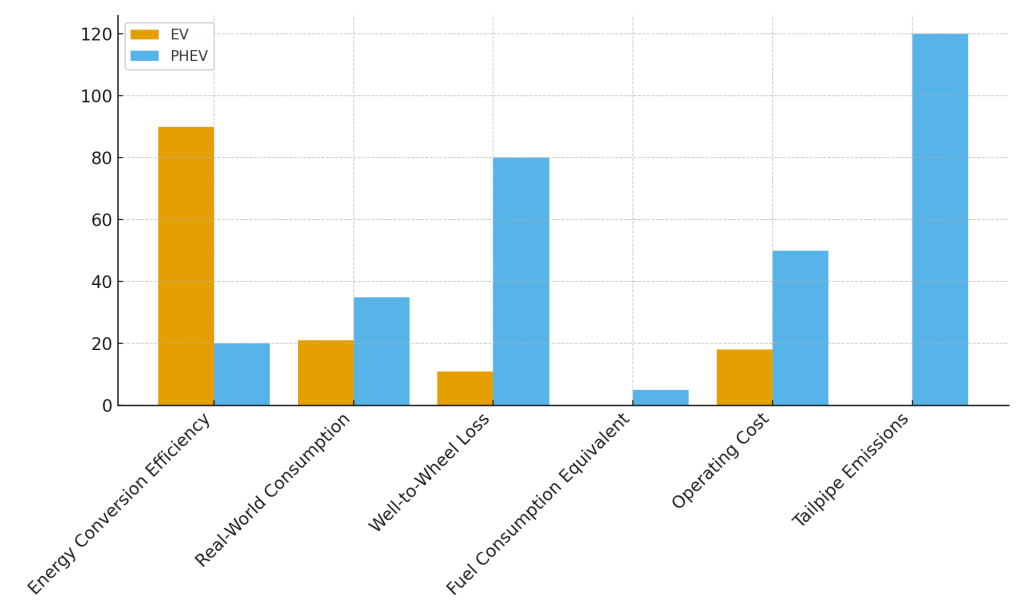
Electric vehicles (EVs) convert about 85–90% of their energy into actual movement. That’s insanely efficient. Meanwhile, the gas engine in hybrids? Only around 20% efficiency. The rest? Gone as heat. Literally just warming up the air around you.
EVs also win the real-world consumption test. Most electric cars use about 21 kWh per 100 km on average. For context, that could cost you way less than filling up a tank — especially if you’re charging at home during off-peak hours.
Plug-in hybrids (PHEVs), on the other hand, are a bit of a wildcard. Lab tests say one thing, but real-world data tells a different story. Some PHEVs in China were found using 4–5 times more energy than advertised. Yikes.
Here’s a breakdown of real-world and theoretical data comparing electric vehicles and hybrid (or plug-in hybrid) vehicles.
Table — Energy Efficiency & Consumption
| Metric | Electric Vehicle (EV) | Hybrid / Plug-in Hybrid (PHEV) |
|---|---|---|
| On-board energy conversion efficiency | ~ 85–90% of electrical energy is converted into motion. (quntrobot.com) | Internal combustion engine (ICE) part: ~ 20% efficiency. (ember-energy.org) |
| Average real-world consumption (certified vs real) | Certified: ~ 19 kWh/100 km; Real-world average: ~ 21 kWh/100 km. (Preprints) | Varies widely — depends on plugin usage, driving behavior, and mode. Some PHEVs in real-world use much more than lab claims. (arXiv) |
| Well-to-wheel energy loss | According to Ember data, EVs lose about 11% energy internally. (ember-energy.org) | ICE losses are much higher (~80%), but PHEVs combine two modes, so actual losses depend on usage split. (ember-energy.org) |
| Fuel consumption equivalent | EVs don’t use fossil fuel directly, but energy content equivalents can be made (e.g., 1 L gasoline ≈ 8.9 kWh) (The Connected by Henry Man) | Plug-in hybrid consumption (electric + fuel) can be modeled; some PHEVs reportedly use 4–5 L / 100 km in real use, depending on conditions. (arXiv) |
| Operating cost (example) | For EVs: ~15–20 kWh/100 km is common; if electricity tariff is moderate, cost per 100 km can be quite low. (blog.transtrack.co) | Hybrids may need fuel more often; but since they use both gasoline and electricity, cost depends heavily on how often they are charged vs driven on fuel. Real-world user data shows combined cost must account for both. (Reddit) |
| Emissions (tailpipe) | Zero tailpipe emissions when driving (but upstream emissions depend on grid mix) | Lower than pure ICE but still emits CO₂ when running on fuel; some PHEVs emit far more in real-world than laboratory estimates. (The Guardian) |
Why EVs Are Kinda Crushing It
They’re just built different. Electric motors are way more efficient than combustion engines. Plus, regenerative braking lets EVs recapture energy every time you slow down. Free power, basically.
Your wallet will thank you. If electricity is cheap where you live, running an EV costs significantly less per kilometer than any gas-powered car.
Better for the planet (mostly). Zero tailpipe emissions means cleaner air in your city. The catch? If your local power grid still runs on coal, the environmental benefit shrinks. But as grids get greener, EVs get even better.
But Wait — Hybrids Aren’t Dead Yet
No range anxiety. Unlike EVs, hybrids don’t leave you stranded searching for a charging station. Gas stations are everywhere, and refueling takes minutes, not hours.
Still better than regular gas cars. Studies show hybrids can hit 18–22 km per liter compared to 10–14 km/L for traditional cars. That’s a solid upgrade.
The real talk, though: If you never plug in your PHEV, you’re basically just driving a heavy gas car with extra steps. The efficiency only kicks in if you actually use the electric mode.
The Emissions Reality Check
Here’s a plot twist: some plug-in hybrids produce nearly five times more CO₂ in real-world driving than what manufacturers claim in lab tests. That’s according to a report that analyzed actual driving data vs. official numbers.
So if you’re buying a hybrid thinking you’re saving the planet, make sure you’re actually plugging it in regularly. Otherwise, the math doesn’t math.
So… Which One Should You Get?
Go EV if:
- You mostly drive short to medium distances
- You have access to home or workplace charging
- Your local electricity is affordable
- You want minimal maintenance (no oil changes, fewer moving parts)
Go Hybrid/PHEV if:
- You regularly take long road trips
- Charging infrastructure in your area is still lacking
- You need the flexibility of both electric and gas
- You’ll actually commit to plugging it in daily
The Bottom Line
Pure EVs are the efficiency kings — there’s no debate there. They convert more energy into movement, cost less to run, and produce zero emissions while driving.
But hybrids aren’t obsolete. They’re a solid middle ground, especially if your lifestyle doesn’t support full-time EV ownership yet.
The real question isn’t which car is better — it’s which car fits YOUR life better.
Choose wisely. The planet (and your bank account) will thank you.
References
- Energy consumption data for EVs in Europe: real-world vs certified: Preprints.org. Preprints
- Efficiency trade-offs due to mass: Environmental Sciences Europe. SpringerOpen
- Well-to-wheel efficiency data: Ember Energy Methodology. ember-energy.org
- Internal combustion vs EV energy conversion: Natural Resources Canada. natural-resources.canada.ca
- Real-world PHEV carbon & energy use in China: arXiv study. arXiv
- Real-world hybrid fuel economy study (Indonesia): Jurnal Teknik Mesin. Publikasi Mercu Buana
- Running cost comparison (electric vs gasoline): TransTRACK. blog.transtrack.co
- Fuel–electric equivalency conversion: Henry Man’s blog. The Connected by Henry Man
- Report on PHEV real-world CO₂ emissions vs lab tests. The Guardian
