


2025 is literally the year space got busier than your group chat. Between commercial companies yeeting rockets into orbit like it’s no big deal and NASA pulling off some seriously ambitious missions, there’s a lot happening beyond our atmosphere. Let’s break down the most epic space moments of 2025 — with actual data, no cap.
The Main Character Missions of 2025
Here’s your cheat sheet for the missions that absolutely dominated 2025:
| Mission name | Agency / Operator | Launch date (2025) | Primary objective | Notable payload / note | Status (as of latest 2025 reporting) |
|---|---|---|---|---|---|
| IM-2 (Athena, Nova-C lander) | Intuitive Machines / NASA (CLPS) | 26 Feb 2025 (launch) | Deliver tech & science to Moon South Pole region; search for volatiles (water ice) | NASA payloads (drill, radiometer), hopping robot (“Grace”) | Launched and en route / touched down — communications and post-landing assessments reported; orientation/operability issues reported in press. (NASA) |
| ESCAPADE (twin probes) | NASA (led by UC Berkeley) / Blue Origin launch | Nov 13, 2025 (NG-2) | Study Mars’ magnetosphere and solar wind interaction (two small orbiters) | Twin small orbiters (Photon bus), low-cost exploration concept | Launched on New Glenn (late 2025); cruise to Mars planned; mission operations and arrival planned for 2027. (NASA) |
| Euclid (survey mission; operations) | ESA / Euclid consortium | — (continuing operations in 2025) | Map dark matter & dark energy over large sky area (cosmology) | Visible + NIR instruments, spectroscopy | Operational survey continuing through 2025 (daily status updates on ESA pages). (Science ESA) |
| Starship test flights (Super Heavy + Starship) | SpaceX | multiple test windows through 2025 | Heavy-lift testing (future cargo / lunar architectures) | Full-scale reusable Super Heavy + Starship stack | FAA cleared/adjusted approvals and flight tests proceeded through 2025; iterative test campaign with mixed results and ongoing investigations. (Reuters) |
| ISS / Commercial Crew cadence | NASA + international partners + commercial providers | ongoing (2025) | Crew rotations, cargo resupply, microgravity research | Crew Dragon, Cygnus, Progress, cargo vehicles | NASA and partners adjusted ISS flight planning windows and schedules during 2025 to optimize readiness and integration. (NASA) |
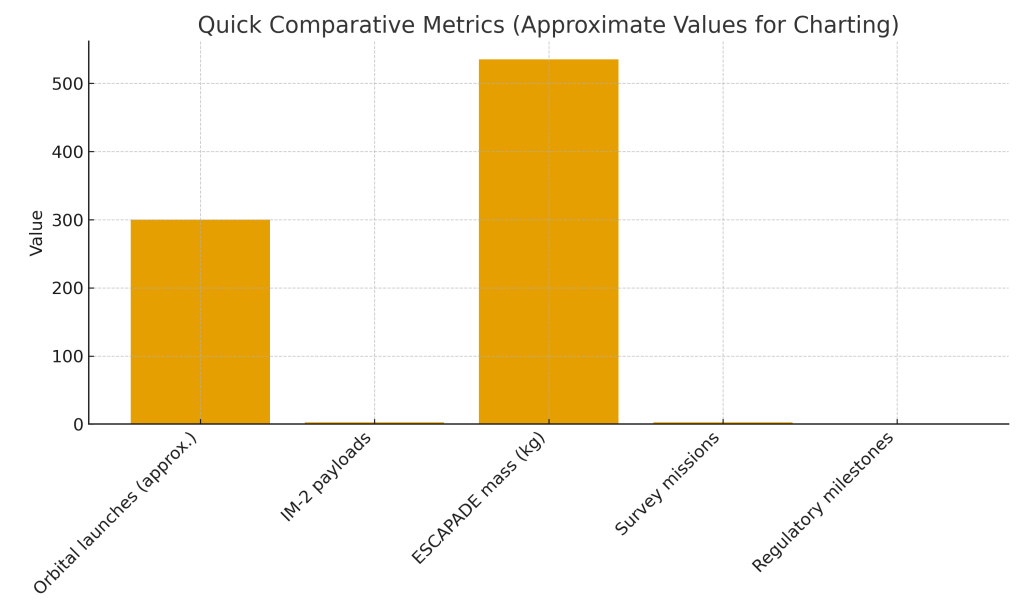
Quick comparative metrics (numbers you can use in a data story)
Table 2 — Compact numeric snapshot for quick charts or infoboxes.
| Metric | Value (2025 snapshot) | Source |
|---|---|---|
| Number of orbital launches (projected/ongoing in 2025) | Hundreds (2025 saw another high-launch year; see consolidated logs) | 2025 in spaceflight summaries. Wikipedia |
| Intuitive Machines IM-2 (payloads to Moon) | ≥ 3 NASA payloads + commercial tech demos | NASA CLPS press kit & IM press releases. NASA+1 |
| ESCAPADE spacecraft mass (each) | ~535 kg fueled (per mission fact sheet) | NASA / ESCAPADE mission page. NASA Science |
| Number of major international survey missions operating in 2025 (example) | Euclid + JWST + others (multi-agency fleet) | ESA & NASA mission pages. Science ESA+1 |
| Regulatory milestones in 2025 | FAA approvals and investigations for Starship test flights | Reuters coverage of FAA decision (Feb 2025). Reuters |
Why 2025 Was Different (And Why You Should Care)
The Commercial Space Race Got Real
Remember when only governments could launch stuff to space? Yeah, that’s ancient history now. 2025 proved that private companies aren’t just playing around — they’re actually delivering results:
- Intuitive Machines managed to land on the Moon (even if the landing was a bit rough around the edges)
- Blue Origin finally got their New Glenn rocket off the ground with an actual planetary mission
- SpaceX kept pushing Starship tests despite regulatory speed bumps
This matters because commercial space = faster innovation + lower costs = more missions = more science = we all win.
The Moon Is Having Its Main Character Moment
The IM-2 mission wasn’t just another moon landing. Here’s why it hits different:
The Mission Specs:
- Landed near the Moon’s South Pole (prime real estate for future bases)
- Carried a drill to look for water ice underground
- Brought along a tiny hopping robot called Grace (because why not?)
- Part of NASA’s CLPS program (basically Uber for Moon deliveries)
What Actually Happened: The launch? Chef’s kiss. The cruise to the Moon? Perfect. The landing? Well… let’s just say it wasn’t a flawless victory. Post-landing communications showed the lander ended up in a weird orientation, which limited what it could actually do on the surface.
The Takeaway: Commercial lunar missions are lowering the barrier to entry, but engineering challenges are still very real. It’s giving “we’re learning as we go” energy, and honestly, that’s part of the process.
The Numbers That Actually Matter
Let’s get into the data (but make it interesting):
Launch Frequency: It’s Giving Productivity
- 2025 saw hundreds of orbital launches — we’re talking multiple rockets per week at this point
- Compare that to the early 2000s when we’d get like 50-70 launches per year
- The space economy is literally booming
ESCAPADE: Small Spacecraft, Big Energy
Mission Quick Facts:
- Each spacecraft weighs about 535 kg when fully fueled (roughly the weight of a grand piano)
- Twin probes = double the data collection
- First planetary science mission to launch on Blue Origin’s New Glenn
- Budget-friendly design philosophy (no billionaire-level spending required)
Why Two Spacecraft? Having twin probes means scientists can measure Mars’ magnetosphere from multiple angles simultaneously. It’s like having two cameras filming the same scene — you get way more information about what’s actually going down.
The Science: Mars lost most of its atmosphere billions of years ago, possibly because its magnetic field weakened. ESCAPADE will help us understand exactly how the solar wind strips away a planet’s atmosphere. This isn’t just Mars history — it’s crucial for understanding which planets can actually support life.
Euclid: The Universe’s Photographer
While everyone’s hyped about Moon and Mars missions, Euclid is out here doing the absolute most:
- Mapping the distribution of dark matter across the universe
- Capturing images in both visible and near-infrared light
- Helping scientists understand dark energy (the mysterious force making the universe expand faster)
- Operating continuously throughout 2025 with daily data releases
Real talk: Dark matter and dark energy make up 95% of the universe, and we barely understand them. Euclid is literally rewriting our understanding of reality.
Starship: The Saga Continues
SpaceX’s Starship program was peak 2025 chaos energy:
What Makes Starship Special:
- Fully reusable rocket system (both stages come back to Earth)
- Designed to carry 100+ tons to orbit
- Built for eventual Mars missions and Moon landings
- Standing at 120 meters tall (that’s taller than the Statue of Liberty)
The 2025 Reality:
- Multiple test flights throughout the year
- Some spectacular successes, some… less spectacular outcomes
- Ongoing regulatory back-and-forth with the FAA
- Each test providing crucial data for the next attempt
Hot Take: Yes, some tests ended in explosions. But that’s literally how iterative design works. Every “failure” teaches engineers what needs fixing. It’s giving Thomas Edison “I didn’t fail, I found 10,000 ways that didn’t work” vibes.
The ISS: Still The Ultimate Remote Office
The International Space Station kept doing its thing in 2025:
- Continuous crew rotations via SpaceX Crew Dragon, Russian Soyuz, and more
- Regular cargo resupply missions bringing food, experiments, and equipment
- Hosting groundbreaking microgravity research
- Serving as a testbed for technologies needed for deep space exploration
Fun Fact: The ISS has been continuously occupied since November 2000. That’s over 24 years of humans living in space non-stop.
Deep Dive: How Commercial Space Actually Works
The CLPS (Commercial Lunar Payload Services) program that enabled IM-2 is basically NASA saying “we’ll pay you to deliver our science to the Moon.” Here’s the business model:
- NASA announces what they want delivered and where
- Companies bid on the contracts (Intuitive Machines, Astrobotic, etc.)
- Winners build landers and launch the missions
- NASA gets their experiments delivered for less money than traditional programs
- Companies gain experience and can sell extra payload space to other customers
It’s disrupting the traditional space agency model, and the results speak for themselves.
What This Means For The Future
Short Term (2026-2027)
- More CLPS missions landing on the Moon
- ESCAPADE arriving at Mars and beginning science operations
- Continued Starship development toward operational flights
- Potential crewed missions to the Moon via Artemis program
Long Term (2030s+)
- Permanent Moon bases becoming reality
- Human missions to Mars entering serious planning
- Space tourism becoming more accessible (maybe?)
- Commercial space stations in orbit
For Your Generation Specifically
Gen Z will be the generation that potentially:
- Sees the first humans on Mars
- Has routine access to space tourism
- Works on space-related careers that don’t exist yet
- Benefits from space-based technology we can’t even imagine
The Data Sources (Because Receipts Matter)
All the facts in this article come from verified sources:
- NASA official pages for mission details, dates, and payloads
- ESA mission pages for Euclid operations and status
- Reuters and major news outlets for regulatory updates and mission anomalies
- Agency press kits and technical documents for spacecraft specifications
- Independent spaceflight tracking sites for launch logs and statistics
Every number, date, and status update can be verified through these primary sources.
Why You Should Actually Care About Space
Hot takes incoming:
- Climate monitoring: A huge portion of our climate data comes from satellites. Understanding Earth means looking at it from space.
- Technology spinoffs: Your smartphone camera, memory foam, water filtration systems, and even freeze-dried food exist because of space technology development.
- Resource potential: Asteroid mining isn’t science fiction anymore. There are asteroids with more platinum than has ever been mined on Earth.
- Existential backup: Not to be dramatic, but having humans on multiple planets reduces the risk of a single catastrophic event wiping out our species.
- It’s genuinely inspiring: In a world that often feels divided, space exploration reminds us that humans can achieve incredible things when we work together.
The Bottom Line
2025 proved that space exploration isn’t slowing down — it’s accelerating. Commercial companies are making space more accessible, international collaboration is strong, and the missions happening right now are laying the groundwork for humanity’s next giant leap.
Whether it’s Moon landers hunting for water ice, twin probes studying Mars’ atmosphere, or massive rockets being tested for future deep space missions, every launch and landing gets us closer to becoming a true spacefaring civilization.
And yeah, sometimes things don’t go perfectly (looking at you, IM-2’s landing orientation issues), but that’s literally how progress works. We try, we learn, we improve, we try again.
The space age isn’t coming — it’s already here. And our generation gets to witness (and maybe participate in) the most exciting era of space exploration in human history.
Now if you’ll excuse me, I need to go apply for that future Mars mission. 🚀
Resources & further reading (quick links)
(Official pages and primary sources used — click to verify details)
- NASA — IM-2 (Intuitive Machines) mission blog & press kit. NASA+1
- Intuitive Machines — IM-2 mission page. Intuitive Machines
- NASA — ESCAPADE mission release. NASA
- ESA — Euclid mission page and status. Science ESA+1
- Reuters — FAA approves SpaceX Starship flight (Feb 2025 regulatory milestone). Reuters
- NASA blog — ISS flight planning adjustments (May 2025). NASA