


The landscape of healthcare is undergoing a remarkable transformation. What was once confined to hospital wards and doctor’s offices is increasingly moving to our wrists, our bodies, and our daily lives. Wearable health technology has emerged from the shadows of experimental gadgetry to become a mainstream force in how we understand, monitor, and manage our well-being.
From the early days of basic pedometers to today’s sophisticated smartwatches capable of detecting irregular heart rhythms, the evolution has been nothing short of extraordinary. These devices are no longer simply counting steps or estimating calories burned. They’re becoming genuine health companions, offering insights that were once available only through clinical testing and professional medical evaluation.
The Growing Significance of Wearable Health Technology
Why This Technology Matters Now
We stand at a unique moment in healthcare history. The convergence of several trends—an aging global population, rising rates of chronic disease, increasing healthcare costs, and rapid technological advancement—has created both urgent challenges and unprecedented opportunities. Wearable health technology sits squarely at this intersection, offering practical solutions to some of our most pressing health concerns.
Consider the traditional model of healthcare: reactive, episodic, and often disconnected from daily life. You feel unwell, schedule an appointment, visit a clinic, receive a diagnosis, and perhaps get prescribed treatment. But what happens between those visits? What patterns emerge in your sleep, your activity levels, your heart rate variability during the weeks and months between check-ups? This is where wearables excel—filling the gaps that conventional healthcare leaves behind.
The Core Value Propositions
Continuous, Real-Time Monitoring
Perhaps the most fundamental advantage of wearable health devices is their ability to provide continuous monitoring. Traditional healthcare operates on snapshots—your blood pressure during a single office visit, your heart rate when the nurse takes it, your weight at your annual physical. But health isn’t static. It fluctuates throughout the day, responds to stress and activity, and exhibits patterns that only become visible over time.
Wearables capture this dynamic reality. They track your heart rate every few seconds, monitor your sleep architecture throughout the night, and record your physical activity across weeks and months. This continuous stream of data provides context that episodic measurements simply cannot. A single elevated blood pressure reading might be anxiety about the doctor’s visit—the so-called “white coat syndrome.” But consistently elevated readings at home, captured by a wearable device, tell a different story entirely.
The Shift Toward Prevention
We’ve long heard that prevention is better than cure, yet our healthcare system remains largely oriented toward treating illness rather than maintaining wellness. Wearables help shift this paradigm by making preventive care tangible and actionable. When your fitness tracker shows declining activity levels over several months, when your smartwatch detects increasingly irregular sleep patterns, or when continuous glucose monitoring reveals pre-diabetic trends, you’re receiving early warning signals—opportunities to intervene before minor issues become major health crises.
This preventive potential extends beyond individual behavior. Early detection of atrial fibrillation, for instance, can prevent strokes. Identifying sleep apnea through wearable data can reduce cardiovascular risk. Catching the early signs of infection through resting heart rate changes might prompt timely medical attention. These aren’t theoretical benefits; they’re increasingly documented in clinical research and real-world applications.
Empowerment Through Information
There’s something profoundly empowering about understanding your own body. Wearables democratize health data, transforming information that was once accessible only through medical professionals into insights you can view on your smartphone. This transparency matters. When people can see how their behaviors affect their health metrics—how a poor night’s sleep correlates with reduced cognitive performance the next day, or how regular exercise improves their resting heart rate over time—they’re more likely to make positive changes.
This empowerment also shifts the doctor-patient dynamic. Instead of passive recipients of medical advice, wearable users come to appointments armed with data about their actual lived experience. The conversation changes from “How have you been feeling?” to “I’ve noticed my heart rate has been elevated at night—here’s the data over the past month.” This collaborative approach to healthcare represents a fundamental evolution in how we think about medical care.
Supporting Chronic Disease Management
For the millions living with chronic conditions—diabetes, hypertension, heart disease, respiratory conditions—wearables offer a pathway to better management. Continuous glucose monitors allow diabetics to see in real-time how different foods affect their blood sugar, enabling more precise insulin dosing and dietary choices. Blood pressure monitors integrated into smartwatches help hypertensive patients track their condition throughout the day, not just during occasional clinic visits.
The impact on quality of life can be substantial. Rather than living with uncertainty between medical appointments, people with chronic conditions gain visibility into their health status. They can identify what triggers exacerbations, understand what interventions work, and feel more in control of conditions that might otherwise feel overwhelming.
Enabling Remote Care and Telehealth
The COVID-19 pandemic accelerated the adoption of telemedicine, but it also highlighted a critical challenge: how do you provide effective remote care without the ability to examine patients or review objective health data? Wearables help bridge this gap. When patients can share continuous data from their devices—heart rate trends, activity levels, sleep quality, oxygen saturation—clinicians can make more informed decisions remotely.
This capability is particularly valuable for elderly patients, those in rural areas with limited healthcare access, and individuals managing multiple chronic conditions. Remote patient monitoring powered by wearables can reduce unnecessary hospital visits, catch deteriorating conditions early, and provide peace of mind for both patients and their care teams.
Understanding the Market: Data and Projections
Current Market Landscape
The wearable health technology market has experienced explosive growth over the past decade, and all indicators suggest this momentum will continue. Understanding the scale and trajectory of this market helps contextualize why this technology matters and where it’s heading.
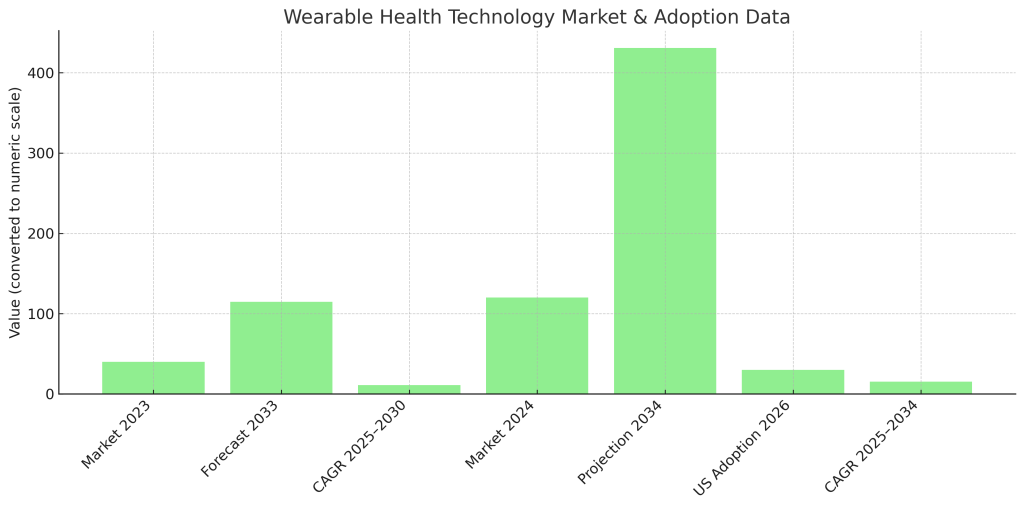
| Metric | Value / Trend | Source |
|---|---|---|
| Global wearable healthcare devices market size (2023) | USD 39.9 billion | (GlobeNewswire) |
| Forecasted market size by 2033 | USD 114.8 billion | (GlobeNewswire) |
| CAGR (Compound Annual Growth Rate) 2025–2030 (Market & Markets) | 10.9% | (MarketsandMarkets) |
| Wearable medical devices market size (2024) per GMI Insights | USD 120.1 billion | (Global Market Insights Inc.) |
| Alternative projection for medical wearables by 2034 | USD 430.76 billion | (GlobeNewswire) |
| Adoption among U.S. adults (for health purposes, by 2026) | ~30% | (Coolest Gadgets) |
| Global forecast for wearable medical device growth (2025–2034) | ~15.4% CAGR | (vantagemarketresearch.com) |
Interpreting the Numbers
These figures tell a compelling story. First, there’s considerable variation in market size estimates depending on how broadly “wearable health technology” is defined. Some figures focus specifically on consumer wellness devices—fitness trackers and smartwatches with health features. Others encompass clinical-grade medical devices like continuous glucose monitors, cardiac monitors, and diagnostic patches. This definitional variance partly explains why estimates range from tens of billions to hundreds of billions of dollars.
Second, the projected growth rates are consistently robust, ranging from roughly 11% to over 15% annually. For context, this far exceeds general economic growth rates in developed countries. It suggests that wearable health technology isn’t just growing with the economy—it’s capturing increasing market share within healthcare spending and consumer technology budgets.
Third, current adoption rates suggest we’re still in relatively early stages. If approximately 30% of U.S. adults are using wearables for health purposes, that means 70% are potential future adopters. Given that the United States typically leads in consumer technology adoption, global penetration rates are likely even lower. This represents substantial room for growth.
Market Drivers
Several factors are propelling this growth:
Consumer Health Awareness: Growing recognition of the importance of preventive health and wellness is driving consumer interest. People want to be proactive about their health, and wearables provide tangible tools to do so.
Technological Advancement: Sensors are becoming smaller, more accurate, and more power-efficient. Battery life is improving. Data analytics capabilities are expanding. What was impossible or impractical five years ago is now commercially viable.
Healthcare System Pressures: Rising healthcare costs, physician shortages, and the burden of chronic disease are pushing healthcare systems to explore more efficient models of care delivery. Wearables offer a scalable approach to monitoring and managing health.
Aging Demographics: As populations age, particularly in developed countries, the prevalence of chronic conditions requiring ongoing monitoring increases. Wearables help address this need without proportionally increasing the burden on healthcare infrastructure.
Insurance and Employer Interest: Health insurers and employers increasingly see value in wearables as tools to encourage healthy behavior and potentially reduce long-term healthcare costs. Some are offering subsidized devices or wellness program incentives tied to wearable use.
Real-World Benefits: Evidence and Applications
Moving beyond market projections, what tangible benefits do wearables actually deliver? The evidence base is growing, and while not every claim is fully validated, several applications show genuine promise.
Cardiac Health Monitoring and Early Detection
Perhaps no application has garnered more attention—and clinical validation—than the use of wearables for cardiac monitoring. Modern smartwatches equipped with electrocardiogram (ECG) sensors can detect atrial fibrillation (AFib), the most common form of irregular heartbeat. AFib significantly increases stroke risk, but it’s often asymptomatic and can go undetected for years.
Studies have demonstrated that wrist-based ECG devices can identify AFib with high sensitivity and specificity. The Apple Heart Study, which enrolled over 400,000 participants, found that irregular pulse notifications prompted users to seek medical attention, with 34% of those who received notifications subsequently being diagnosed with AFib by their physicians. While false positives remain a concern, the potential to catch AFib before it causes a stroke is clinically meaningful.
Beyond AFib detection, wearables are increasingly monitoring other cardiac parameters. Heart rate variability—the variation in time between heartbeats—is emerging as a valuable indicator of stress, recovery, and overall cardiovascular health. Some devices monitor blood oxygen saturation, which can detect respiratory issues or sleep apnea. Advanced medical-grade wearables can even monitor blood pressure continuously, providing a much more comprehensive picture than occasional clinic readings.
The implications extend to cardiac rehabilitation. Patients recovering from heart attacks or heart surgery can be monitored remotely through wearable devices, allowing clinicians to track recovery progress and intervene quickly if concerning patterns emerge. This extends high-quality cardiac care beyond the hospital and into patients’ daily lives.
Sleep: The Forgotten Pillar of Health
We spend roughly a third of our lives sleeping, yet until recently, understanding sleep quality required expensive sleep studies in clinical laboratories. Wearables have brought sleep monitoring into the mainstream, and the insights they provide are proving valuable both for individuals and clinicians.
Modern sleep tracking goes beyond simply recording how long you slept. Devices use accelerometers and heart rate sensors to estimate sleep stages—light sleep, deep sleep, and REM (rapid eye movement) sleep. While not as precise as polysomnography (the gold standard sleep study conducted in labs), wearable sleep tracking provides a reasonable approximation that’s far better than nothing.
For individuals, this data can be revelatory. Seeing objective data about sleep disruptions, time spent in different sleep stages, and correlations between daytime behaviors and nighttime sleep quality can motivate improvements in sleep hygiene. Going to bed at consistent times, reducing caffeine intake, managing stress, and optimizing bedroom environment—these common-sense recommendations become more compelling when you can see their effects in your own data.
Clinically, sleep data from wearables is helping identify potential sleep disorders. Patterns of frequent awakening, low oxygen saturation during sleep, or severely disrupted sleep architecture might indicate sleep apnea, a condition affecting millions that often goes undiagnosed. While a wearable can’t definitively diagnose sleep apnea, it can prompt individuals to seek proper evaluation.
Research is also revealing how sleep quality affects virtually every aspect of health—cognitive performance, immune function, metabolic health, and cardiovascular risk. Wearables are making these connections visible, potentially motivating people to prioritize sleep as the foundational health behavior it is.
Managing Chronic Conditions: Diabetes and Beyond
For people living with chronic conditions, wearables are transitioning from interesting gadgets to essential management tools. Continuous glucose monitors (CGMs) exemplify this transformation. Initially developed for type 1 diabetics who need intensive insulin management, CGMs are now being used by type 2 diabetics and even non-diabetics interested in understanding their metabolic health.
CGMs provide real-time glucose readings throughout the day and night, revealing how different foods, activities, stress levels, and sleep affect blood sugar. This granular feedback enables much more precise management. Instead of making dietary decisions based on general guidelines and occasional finger-stick tests, users can see exactly how their body responds to specific meals and adjust accordingly.
The impact on diabetes management has been significant. Studies show that CGM use is associated with better glycemic control, reduced hypoglycemic events, and improved quality of life. Users report feeling more confident managing their condition and less anxious about unexpected blood sugar fluctuations.
Beyond diabetes, wearables are supporting management of cardiovascular disease, respiratory conditions, and neurological disorders. Cardiac patients might wear monitors that detect arrhythmias or track heart failure indicators. People with COPD or asthma can monitor respiratory rate and blood oxygen. Individuals with Parkinson’s disease can use wearable sensors that track tremors and movement patterns, helping optimize medication timing.
Promoting Physical Activity and Behavioral Change
While medical applications garner headlines, the most widespread use of wearables remains fitness and activity tracking. The simple step counter, once a standalone device, is now embedded in virtually every smartphone and fitness tracker. But does counting steps actually change behavior?
The evidence suggests that, for many people, it does—at least initially. Studies have shown that fitness tracker users tend to increase their physical activity, at least in the short to medium term. The mechanisms are straightforward: setting goals, receiving feedback, and seeing progress creates motivation. Social features—sharing achievements with friends, competing in challenges—add another layer of engagement.
The gamification of physical activity has real health implications. Even modest increases in activity—say, going from sedentary to walking 30 minutes daily—yield substantial health benefits. Reduced cardiovascular risk, better weight management, improved mood, enhanced cognitive function—physical activity is perhaps the single most impactful health behavior, and anything that increases activity deserves attention.
However, maintaining engagement is challenging. The initial enthusiasm often wanes. This is where more sophisticated wearables are evolving, incorporating coaching features, adaptive goal-setting, and integration with broader health management platforms. The next generation of activity promotion may be less about raw step counts and more about personalized recommendations based on comprehensive health data.
Supporting Mental Health and Stress Management
An emerging and particularly promising application of wearables is in mental health. While mental health challenges are complex and multifaceted, wearables can provide objective data that complements subjective experience.
Several metrics show promise. Heart rate variability, mentioned earlier in the cardiac context, also serves as an indicator of autonomic nervous system balance and stress response. Consistently low HRV may suggest chronic stress or poor recovery. Resting heart rate changes can signal stress, overtraining, or the onset of illness. Sleep disruption often correlates with mental health challenges—anxiety and depression both frequently manifest in altered sleep patterns.
Some wearables are now incorporating explicit stress monitoring features, using algorithms that combine multiple physiological signals. While not diagnostic tools, these features can help users recognize when they’re experiencing elevated stress and prompt stress-management interventions—breathing exercises, meditation, physical activity, or simply awareness.
The integration of wearables with mental health apps and digital therapeutics represents an exciting frontier. Imagine a comprehensive system that tracks your physiological indicators, identifies patterns associated with anxiety or low mood, and proactively suggests evidence-based interventions. We’re not there yet, but the foundation is being built.
Contributing to Research and Public Health
Beyond individual benefits, the aggregated data from millions of wearable devices represents an unprecedented resource for health research and public health surveillance. When users consent to share their data (in anonymized form), researchers gain access to population-level insights that were previously impossible to obtain.
Studies leveraging wearable data have explored questions ranging from seasonal patterns in physical activity to the impact of air quality on cardiovascular metrics. During the COVID-19 pandemic, researchers investigated whether wearable data—particularly resting heart rate and heart rate variability—could detect infection before symptoms appeared. While results were mixed and the approach remains experimental, it illustrates the potential for wearables to contribute to early disease detection at a population scale.
Public health officials could potentially use wearable data to track health trends in near real-time, identify high-risk populations, and evaluate the effectiveness of interventions. Of course, this requires careful attention to privacy, consent, and data governance—topics we’ll address shortly.
Navigating the Challenges: Privacy, Accuracy, and Adoption
For all their promise, wearables face significant challenges that must be acknowledged and addressed if the technology is to achieve its potential.
Data Privacy and Security: The Central Concern
Wearable health devices collect intimate, continuous data about our bodies and behaviors. Where we go, how we sleep, our heart rate throughout the day, our activity levels—this information is deeply personal. The question of who has access to this data, how it’s used, and how it’s protected is not just technical; it’s fundamental to whether people will trust and adopt these technologies.
The concerns are not hypothetical. Data breaches affecting health information occur regularly. The potential for misuse—by insurers seeking to adjust premiums based on activity levels, by employers monitoring employee health, by marketers targeting vulnerable individuals—is real and troubling. Even well-intentioned uses can become problematic if consent is unclear or data is shared beyond what users expect.
Current regulatory frameworks are struggling to keep pace. In the United States, the Health Insurance Portability and Accountability Act (HIPAA) protects certain health information, but much wearable data falls outside its scope because the devices are marketed for wellness rather than medical purposes. The European Union’s General Data Protection Regulation (GDPR) offers broader protections, but enforcement and compliance vary.
Researchers and technologists are exploring solutions. Blockchain-based consent mechanisms could give users more granular control over who accesses their data and for what purposes. Federated learning—a machine learning approach where models are trained on decentralized data without raw data ever leaving users’ devices—could enable research and personalization while preserving privacy. Differential privacy techniques can extract population-level insights while protecting individual identity.
These technical solutions are promising but not sufficient. Clear regulations, transparent data practices, and genuine user control must be the foundation. Companies developing wearables need to prioritize privacy not as a compliance checkbox but as a core value proposition.
Questions of Accuracy and Clinical Validation
Not all wearable health devices are created equal. Some have undergone rigorous clinical validation; others make claims based on minimal evidence. For users and clinicians alike, understanding what data to trust is crucial and often difficult.
The regulatory landscape creates confusion. Medical devices—those intended to diagnose, treat, or prevent disease—must receive regulatory approval (from the FDA in the U.S., similar bodies elsewhere). But many wearables position themselves as wellness or lifestyle devices, explicitly avoiding medical claims to sidestep regulatory requirements. This creates a gray area where devices provide health-related information without the validation expected of medical devices.
Even validated devices have limitations. Optical heart rate sensors, the technology in most wrist-worn devices, work well for most people under most conditions but can be less accurate during high-intensity exercise, in cold conditions, or for users with darker skin tones or certain tattoos. Sleep stage classification, while useful, is less accurate than clinical polysomnography. Step counting can be confounded by certain activities or movements.
This doesn’t necessarily mean wearables are useless—approximations can still be valuable. But users and clinicians need realistic expectations. A smartwatch notification about irregular heart rhythm should prompt medical evaluation, not self-diagnosis. Sleep data from a fitness tracker can identify concerning patterns but shouldn’t replace a sleep study when one is medically indicated.
Moving forward, greater transparency about device accuracy, clearer distinction between medical-grade and wellness devices, and more clinical validation studies will help everyone make better decisions about how to use these tools.
The Challenge of Sustained Engagement
Here’s an uncomfortable truth about wearable health technology: many devices end up in drawers. Studies suggest that approximately 20% of users stop using their devices within a few months, and even among continuing users, engagement often wanes. The initial enthusiasm—checking your stats multiple times daily, religiously closing your activity rings, obsessing over sleep scores—tends to fade.
Why? Several factors contribute. For some, the novelty simply wears off. For others, the data becomes overwhelming or confusing—what does it mean that my HRV was 45 yesterday and 52 today? Is that good? Bad? Should I change anything? Without clear guidance on interpretation and action, data can feel meaningless. Some users find the devices uncomfortable or inconvenient. Others experience “tracking fatigue,” feeling oppressed by constant monitoring rather than empowered.
This engagement challenge matters because unused devices provide no health benefit. The solution likely involves multiple approaches: better user education about interpreting data, more actionable and personalized insights rather than raw numbers, improved device comfort and design, and perhaps most importantly, integration with broader health management systems where wearable data contributes to a larger picture rather than existing in isolation.
Some developers are exploring intermittent tracking—devices that prompt users to track intensively during specific periods but not continuously—as a way to maintain long-term engagement without burnout. Others are focusing on making the devices themselves more pleasant to wear and use, recognizing that even the most powerful features are useless if people won’t wear the device.
Cost and Accessibility: Who Benefits?
High-end smartwatches with comprehensive health features can cost several hundred dollars. Medical-grade continuous glucose monitors require not just device costs but ongoing expenses for disposable sensors. Even mid-range fitness trackers represent a meaningful expense for many households.
This raises important equity concerns. If wearable health technology delivers genuine health benefits, but those benefits are accessible primarily to wealthy individuals in developed countries, we risk exacerbating existing health disparities. The populations that might benefit most from preventive health tools—those with limited access to regular medical care, those at high risk for chronic disease—may be the least able to afford these devices.
Some solutions are emerging. Lower-cost devices with basic but useful features are becoming available. Some health insurance plans and employers subsidize wearables as part of wellness programs, though these initiatives have their own complexities. Researchers and public health officials are exploring whether providing wearables to high-risk populations might be cost-effective from a healthcare system perspective, even if individuals couldn’t afford them.
As the technology matures and manufacturing scales, prices will likely decrease. But intentional effort will be needed to ensure that wearable health benefits don’t remain the province of the privileged.
The Integration Challenge: Making Data Actionable
Even accurate, privacy-protected wearable data from engaged users has limited value if it remains isolated. For wearables to truly transform healthcare, the data must integrate into the broader healthcare ecosystem—electronic health records, care coordination platforms, clinical decision support tools.
This integration is currently limited. Technical challenges around data formatting and interoperability persist. Some healthcare providers are hesitant to incorporate patient-generated data into clinical workflows, concerned about data quality, liability, or simply the time required to review additional information. Reimbursement structures often don’t support clinicians spending time reviewing and acting on wearable data.
These barriers are gradually being addressed. Remote patient monitoring codes now allow for reimbursement of certain wearable-supported care. EHR vendors are developing integration capabilities. Clinical guidelines for incorporating patient-generated data are emerging. But progress is slow, and the gulf between wearable data’s potential and its actual use in clinical care remains substantial.
Looking Forward: The Future of Wearable Health Technology
Despite the challenges, the trajectory of wearable health technology points toward expanding capabilities, deeper integration, and ultimately, meaningful impact on health outcomes.
The Evolution Toward Clinical-Grade Devices
The line between consumer wellness devices and medical-grade equipment will continue to blur. We’re already seeing this with smartwatches that received FDA clearance for ECG and blood oxygen monitoring. Future devices will likely incorporate more sophisticated sensors—continuous blood pressure monitoring, non-invasive glucose sensing, advanced respiratory monitoring, perhaps even biomarkers currently requiring blood tests.
This evolution requires maintaining appropriate regulatory oversight while not stifling innovation. Clearer pathways for validating and approving wearable health technologies, international harmonization of standards, and ongoing post-market surveillance to ensure real-world performance matches clinical claims will all be important.
Artificial Intelligence and Predictive Analytics
The true power of continuous health monitoring may lie not in any single measurement but in patterns across multiple data streams over time. This is where artificial intelligence and machine learning become transformative.
Imagine a system that learns your individual baselines and patterns—how your resting heart rate, HRV, sleep quality, and activity levels normally relate to each other. It could then identify subtle deviations that might indicate illness, overtraining, high stress, or the need for medical attention. It might predict when you’re getting sick before symptoms appear, or identify heart failure decompensation before it becomes acute, or detect mental health episodes in their early stages.
Research in this direction is active and promising, though still largely in early phases. The challenges are substantial—individual variation is high, and predictive accuracy must be robust before clinical decisions are made based on algorithms. But the potential is real, and we’ll likely see increasing sophistication in the insights wearables can provide.
Toward Truly Personalized Health
Medicine has long aspired to be personalized—treatments and recommendations tailored to the individual rather than applied uniformly. Wearables offer a pathway toward this vision, providing the granular, longitudinal data needed to understand individual response and variation.
Consider nutrition. General dietary guidelines exist, but individuals vary enormously in how they respond to different foods. Continuous glucose monitoring combined with food logging can reveal your personal metabolic response to specific meals, enabling truly personalized dietary recommendations. Similar personalization could apply to exercise—identifying the types, intensity, and timing of physical activity that benefit you specifically. Or sleep—understanding your individual sleep needs and optimization strategies.
This personalized approach extends to medication management. Wearables could help titrate medications based on continuous monitoring rather than periodic check-ins. They could identify when medications need adjustment, or flag potential side effects through changes in physiological patterns.
Building Privacy-Preserving Infrastructure
As wearable data becomes more integrated into healthcare and research, robust privacy-protecting infrastructure will be essential. The technologies exist—federated learning, secure multi-party computation, blockchain for consent management, differential privacy, zero-knowledge proofs. The challenge is implementing them in usable, scalable ways.
We may see the emergence of personal health data trusts or cooperatives—organizations that manage individuals’ health data on their behalf, ensuring it’s used only with informed consent and in ways that align with owners’ values. Regulatory frameworks will likely evolve, potentially creating special categories for continuous health monitoring data with enhanced protections.
The goal should be enabling the beneficial uses of wearable data—clinical care, research, public health—while preventing misuse and preserving individual autonomy and privacy. This balance is achievable but requires commitment and thoughtful design.
Integration into Comprehensive Care Models
The future of wearable health technology likely lies not in standalone devices but in integration with comprehensive health management ecosystems. Imagine a system where your wearable data flows seamlessly into your health record, where algorithms flag concerning patterns for your care team’s attention, where personalized health recommendations consider not just your wearable metrics but your medical history, genetic information, environmental exposures, and personal goals.
This vision requires breaking down current silos. Healthcare systems, technology companies, payers, and regulators must collaborate to create interoperable, patient-centered ecosystems where data serves the individual’s health goals. It requires moving beyond fee-for-service models that don’t value prevention and monitoring. It requires cultural change in healthcare, where patient-generated data is seen as valuable rather than burdensome.
Progress is happening. Accountable care organizations, value-based payment models, and innovative care delivery organizations are experimenting with comprehensive approaches that incorporate wearables. As evidence for effectiveness grows and reimbursement models evolve, adoption will likely accelerate.
Democratizing Access
Realizing wearable health technology’s promise requires ensuring broad access. This might involve multiple strategies: continued cost reduction through technological improvement and scale, public health initiatives that provide devices to high-risk populations, insurance coverage and employer programs, and creative financing models.
Some envision wearable devices as public health infrastructure—provided to communities the way water systems or vaccination programs are, as a fundamental enabler of population health. While this may seem far-fetched, if wearables prove effective at reducing healthcare costs through prevention and early intervention, the investment might be justified.
Accessibility also means designing for diverse users—devices that work across different body types, skin tones, ages, and abilities. It means interfaces that don’t require high health literacy or technical sophistication. It means culturally appropriate approaches that resonate with diverse communities.
Practical Guidance: Making Wearables Work for You
For individuals considering whether to use wearable health technology, or trying to get more value from devices they already own, some practical guidance:
Start with clear goals. Don’t buy a device just because it’s trendy. What health aspects do you want to monitor or improve? Better sleep? More physical activity? Understanding your heart health? Choose a device aligned with your priorities.
Set realistic expectations. Wearables provide useful information, but they’re not medical devices (unless explicitly approved as such). They complement but don’t replace professional healthcare.
Focus on trends, not individual readings. Day-to-day variation is normal and often noise. What matters is patterns over weeks and months. Is your resting heart rate trending down with training? Are you gradually increasing activity? Are sleep patterns improving?
Take action on insights. Data without action is just numbers. If your device shows you’re consistently not getting enough sleep, use that information to change your habits. If your activity is declining, figure out what barriers exist and address them.
Protect your privacy. Review privacy settings carefully. Understand what data is shared and with whom. Be cautious about connecting devices to unnecessary apps or services. Consider whether the benefits of sharing data (with researchers, your doctor, friends) outweigh privacy concerns.
Don’t let tracking become stressful. If constantly monitoring your health metrics creates anxiety rather than empowerment, step back. Consider less frequent checking, or taking breaks from wearing the device. Health tracking should serve your wellbeing, not undermine it.
Combine wearable data with how you feel. Technology isn’t infallible. If your device says you slept well but you feel exhausted, trust your subjective experience. The data provides one perspective; your lived experience matters more.
Share relevant data with your healthcare providers. If you notice concerning patterns, bring that information to medical appointments. Clinicians may not always know how to interpret wearable data, but it can still inform conversations and decisions.
Conclusion: An Evolving Partnership in Health
Wearable health technology represents neither a panacea nor a passing fad. It’s a genuine innovation that’s finding its place in the complex ecosystem of health and healthcare. The market growth, clinical applications, and research evidence all point to lasting impact.
The benefits are real but nuanced. For some people in some situations, wearables provide transformative health insights and management tools. For others, they’re interesting but not life-changing. The technology works best when integrated into broader health management strategies, supported by clinical care when appropriate, and used thoughtfully rather than obsessively.
The challenges are equally real. Privacy concerns must be addressed through better regulation, transparent practices, and privacy-preserving technologies. Accuracy and clinical validation need continued attention. Sustained engagement requires better design and clearer value propositions. Accessibility demands intentional effort to prevent worsening health disparities.
Looking forward, wearable health technology will likely become more sophisticated, more integrated, and more personalized. The devices on our wrists today are primitive compared to what we’ll see in five or ten years. Artificial intelligence will extract more meaningful insights from continuous data. Integration with healthcare systems will deepen. New sensors will monitor parameters we can’t easily track today.
But fundamentally, wearables are tools—powerful tools with real potential, but tools nonetheless. Their value depends on how we use them, the systems we build around them, and whether we can navigate the challenges while capturing the benefits. The goal isn’t technology for its own sake but better health outcomes, greater empowerment, and healthcare systems that serve people more effectively.
As individuals, clinicians, researchers, policymakers, and technology developers continue collaborating and learning, wearable health technology can become what it promises to be: a genuine partner in the pursuit of better health, accessible to all who might benefit, respectful of privacy and autonomy, and integrated thoughtfully into the broader project of caring for ourselves and each other.
The journey has begun, but we’re still in early chapters. The coming years will determine whether wearable health technology fulfills its considerable promise or remains a useful but limited tool. The choices we make—about privacy protection, equitable access, clinical validation, and human-centered design—will shape that outcome. The opportunity is substantial; so is the responsibility to get it right.
References and Further Reading
- Global market intelligence reports from Global Growth Insights analyzing the wearable healthcare devices market trajectory and key drivers
- Industry forecasts and analysis from Statifacts and Precedence Research on market sizing and compound annual growth rates
- Markets & Markets comprehensive research on wearable medical device definitions, market segmentation, and growth projections across regions and device categories
- Global Market Insights extensive reports on medical device market dynamics, including regulatory landscape and technological innovations
- Vantage Market Research long-term projections for wearable medical devices with scenario analyses
- Consumer adoption studies and behavioral research from Coolest-Gadgets examining usage patterns and engagement challenges
- Academic research on privacy-preserving technologies including blockchain consent mechanisms and federated learning applications in healthcare (ArXiv)
- Clinical validation studies on wearable cardiac monitoring, sleep tracking, and chronic disease management efficacy
- Regulatory guidance documents from health authorities on classification and approval pathways for wearable health devices


