



New founders often hear that they need a pitch deck. But what is a pitch deck, exactly?
A pitch deck is a short visual presentation explaining your business, the problem it solves, the opportunity ahead, and your team. Founders use it to introduce a startup to investors and begin a deeper conversation.
It is not a business plan squeezed into slides. It is the clearest version of your story.
What Is a Pitch Deck in Simple Terms?
In simple terms, a pitch deck is a guided introduction to your business.
Imagine meeting someone who knows nothing about your company. Within a few minutes, they should understand what you do, who you help, and why your approach is worth exploring.
That is the pitch deck meaning in practice: arranging the right information in an order that is easy to follow.
- presented during an investor meeting;
- sent as a PDF before a call;
- shared after an introduction; or
- used internally to help a team explain the business consistently.
What Is the Main Purpose of a Pitch Deck?
The first goal is usually not to secure an investment immediately. It is to create enough clarity and interest for the conversation to continue.
An effective deck helps an investor answer a few basic questions:
- What does this company do?
- What real problem is it solving?
- Who needs the solution, and is there evidence it can work?
- Why is this team suited to build it?
- What is the founder asking for?
Clarity is practical. Several 2024 DocSend Pitch Deck Interest updates reported average review times around two minutes and thirty seconds. It is a snapshot, not a rule, but it shows why a deck should be easy to scan.
Your audience should not have to search through dense paragraphs to discover the main point.
What Does a Pitch Deck Usually Include?
There is no single slide order for every company. A founder with an early idea will tell a different story from a company with revenue, customers, and years of data.
Still, most investor pitch decks cover a familiar set of topics:
- Cover and company purpose — Your name and a clear one-line description.
- Problem — The specific difficulty your target customer faces.
- Solution — How your product or service addresses that problem.
- Product — A simple look at how the solution works.
- Market opportunity — Who the customers are and how large the opportunity may be.
- Business model — How the company makes or plans to make money.
- Traction — Evidence such as users, revenue, pilots, partnerships, or growth.
- Go-to-market plan — How you expect to reach and win customers.
- Competition — The alternatives available and how your approach differs.
- Team — The people building the company and their relevant strengths.
- Financial direction — Key assumptions, projections, or milestones.
- The ask — The funding or support you need and what it will help you achieve.
This is a starting framework, not a box-ticking exercise. Sequoia Capital’s guide follows a similar path from company purpose and customer pain to the solution, market, business model, team, and vision.
The best order is the one that makes your particular story feel logical.
Pitch Deck, Slide Deck, and Business Plan: What Is the Difference?
These formats are related, but they serve different purposes.
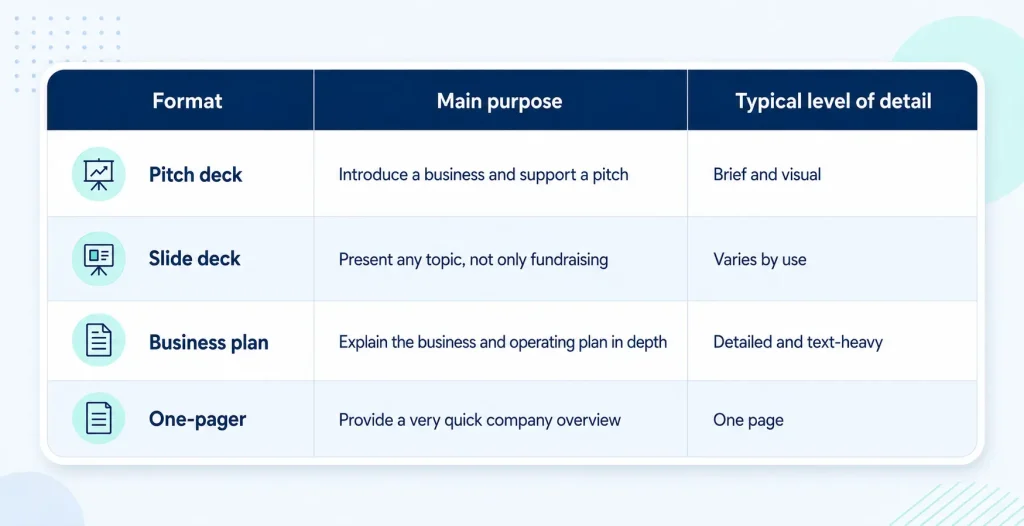
A pitch deck is one kind of slide deck, but a training or sales deck has a different purpose. It also does not replace a business plan or financial model. Those provide deeper detail when needed.
What Makes a Pitch Deck Easy to Understand?
You do not need elaborate graphics on every slide. Visual polish cannot rescue an unclear story.
Start with these simple principles:
- Give each slide one main message.
- Use headlines that communicate a point, not just a topic.
- Replace long paragraphs with short, specific statements.
- Show evidence close to the claim it supports.
- Use charts only when they make the data easier to understand.
- Keep fonts, colours, spacing, and graphic styles consistent.
Y Combinator’s seed-round pitch deck guide is a useful next reference for a focused seed story.
Ask someone unfamiliar with your company to scan the deck. Can they explain the business back to you in one or two sentences? If not, simplify it again.
Common Pitch Deck Mistakes to Avoid
First-time founders often make the deck harder than it needs to be. Common problems include:
- starting with product features before explaining the customer problem;
- using vague claims such as “huge market” without evidence;
- placing several important ideas on one slide;
- adding small text that is difficult to read;
- copying another startup’s slide order without considering context; and
- ending without a clear funding ask or next step.
Design is not decoration. It should help readers notice what matters and move through the story easily.
See this thinking in Malota Studio’s presentation portfolio and guide to winning pitch deck design.
A Simple Way to Start Your Pitch Deck
Do not begin with a PowerPoint template. Write one sentence describing the company, then list the problem, solution, strongest evidence, market, team advantage, and funding goal. Arrange those points before designing individual slides.
Frequently Asked Questions
How long should a pitch deck be?
There is no universal length. About 10 to 15 core slides is a practical starting point, but clarity matters more than a specific number. Move supporting detail to an appendix.
Is a pitch deck only for startups?
No. Established businesses, nonprofits, and project teams can also use one to present an opportunity and ask for support.
Can I send a pitch deck without presenting it?
Yes. A deck sent by email should be understandable on its own, with enough context to prevent confusion.
Do I need a professional designer?
Not always. Professional support becomes valuable when the story is complex, the audience is high-stakes, or the presentation needs a consistent visual system.
Final Thoughts
So, what is a pitch deck? It is a short visual story that helps people understand a business and decide whether to continue the conversation.
Strong decks do not say everything. They present the right information in a clear order, support claims with evidence, and make the next step obvious.
Use Malota Studio’s 12-Slide Pitch Deck Outline as a starting point. If the slides need clarity and polish, explore our presentation work or tell us about your project.