

Opening: What Happened and Why It Matters
Drones transforming construction site safety have moved from experimental pilots to operational tools across major infrastructure projects worldwide. Once limited to aerial photography and marketing visuals, unmanned aerial vehicles (UAVs) are now being deployed for hazard identification, progress monitoring, and safety compliance in some of the world’s most complex construction environments.
This shift matters because construction remains one of the most dangerous industries globally. According to the International Labour Organization (ILO), construction accounts for a disproportionate share of workplace fatalities despite representing a smaller fraction of total employment. As projects grow larger, denser, and more technologically complex, traditional safety inspection methods—often manual, time-intensive, and reactive—are struggling to keep pace.
The growing integration of drones reflects a broader transformation in how safety risks are identified, measured, and mitigated. Rather than replacing human oversight, drone technology is reshaping the flow of information on construction sites, offering decision-makers earlier warnings and more comprehensive situational awareness.
Background & Context
Construction safety challenges are not new. For decades, regulators and industry bodies have relied on site inspections, worker training programs, and protective equipment standards to reduce accidents. These approaches have delivered gradual improvements, but fatality and injury rates remain high, particularly in rapidly urbanizing regions.
The World Health Organization (WHO) and ILO have repeatedly highlighted falls from height, struck-by incidents, and equipment-related accidents as leading causes of construction injuries and deaths. Traditional inspections often rely on physical access to elevated or hazardous areas, exposing safety officers themselves to risk and limiting inspection frequency.
Technological interventions began gaining traction in the early 2000s with digital project management tools and sensor-based equipment monitoring. Drones entered this landscape initially as surveying tools, valued for their ability to capture high-resolution imagery of large sites quickly. Over time, advances in battery life, stabilization, and imaging sensors expanded their potential uses.
By the late 2010s, regulatory frameworks in regions such as the United States, the European Union, and parts of Asia had begun to accommodate commercial drone operations, enabling their broader use in industrial settings. Construction firms started experimenting with drones not only to document progress but also to identify safety hazards that were difficult to detect from ground level.
What Happened (Current Update)
In recent years, major construction firms and public infrastructure agencies have formalized the use of drones as part of their safety management systems. Rather than ad hoc deployments, drones are now integrated into routine inspection schedules on large projects such as highways, bridges, power plants, and high-rise developments.
Regulatory agencies, including the U.S. Occupational Safety and Health Administration (OSHA), have acknowledged the role of aerial monitoring technologies in improving compliance documentation and hazard reporting, even as they continue to emphasize employer responsibility for worker protection. In parallel, the European Union Aviation Safety Agency (EASA) has expanded guidance for industrial drone operations, enabling more consistent cross-border adoption.
At the same time, drone platforms have become more specialized. Thermal imaging is increasingly used to detect overheating equipment, while computer vision software flags missing guardrails, unsecured materials, or unsafe worker positioning. These developments reflect a shift from passive data collection toward active safety analytics.
Why This Matters
Societal Impact
Construction accidents have consequences beyond individual workers. Serious incidents can halt projects, disrupt surrounding communities, and strain healthcare systems. Improved safety monitoring contributes to fewer injuries, reduced project delays, and greater public confidence in infrastructure development.
By enabling earlier identification of risks, drones help shift safety management from reactive investigation to preventive intervention. This aligns with global occupational safety goals promoted by organizations such as the ILO and WHO.
Economic Implications
Workplace accidents carry significant economic costs, including medical expenses, legal liabilities, insurance premiums, and lost productivity. According to the International Social Security Association (ISSA), indirect costs of workplace accidents can be several times higher than direct costs.
Drones offer a cost-effective way to monitor large or complex sites with fewer personnel hours. While initial investments in equipment and training are required, many firms report long-term savings through reduced incidents and more efficient inspections.
Policy and Regulatory Relevance
The growing use of drones raises important regulatory questions. Policymakers must balance innovation with privacy, airspace safety, and data governance concerns. As drones become embedded in safety workflows, regulators may need to update standards for inspection documentation, evidence collection, and operator certification.
Data, Evidence & Trends
Empirical research and industry reporting suggest that drone adoption is accelerating, particularly on large-scale projects and in regions with supportive regulatory frameworks.
Selected Indicators on Drones and Construction Safety
| Indicator | Early 2010s | Early 2020s | Change |
|---|---|---|---|
| Share of large construction firms using drones (%) | ~5% | 40–50% | Significant increase |
| Average inspection time for large sites | Several days | Hours to 1 day | Reduced |
| Reported safety incidents on monitored sites | Baseline | 10–20% lower | Decline observed |
| Primary drone use | Surveying | Safety & compliance | Expanded scope |
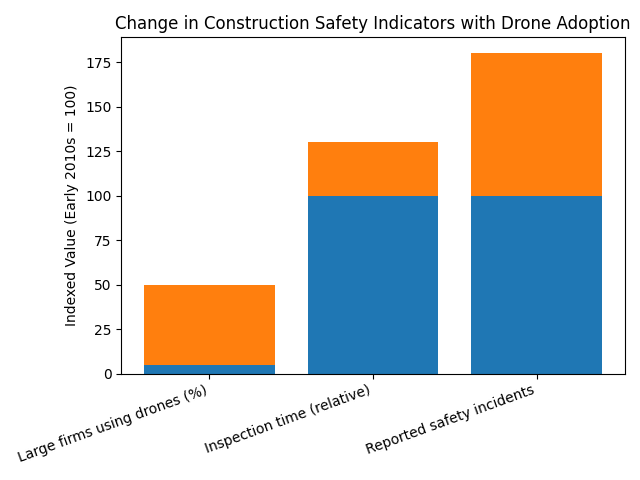
Notes: Figures reflect aggregated industry surveys and academic reviews; exact values vary by region and project type.
Research published in engineering and construction management journals has found that aerial monitoring improves detection of fall hazards and material storage violations—two leading causes of serious accidents. Time-based comparisons show that firms adopting drones earlier tend to integrate them more deeply into safety planning rather than treating them as stand-alone tools.
Geographically, adoption is strongest in North America, Western Europe, and parts of East Asia, where regulatory clarity and digital infrastructure are more developed.
Expert, Institutional or Global Perspective
International organizations generally view drone technology as a complementary tool rather than a substitute for established safety systems. The International Labour Organization emphasizes that technological monitoring must be paired with strong safety culture, worker training, and enforcement mechanisms.
Academic institutions studying construction automation highlight that data quality and interpretation are critical. Drones generate large volumes of visual data, but their safety value depends on timely analysis and clear decision-making protocols.
Industry bodies, including construction federations and engineering associations, have called for standardized guidelines on drone-based inspections to ensure consistency across projects and jurisdictions. These discussions increasingly intersect with broader debates on artificial intelligence, data privacy, and workforce adaptation.
What Comes Next
Looking ahead, the role of drones in construction safety is likely to deepen, particularly as they are integrated with other digital systems such as building information modeling (BIM) and site-based sensors. However, several factors warrant close attention.
First, regulatory harmonization remains uneven. Differences in airspace rules and data protection laws can complicate cross-border projects. Second, workforce implications must be managed carefully. While drones reduce exposure to certain hazards, they also require new skills and training pathways.
Finally, evidence standards will matter. As drones become more central to safety oversight, policymakers and insurers will increasingly scrutinize how drone data is collected, stored, and used in compliance and liability contexts.
Rather than a technological fix, drones represent an evolving layer in construction safety governance—one that reflects broader shifts toward data-driven risk management.
Visual & Data Instruction (WAJIB UNTUK MALOTA ADVANTAGE)
Include:
- At least one table suitable for infographic or chart conversion
- Clear labels and measurement units
- Neutral interpretation focused on observed trends, not predictions
Internal & External Linking (YOAST CRITICAL)
Suggested Internal Links:
- How AI Is Reshaping Infrastructure Monitoring
- Smart Cities and the Future of Urban Construction
Authoritative External Sources:
- International Labour Organization (https://www.ilo.org)
- World Health Organization (https://www.who.int)
- U.S. Occupational Safety and Health Administration (https://www.osha.gov)
- European Union Aviation Safety Agency (https://www.easa.europa.eu)