



Introduction
Environmental impact reporting for projects has moved from a regulatory checkbox to a strategic enterprise discipline. As regulatory scrutiny intensifies and investors demand greater transparency, large organisations are under pressure to demonstrate measurable environmental performance across their project portfolios. According to the World Bank, over 75% of major infrastructure projects globally now require formal environmental impact assessment reporting as part of approval processes.
In our work with enterprise reporting teams, we increasingly see environmental data treated with the same rigour as financial metrics. This shift reflects a broader reality: environmental risk is now operational risk. For project-heavy organisations in energy, construction, technology infrastructure, and industrial sectors, robust project sustainability reporting is becoming essential for maintaining regulatory approval, stakeholder trust, and capital access.
Business context and industry background
Within large enterprises, environmental impact assessment reporting sits at the intersection of compliance, risk management, and corporate strategy. It typically involves cross-functional coordination among sustainability teams, project management offices, legal departments, environmental specialists, and executive leadership.
The stakes are significant. The United Nations Environment Programme reports that environmental non-compliance can increase project costs by up to 20% due to delays, redesigns, and penalties. Meanwhile, institutional investors are increasingly integrating environmental metrics into due diligence processes.
In mature organisations, environmental compliance reporting supports several enterprise objectives:
- Executive visibility into project risk exposure
- Regulatory readiness across jurisdictions
- Investor-grade ESG disclosures
- Operational efficiency improvements
- Long-term asset resilience
Industries with capital-intensive assets—such as utilities, mining, infrastructure, and large-scale manufacturing—are typically the most advanced adopters of structured EIA reporting workflows. However, SaaS and technology companies are also expanding environmental reporting as data centre energy use and supply chain emissions come under scrutiny.
Key challenges companies face
Fragmented data environments
One of the most persistent barriers in environmental impact reporting for projects is data fragmentation. Environmental data often resides across engineering systems, contractor reports, environmental monitoring tools, and manual spreadsheets.
Research from McKinsey & Company indicates that more than 60% of organisations struggle to consolidate ESG data across business units, creating delays and audit risks. Without integration, reporting cycles become slower and less reliable.
Inconsistent methodologies
Enterprises frequently operate across multiple jurisdictions with differing environmental standards. As a result, environmental impact assessment reporting may be performed using inconsistent baselines, assumptions, or calculation methods.
This inconsistency creates several enterprise risks:
- Limited comparability across projects
- Difficulty aggregating portfolio-level impact
- Increased audit complexity
- Reduced confidence from regulators
Late-stage compliance focus
In less mature organisations, environmental compliance reporting is still treated as a late-stage approval exercise rather than an embedded project discipline. This reactive approach often leads to costly redesigns.
The International Association for Impact Assessment has noted that early-stage environmental integration can reduce mitigation costs by 15–25% compared to projects that address impacts late in the lifecycle.
Limited executive visibility
Even when data exists, it is often buried in technical reports that are difficult for executives to interpret. Without clear dashboards and decision-ready summaries, environmental risks may not receive appropriate board-level attention.
Best practices and professional approaches
Embed environmental review early in the project lifecycle
Leading enterprises integrate environmental screening during the feasibility and concept phases. This approach enables project teams to identify high-risk factors before major capital commitments are made.
In practice, mature organisations typically:
- Conduct preliminary impact screening within the first 30–60 days of project initiation
- Flag high-risk projects for full environmental impact assessment
- Align environmental milestones with capital approval gates
This early integration significantly reduces downstream rework.
Standardise the EIA reporting workflow
A consistent EIA reporting workflow improves both efficiency and audit readiness. Enterprises with mature processes often maintain centralised templates, data dictionaries, and review protocols.
Typical benefits include:
- Reporting cycle time reductions of 20–30%
- Improved cross-project comparability
- Lower external assurance costs
- Faster regulatory submissions
Standardisation is especially important for multinational organisations operating under multiple regulatory regimes.
Invest in integrated environmental data platforms
Digital integration is becoming a differentiator in project sustainability reporting. Rather than relying on static documents, many enterprises now deploy environmental data platforms that connect monitoring systems, GIS data, and reporting tools.
Common enterprise capabilities include:
- Automated emissions calculations
- Real-time environmental monitoring feeds
- Role-based dashboards
- Audit trail functionality
These platforms support more frequent and reliable environmental compliance reporting.
Align project reporting with enterprise ESG strategy
High-performing organisations do not treat project-level reporting in isolation. Instead, they align environmental impact reporting for projects with broader ESG frameworks and corporate sustainability goals.
This alignment enables:
- Portfolio-level impact aggregation
- Consistent investor disclosures
- Improved strategic planning
- Stronger narrative coherence in annual reports
Data, reporting, and documentation perspective
From a governance standpoint, environmental reporting must balance technical accuracy with executive clarity. In enterprise environments, reporting typically occurs across multiple layers:
- Operational monitoring — continuous or monthly
- Project reviews — quarterly or at major milestones
- Executive dashboards — quarterly or semi-annual
- External disclosures — annual ESG or sustainability reports
The table below summarises widely cited benchmarks for environmental assessment adoption and compliance risk.
Environmental assessment adoption and risk indicators
| Metric | Value | Source |
|---|---|---|
| Major infrastructure projects requiring EIA | ~75% globally | World Bank |
| Potential project cost increase from environmental non-compliance | Up to 20% | UNEP |
| Organisations struggling with ESG data consolidation | >60% | McKinsey |
| Cost savings from early environmental integration | 15–25% | IAIA |
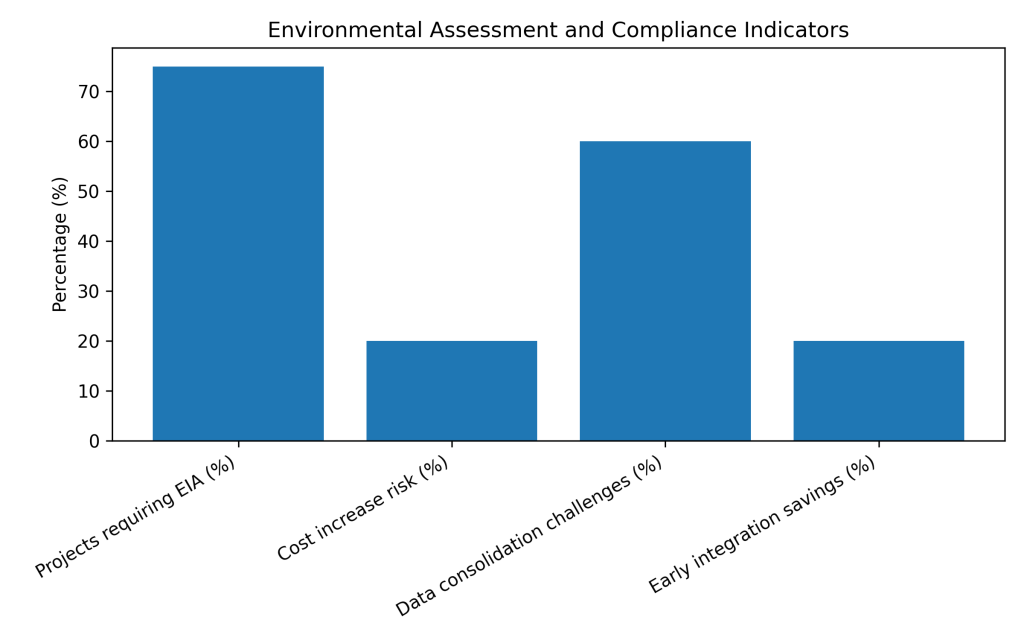
Table note: Data compiled from publicly available reports by the World Bank, UNEP, McKinsey, and IAIA.
In mature enterprises, environmental dashboards are increasingly integrated into enterprise risk management systems. We see growing adoption of:
- Traffic-light risk indicators
- Scenario modelling for environmental exposure
- Automated compliance alerts
- Cross-project benchmarking
Clarity and auditability remain critical. Environmental reports that cannot be traced back to verifiable source data create material risk during regulatory review or third-party assurance.
Common mistakes to avoid
Treating reporting as a documentation exercise
When environmental impact assessment reporting is reduced to document production, organisations miss its strategic value. This often results in delayed risk detection and reactive mitigation.
Enterprises that shift to decision-oriented reporting typically improve project approval timelines by measurable margins.
Overlooking data governance
Weak data governance leads to version conflicts, unverifiable metrics, and audit findings. In large organisations, even a 5–10% data error rate can trigger significant rework during external assurance.
Clear ownership, validation rules, and audit trails are essential.
Underestimating cross-functional coordination
Environmental reporting touches engineering, legal, sustainability, procurement, and executive teams. Without structured workflows, handoffs become a bottleneck.
Symptoms include:
- Missed regulatory deadlines
- Duplicate data requests
- Conflicting impact assumptions
- Extended approval cycles
Failing to design for executive consumption
Highly technical reports that lack clear visualisation often fail to influence decision-making. Executive teams typically require:
- Concise risk summaries
- Comparable project metrics
- Trend visibility
- Financial linkage to environmental exposure
Without these elements, environmental compliance reporting may not receive appropriate strategic attention.
Conclusion
For project-driven enterprises, environmental impact reporting for projects is no longer optional infrastructure—it is a core component of risk management, regulatory readiness, and ESG credibility. Organisations that embed structured environmental workflows early in the project lifecycle consistently outperform peers in approval speed, cost control, and stakeholder confidence.
With global data indicating that up to three-quarters of major projects require formal environmental assessment, enterprises that invest in integrated, decision-ready reporting capabilities will be significantly better positioned to manage complexity and maintain regulatory trust in the years ahead.
References and further reading
- World Bank — Environmental Assessment policies:
https://www.worldbank.org/en/projects-operations/environmental-and-social-framework - United Nations Environment Programme — Environmental impact resources:
https://www.unep.org/resources - McKinsey & Company — ESG and sustainability insights:
https://www.mckinsey.com/capabilities/sustainability - International Association for Impact Assessment — Best practices:
https://www.iaia.org